

The U.S. healthcare system recently witnessed one of the largest fraud crackdowns in history. The Justice Department’s 2025 National Health Care Fraud Takedown uncovered an alarming $14.6 billion in intended fraud, leading to criminal charges against 324 defendants, including 96 licensed medical professionals across federal and state jurisdictions.
While headlines focus on the scale of the crime, the real story lies deeper — in the systemic weaknesses of healthcare payment systems that made such massive fraud possible.
For healthcare providers, insurers, and payers, this isn’t just news. It’s a wake-up call.
At the center of the problem is a critical gap: outdated and fragmented payment solutions healthcare systems that lack the intelligence, automation, and security required to prevent modern fraud.
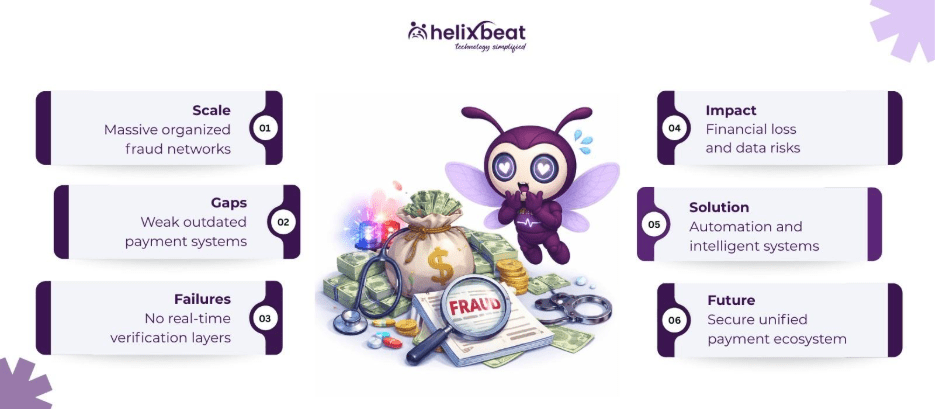
Table of Contents
The Scale of the Problem: More Than Just Numbers
The $14.6 billion fraud case is not just another statistic — it is more than double previous records in healthcare fraud enforcement. The schemes involved:
- Fake billing practices
- Stolen patient identities
- Shell companies posing as legitimate providers
- Cross-border criminal networks
- Exploitation of Medicare and Medicaid systems
These fraud schemes were not random or isolated. They were well-organized, technology-driven operations that exploited vulnerabilities in existing payment solutions healthcare frameworks.
The result? Billions lost, compromised patient data, and a weakened healthcare system.
Why Healthcare Payment Systems Are Failing
To understand how such fraud reached this scale, we need to examine the core issues in current payment solutions healthcare infrastructure.
1. Lack of Real-Time Verification
Many healthcare systems still rely on delayed validation processes. Claims are often processed before being thoroughly verified, creating opportunities for fraudulent entries.
Without strong healthcare payment integrity solutions, fraudulent claims can slip through unnoticed until it’s too late.
2. Fragmented Payment Ecosystem
Healthcare payments involve multiple stakeholders — providers, payers, clearinghouses, and third-party vendors. This fragmentation creates blind spots.
Disconnected systems mean:
- Limited data sharing
- Inconsistent validation rules
- Reduced visibility into transactions
This is where modern healthcare payment solutions must step in to unify operations and eliminate gaps.
3. Weak Identity and Provider Verification
Fraudsters in this case used stolen identities and fake entities to submit claims. When systems lack strong authentication layers, it becomes easy to impersonate providers or patients.
Advanced payment integrity solutions healthcare are essential to ensure that every transaction is tied to verified identities.
4. Manual and Outdated Processes
Manual intervention in payment processing increases the risk of human error and delays fraud detection.
Legacy systems are simply not equipped to handle today’s sophisticated fraud techniques. A robust healthcare payment processing solution must include automation and AI-driven validation.
5. Lack of End-to-End Transparency
In many systems, once a payment is initiated, tracking it across the lifecycle becomes difficult.
This lack of transparency allows fraudulent payments to move undetected — highlighting the need for intelligent payment solutions healthcare platforms that provide full visibility.
The Real Cost of Weak Payment Systems
The financial loss is staggering, but the impact goes beyond money.
- Financial Drain
Taxpayer-funded programs like Medicare and Medicaid bear the burden, leading to increased costs across the system.
- Operational Disruption
Fraudulent claims clog systems, delaying legitimate payments and affecting provider cash flow.
- Data Breaches
Stolen patient identities compromise privacy and trust.
- Compliance Risks
Organizations face penalties and reputational damage due to inadequate fraud prevention measures.
Without strong healthcare payment integrity solutions, these risks continue to grow.
What This Case Reveals About the Future of Healthcare Payments
This fraud case highlights a fundamental truth: traditional payment systems are no longer sufficient.
Healthcare organizations must transition to smarter, more secure, and integrated payment solutions healthcare systems that can:
- Detect fraud in real time
- Validate identities instantly
- Automate payment workflows
- Provide complete transaction visibility
The future lies in intelligent healthcare payment solutions that combine technology, automation, and security.
The Role of Payment Integrity in Preventing Fraud
Payment integrity is no longer optional — it is a necessity.
Modern payment integrity solutions healthcare focus on:
- Pre-payment Validation
Stopping fraud before payments are made
- Continuous Monitoring
Tracking transactions across the lifecycle
- Data Intelligence
Using analytics to detect unusual patterns
- Compliance Enforcement
Ensuring adherence to regulatory standards
With strong healthcare payment integrity solutions, organizations can significantly reduce fraud exposure.
Why Automation is Critical in Healthcare Payments
Automation plays a key role in strengthening payment solutions healthcare systems.
Benefits of Automation:
- Faster claim processing
- Reduced manual errors
- Real-time fraud detection
- Improved operational efficiency
A modern healthcare payment processing solution integrates automation at every stage — from claim submission to payment reconciliation.
Building a Fraud-Resistant Payment Ecosystem
To prevent large-scale fraud, healthcare organizations must adopt a proactive approach.
Here’s what a strong payment solutions healthcare ecosystem should include:
1. Unified Platform
A single platform that connects all stakeholders and eliminates data silos.
2. Real-Time Analytics
Immediate insights into claims and transactions.
3. Advanced Identity Verification
Secure authentication for patients and providers.
4. Automated Workflows
Reduced dependency on manual processes.
5. End-to-End Transparency
Complete visibility into payment journeys.
By implementing these capabilities, organizations can enhance their healthcare payment solutions and reduce vulnerabilities.
How PayNova Addresses These Challenges
The lessons from the $14.6 billion fraud case clearly point to the need for smarter systems — and this is where PayNova makes a difference.
PayNova is designed to transform payment solutions healthcare by addressing the exact gaps exposed by large-scale fraud incidents.
- Enhanced Security
PayNova integrates advanced validation mechanisms to support healthcare payment integrity solutions, ensuring that every transaction is secure and verified.
- Real-Time Processing
With intelligent workflows, PayNova enables faster and more reliable healthcare payment processing solution capabilities.
- Fraud Detection
Built-in analytics help identify suspicious patterns, strengthening payment integrity solutions healthcare.
- Unified Ecosystem
PayNova connects multiple stakeholders into a single platform, improving efficiency and transparency in healthcare payment solutions.
- Complete Visibility
Organizations gain full control over transactions with real-time tracking and reporting.
Turning Crisis into Opportunity
The $14.6 billion fraud case is a warning — but it is also an opportunity.
Healthcare organizations that act now can:
- Strengthen their payment infrastructure
- Improve operational efficiency
- Build trust with patients and stakeholders
- Stay compliant with evolving regulations
By investing in advanced payment solutions healthcare, organizations can turn vulnerabilities into competitive advantages.
Final Thoughts
The largest healthcare fraud crackdown in U.S. history has exposed a harsh reality: weak payment systems are the foundation of large-scale fraud.
Without modern healthcare payment integrity solutions, even the most sophisticated healthcare systems remain vulnerable.
The path forward is clear:
- Adopt intelligent healthcare payment solutions
- Implement robust payment integrity solutions healthcare
- Leverage automation through advanced healthcare payment processing solution platforms
The future of healthcare depends not just on better care — but on secure, transparent, and efficient payment systems.
And in a world where fraud is becoming more advanced, the right payment solutions healthcare platform is no longer a choice — it’s a necessity.
FAQs
1. What does the $14.6 billion healthcare fraud case reveal?
It highlights major weaknesses in payment solutions healthcare, including lack of real-time validation, poor identity checks, and fragmented systems.
2. Why are healthcare payment systems vulnerable to fraud?
Outdated processes, manual workflows, and lack of healthcare payment integrity solutions make systems easy targets for large-scale fraud schemes.
3. What are healthcare payment integrity solutions?
Healthcare payment integrity solutions are technologies that prevent fraud by validating claims, verifying identities, and monitoring transactions in real time.
4. How can automation improve healthcare payment systems?
A healthcare payment processing solution with automation reduces errors, speeds up claims, and helps detect fraud instantly.
5. How does PayNova help prevent healthcare payment fraud?
PayNova strengthens payment solutions healthcare with real-time tracking, fraud detection, secure processing, and unified payment management.