

Healthcare is rapidly evolving toward a more connected, data-driven ecosystem. From electronic health records (EHRs) to patient apps and wearable devices, the volume and complexity of healthcare data continue to grow. However, without a standardized way to exchange this data, fragmentation becomes a major barrier to delivering high-quality care.
This is where a FHIR server becomes critical. Built on the Fast Healthcare Interoperability Resources (FHIR) standard, a dedicated FHIR server acts as the backbone for seamless data exchange, interoperability, and modern healthcare innovation.
In this blog, we will explore why healthcare organizations need a FHIR server, how it works, and the tangible benefits it brings to providers, patients, and the broader healthcare ecosystem.
Table of Contents
What Is a FHIR Server?
A FHIR server is a system that stores, manages, and exchanges healthcare data using the FHIR standard. FHIR defines how healthcare information can be structured and shared across systems using modern web technologies like RESTful APIs, JSON, and XML.
Key Components of a FHIR Server:
- Resources: Standardized data models (e.g., Patient, Observation, Medication)
- RESTful APIs: Enable systems to read, write, search, and update data
- Security Protocols: OAuth 2.0 and SMART on FHIR for secure access
- Interoperability Layer: Connects disparate healthcare systems
A dedicated FHIRserver acts as a centralized hub that enables real-time, standardized communication between multiple healthcare applications.
The Growing Need for Interoperability in Healthcare
Healthcare organizations face increasing pressure to share data across systems, departments, and even countries. However, legacy systems often operate in silos, which leads to:
- Incomplete patient records
- Delayed clinical decisions
- Redundant testing and procedures
- Poor patient experience
A FHIR server addresses these challenges by facilitating consistent, real-time data exchange across platforms.
Why Healthcare Organizations Need a Dedicated FHIR Server?
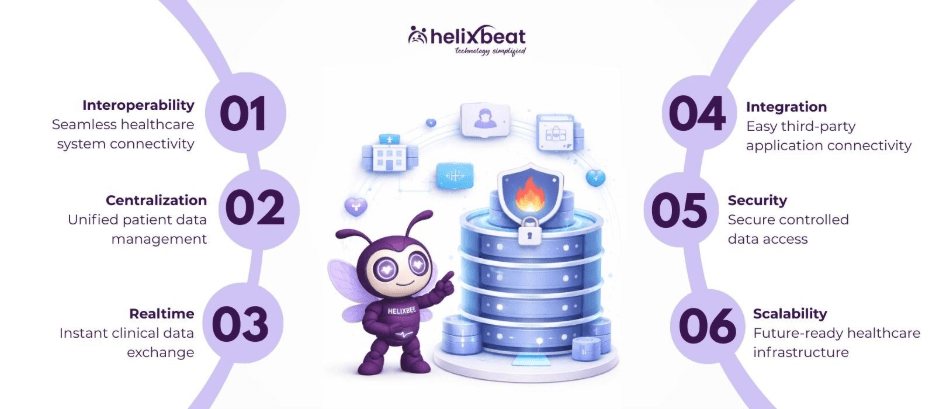
1. Centralized Data Management
A dedicated FHIR server provides a single source of truth for healthcare data. Instead of storing patient data across multiple disconnected systems, organizations can centralize it in a structured, standardized format.
Benefits:
- Reduced data duplication
- Improved data consistency
- Easier access to patient records
2. Seamless Interoperability Across Systems
One of the primary reasons to implement a FHIR-server is interoperability. Healthcare organizations use a wide range of systems, including:
- EHR/EMR platforms
- Laboratory information systems (LIS)
- Radiology systems (RIS)
- Billing and insurance platforms
A FHIR server enables these systems to communicate using a common standard, eliminating the need for complex, custom integrations.
3. Real-Time Data Exchange
Traditional healthcare data exchange methods often rely on batch processing or manual uploads. On the contrary, a FHIR server supports real-time API-based communication.
Use Cases:
- Instant access to lab results
- Real-time patient monitoring data
- Immediate updates to care plans
This real-time capability improves clinical decision-making and patient outcomes.
4. Enhanced Patient-Centric Care
Modern healthcare is shifting toward patient-centered models. A FHIR server enables patients to access and control their health data through apps and portals.
Examples:
- Mobile health applications
- Wearable device integrations
- Telemedicine platforms
As a result, patients gain better visibility into their health, which leads to higher engagement and improved outcomes.
5. Simplified Integration with Third-Party Applications
Healthcare organizations increasingly rely on third-party applications for analytics, telehealth, AI diagnostics, and more.
A FHIR server makes it easier to integrate these applications through standardized APIs.
Advantages:
- Faster deployment of new tools
- Reduced integration costs
- Greater flexibility in technology adoption
6. Regulatory Compliance and Standardization
Governments and regulatory bodies worldwide are promoting interoperability standards like FHIR.
A dedicated FHIR server helps organizations align with these requirements by:
- Standardizing data formats
- Supporting audit trails
- Facilitating secure data sharing
Compliance becomes more manageable when data is structured and accessible.
7. Improved Data Security and Access Control
Security is a top priority in healthcare. A FHIR server incorporates modern security frameworks such as:
- OAuth 2.0
- OpenID Connect
- Role-based access control
This allows organizations to control who can access specific data and under what conditions.
8. Scalability for Future Growth
Since healthcare data is growing exponentially, a dedicated FHIR server is designed to scale as data volume and system complexity increase.
Scalability Benefits:
- Supports large patient populations
- Handles high API traffic
- Adapts to new data sources
This future-ready architecture is critical for long-term digital transformation.
9. Better Clinical Decision Support
A FHIR server can integrate with clinical decision support systems (CDSS). By providing real-time access to structured data, clinicians can:
- Identify potential drug interactions
- Receive alerts for abnormal lab values
- Access evidence-based recommendations
This leads to more accurate and timely decisions.
10. Accelerated Innovation in Healthcare
Innovation in healthcare depends on access to high-quality data. A FHIR server acts as a foundation for:
- Artificial intelligence (AI) and machine learning
- Predictive analytics
- Population health management
As a result, developers can build new solutions more quickly using standardized APIs and data models.
Integrated FHIR Layer vs. Dedicated FHIR Server
Some organizations attempt to add FHIR capabilities directly into existing systems. While this approach may work for smaller implementations, it has limitations.
Integrated FHIR Layer:
- Limited scalability
- Complex upgrades
- Potential performance bottlenecks
Dedicated FHIR Server:
- Centralized architecture
- High scalability
- Easier maintenance
- Better performance
Therefore, a dedicated FHIR server, like FUSION, offers a more robust and future-ready solution.
Unlock Seamless Healthcare Interoperability with FUSION
Built by Helixbeat, FHIR server FUSION leverages RESTful APIs for seamless connectivity with legacy systems, modern EHRs, and emerging tools like wearable devices and telehealth platforms. This isn’t just compliance, it’s acceleration.
Organizations using FUSION report up to 70% faster data sharing, slashing referral delays by 60% and reducing redundant tests by 25%. That’s not hype; it’s a measurable impact, with providers saving $1,000 – $2,000 per patient annually through streamlined claims and operations.
Certified Excellence
FUSION is officially certified by the Drummond Group for FHIR-based interoperability, validating its conformance with healthcare data exchange standards HL7, FHIR, and SMART on FHIR. This certification demonstrates that FUSION meets industry-recognized benchmarks for secure, standardized data exchange.
Final Thoughts
As digital transformation accelerates, investing in a robust FHIR server is no longer optional – it is a strategic necessity for healthcare organizations aiming to stay competitive.
Ready to modernize your healthcare infrastructure with a FHIR server? Connect with our experts today to explore how you can implement FUSION tailored to your organization.
FAQs
1. What is a FHIR server used for?
A FHIR server is used to store, manage, and exchange healthcare data using standardized formats and APIs.
2. Why is a dedicated FHIR server important?
A dedicated FHIR server offers better scalability, performance, and centralized data management compared to integrated solutions.
3. How does a FHIR server improve interoperability?
It enables different healthcare systems to communicate using standardized data models and APIs.
4. Is a FHIR server secure?
Yes, FUSION uses modern security protocols like OAuth 2.0 and role-based access control.
5. Can a FHIR server integrate with legacy systems?
Yes, FUSION can act as an interoperability layer to connect legacy systems with modern applications.