

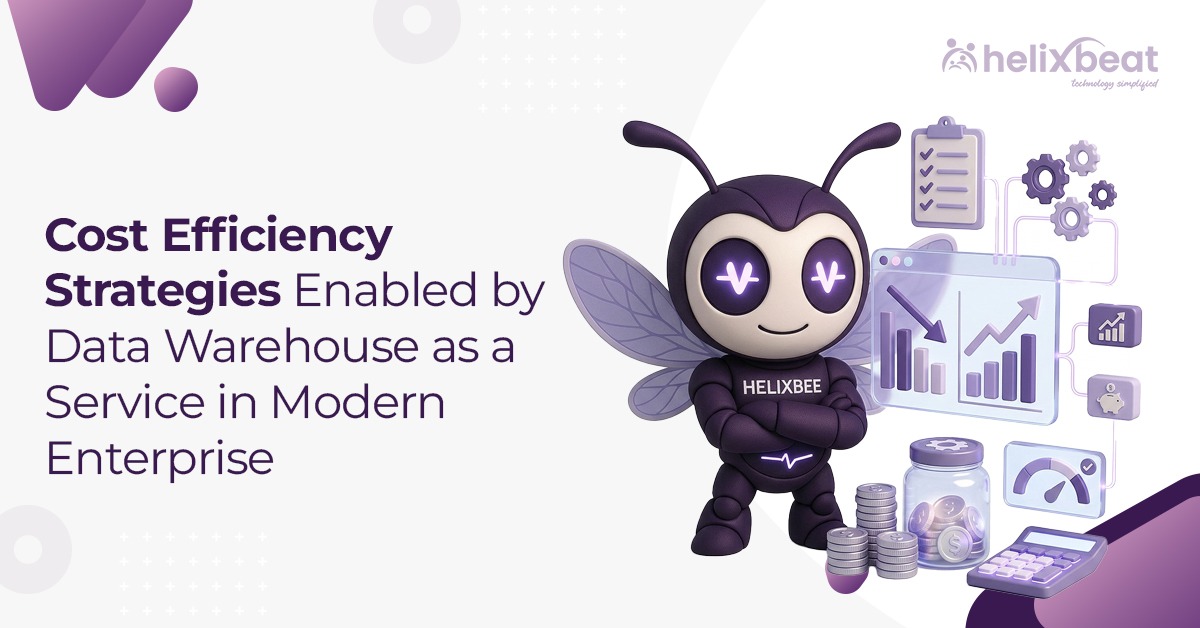
Here’s a reality most enterprises face today: data costs are rising faster than data value realization. That’s where data warehouse as a service changes the game. Instead of heavy infrastructure investments, businesses are now shifting toward flexible, cloud-first intelligence systems built on data warehouse as a service models.
The data warehouse as a service market is expanding rapidly as organizations demand scalability without financial overload. Modern enterprises are replacing legacy setups with smarter data warehouse as a service providers to control spending while improving performance and operational efficiency.
This blog explores how data warehouse as a service (DWaaS) enables practical cost efficiency strategies that transform how companies manage data infrastructure, analytics operations, and long-term data investment decisions.
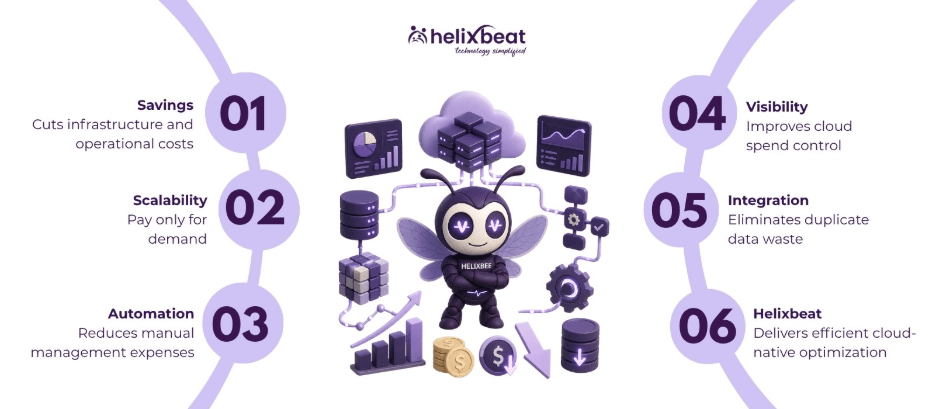
Table of Contents
1. How Does Data Warehouse as a Service Reduce Infrastructure and Operational Costs?
Cost reduction starts with removing what enterprises no longer need to own or manage. Data warehouse as a service eliminates heavy infrastructure dependencies and shifts spending to flexible, usage-based models.
Why Infrastructure Costs Drop with Data Warehouse as a Service
With traditional systems, enterprises invest heavily in hardware, maintenance, and upgrades. Data warehouse as a service replaces this with cloud-native scalability and managed infrastructure.
- No physical servers required
- No dedicated maintenance teams
- Automatic scaling based on workload
Cost Comparison
| Cost Element | Traditional Warehouse | DWaaS Model |
| Hardware | High upfront cost | None |
| Maintenance | Continuous expense | Included in service |
| Scaling | Expensive upgrades | Automatic scaling |
| Storage | Fixed capacity | Elastic usage |
This shift is why modern data management system software built on data warehouse as a service dwaas is becoming the preferred choice for cost-conscious enterprises.
2. How Does Elastic Scalability Improve Cost Efficiency in Data Warehouse as a Service?
Scalability in data warehouse as a service is not just a technical feature—it directly impacts cost efficiency across enterprise operations.
Scaling Based on Real Demand
Instead of paying for unused capacity, businesses scale resources dynamically:
- Increase compute during peak analytics
- Reduce usage during idle periods
- Optimize storage automatically
Avoiding Over-Provisioning Costs
Traditional systems force companies to purchase excess capacity in advance. Data warehouse as a service eliminates this inefficiency completely.
Adopt scalable data warehouse as a service model to eliminate unnecessary infrastructure spending.
3. How Does Automation in Data Warehouse as a Service Reduce Operational Expenses?
Automation is one of the strongest cost-saving pillars in data warehouse as a service dwaas architecture.
Eliminating Manual Data Management Tasks
Routine operations such as backups, patching, and updates are fully automated:
- Reduced IT staffing requirements
- Faster system recovery
- Lower human error risk
Automated Data Optimization Workflows
| Automation Area | Cost Benefit |
| Data cleansing | Reduced manual labor |
| Query optimization | Lower compute cost and faster insights |
| Backup & recovery | Minimal downtime impact |
This automation-driven efficiency is a major factor fueling growth in the data warehouse as a service market, as enterprises prioritize cost optimization and operational simplicity.
4. How Do Data Warehouse as a Service Providers Optimize Cloud Spending?
Choosing the right provider plays a major role in cost efficiency outcomes within a data warehouse as a service ecosystem.
Role of Leading Data Warehouse as a Service Providers
Top data warehouse as a service providers optimize pricing models, resource allocation, and workload efficiency to reduce unnecessary cloud spending.
- Multi-cloud optimization
- Intelligent workload distribution
- Usage analytics for cost tracking
Cost Visibility and Control Systems
| Feature | Business Impact |
| Real-time cost dashboards | Better budget control |
| Query-level billing | Transparent spending |
| Resource tagging | Department-wise cost allocation |
This transparency is a key advantage over legacy data management system software, which often lacks real-time cost visibility and granular tracking.
5. How Does Data Integration Strategy Impact Cost in Data Warehouse as a Service?
Poor data integration often leads to duplication, inefficiency, and unnecessary storage consumption in data warehouse as a service environments.
Unified Data Pipelines Reduce Redundancy
Modern data warehouse as a service dwaas platforms integrate multiple data sources into a single architecture.
- Eliminates duplicate storage
- Reduces ETL complexity
- Improves processing efficiency
Lower Storage and Compute Waste
Efficient integration ensures only relevant and optimized data is processed, significantly reducing cloud expenditure.
How Does Helixbeat DWaaS Deliver Cost Efficiency for Enterprises?
Helixbeat provides a structured approach to cost optimization using a modern data warehouse as a service dwaas architecture.
Helixbeat DWaaS Cost Optimization Model
Helixbeat DWaaS reduces total cost of ownership through intelligent cloud-native design.
- Cloud-native architecture for flexibility
- Pay-per-use consumption model
- Built-in performance optimization
Business Value Delivered by Helixbeat DWaaS
| Capability | Cost Benefit |
| Smart workload management | Reduced compute cost |
| Automated scaling | No idle resource waste |
| Integrated analytics layer | Eliminates extra tools |
This makes Helixbeat a strong choice in the evolving data warehouse as a service market, where enterprises prioritize efficiency and scalability.
What Role Does Data Management System Software Play in DWaaS Cost Optimization?
Modern enterprises depend on structured operations powered by advanced data management system software.
Unified Control Through Software Layer
Advanced systems integrate governance, security, and analytics into a single control framework.
- Centralized data management
- Reduced duplication risks
- Improved compliance efficiency
Lower Licensing and Maintenance Costs
| Traditional Tools | DWaaS-Based Software |
| Multiple licenses | Unified subscription |
| High upgrade costs | Automatic updates |
| Manual governance | Automated policies |
This transition significantly reduces operational friction and cost leakage in data warehouse as a service dwaas environments.
Wrapping Up
Cost efficiency in modern enterprises is no longer optional—it is strategic. Data warehouse as a service enables organizations to scale intelligently, automate operations, and eliminate infrastructure waste. With growing adoption in the data warehouse as a service market, businesses are shifting toward flexible and predictable cost structures.
Key Takeaways
- DWaaS reduces infrastructure and operational expenses
- Automation and scalability drive long-term savings
- Providers like Helixbeat DWaaS improve cost visibility and efficiency
FAQs
1. How do I know if my company is overspending on a traditional data warehouse?
If you are paying for unused storage, frequent upgrades, and maintaining large infrastructure teams, you are likely overspending. Most enterprises use only part of their capacity, which makes data warehouse as a service a more cost-efficient alternative.
2. Will moving to data warehouse as a service disrupt my existing systems?
Not necessarily. Most data warehouse as a service providers support phased migration, allowing legacy systems and cloud environments to run together. This reduces downtime and ensures smooth transition without affecting ongoing analytics or business operations.
3. How can I prevent unexpected cloud costs in DWaaS?
Unexpected costs usually come from unoptimized queries and uncontrolled usage. Using monitoring tools, workload scheduling, and governance features in data management system software helps track usage and keeps spending predictable and under control.
4. Is DWaaS suitable for small and mid-sized businesses?
Yes, DWaaS is highly suitable because it removes upfront infrastructure costs. Small and mid-sized businesses can scale gradually and only pay for what they use, making it a practical option within the data warehouse as a service market.
5. How does DWaaS improve ROI compared to traditional systems?
DWaaS improves ROI by eliminating hardware costs, reducing maintenance effort, and speeding up data insights. Businesses get faster analytics at lower operational expense, leading to better decision-making and improved overall profitability.
6. What risks should I consider before adopting Helixbeat DWaaS?
Key risks include migration complexity and vendor dependency. However, Helixbeat DWaaS minimizes these through scalable architecture, secure integration, and flexible deployment models designed to reduce long-term operational and financial risks.