

Let’s be honest — the way we manage office buildings hasn’t kept up with the way we actually work.
Hybrid schedules, flexible headcounts, and distributed teams have completely changed how people use commercial spaces. Yet many organizations are still running their facilities on outdated processes — manual sign-in sheets, disconnected security systems, and gut-feel decisions about whether they actually need all that office space.
The result? Companies are overpaying for square footage they’re not fully using, while simultaneously struggling to deliver the kind of smooth, professional workplace experience that employees and visitors now expect.
That’s where intelligent workplace management steps in — and at the heart of it is something you might not have thought of as strategic: your visitor entry system.
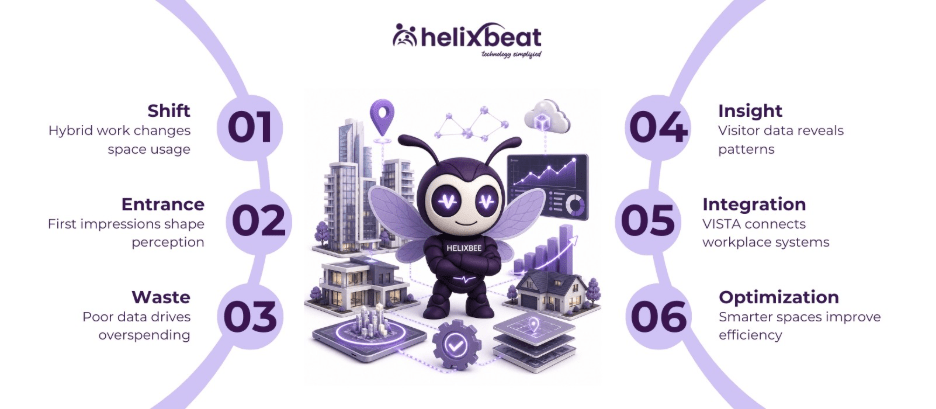
Table of Contents
Why Your Office Entrance Is More Important Than You Think
Think about the last time you visited a company’s office for the first time. Did you wait at an unmanned reception desk? Fill out a paper log? Stand around while someone tracked down the person you were meeting?
Now think about how that experience shaped your perception of the company before you even sat down for your meeting.
First impressions in business are formed within minutes, and your building entrance is where that impression gets made. A modern visitor entry system doesn’t just speed things up — it signals organizational competence. It tells your visitors, clients, and partners that you take operations seriously.
But here’s what most facility managers are only beginning to realize: a well-implemented visitor entry system isn’t just about experience. It’s a live data engine that feeds some of the most valuable operational intelligence your business can have.
The Real Cost of Not Optimizing Your Space
According to CBRE’s 2024 Global Real Estate Market Outlook, more than 60% of corporate occupiers are actively rethinking their space strategies — but fewer than a third have the operational data to make confident decisions.
That’s the gap. And it’s an expensive one.
When you don’t know how your building is actually being used — which floors are consistently busy, which meeting rooms sit empty, what time visitor traffic peaks — you’re making million-dollar real estate decisions based on assumption. You renew leases for spaces you don’t need. You staff reception for demand that doesn’t show up. You invest in infrastructure for parts of the building that barely get used.
An intelligent visitor entry system is one of the most direct ways to close that gap. Every check-in, every arrival time, every visitor-to-host interaction generates structured data that, over time, paints a precise picture of how your building functions versus how you assumed it does.
That picture changes how you make decisions.
What Intelligent Visitor Management Actually Looks Like
Let’s get specific about what a modern visitor entry system does — because it’s come a long way from a tablet on a reception desk.
Contactless, self-service check-in. Visitors pre-register before they arrive, receive a QR code, and walk straight through to their destination without stopping at the front desk. No waiting, no paperwork, no friction. A smart visitor entry system makes this the default experience, not a premium one.
Real-time host notifications. The moment a visitor checks in, their host receives an instant alert — by email, SMS, or Slack. No more visitors waiting in the lobby while someone runs up to reception. No more missed arrivals because the front desk forgot to call.
Digital identity verification and access control. A sophisticated visitor entry system integrates directly with your building’s access infrastructure. Verified visitors automatically receive elevator permissions, floor access, and temporary Wi-Fi credentials — all triggered by a single check-in event. The building responds to the person, not the other way around.
Compliance-ready recordkeeping. For organizations in healthcare, finance, legal, or government, visitor logs aren’t just useful — they’re mandatory. An automated visitor entry system maintains accurate, searchable records of every visit without requiring manual entry or after-the-fact reconciliation.
Visitor analytics and traffic reporting. This is where it gets strategically interesting. When your visitor entry system captures consistent, structured data across days, weeks, and months, you can identify patterns: peak arrival windows, high-traffic departments, underutilized areas, staffing mismatches. This is the intelligence that drives real estate decisions.
How VISTA Brings It All Together
VISTA was built specifically for organizations that want to treat their workplace as an optimized operational system — not just a place people show up to.
At its core, VISTA’s visitor entry system combines contactless check-in, digital badge issuance, automated host notifications, and real-time access management into a single, centralized platform. But what sets it apart is how deeply it integrates with the rest of your building’s infrastructure.
VISTA connects with access control systems, RFID readers, biometric authentication tools, meeting room scheduling platforms, and enterprise security infrastructure. This means your visitor entry system isn’t operating as a standalone tool — it’s a connected layer within your broader workplace ecosystem.
When a visitor checks in through VISTA, it doesn’t just log a name. It can trigger a cascading set of automated responses: unlocking the right floor, reserving the meeting room, sending a parking authorization, generating a temporary access credential. The building becomes proactive rather than passive.
For multi-location organizations, VISTA provides centralized visibility across all sites — so your facilities team in headquarters can see what’s happening at regional offices in real time, and your security team has a unified audit trail regardless of which building a visitor entered.
That kind of integrated intelligence is what separates a modern visitor entry system from a digital clipboard.
The Space Optimization Connection
Here’s the through-line that makes visitor management genuinely strategic: every smart real estate decision requires occupancy data, and a visitor entry system is one of your most reliable sources of it.
Traditional occupancy sensors tell you when a room is warm. They don’t tell you who is there, why, or what patterns are emerging over time. Visitor management data fills that gap with context.
When you layer visitor traffic reports over room booking data and badge access records, you start to see your building’s actual utilization with clarity. You discover that three of your large conference rooms go unused every Friday. You notice that visitor traffic to your engineering floor has tripled since Q1 — suggesting you may need to rethink that area’s layout. You realize your Tuesday staffing at reception is 40% over what demand requires.
These are not small findings. They translate directly into lease negotiations, renovation decisions, staffing plans, and capital allocation. A well-deployed visitor entry system generates the evidence that makes those conversations precise instead of speculative.
Security Without the Friction
One of the biggest objections to modern visitor management is a fear of making security feel invasive or unwelcoming. The assumption is that tighter security means longer waits, more checkpoints, and a less pleasant experience for guests.
A well-designed visitor entry system proves the opposite.
When identity verification, pre-registration, and access approvals are handled automatically before a visitor even arrives, the in-person experience is faster and smoother — not slower. Visitors feel welcomed, not scrutinized. Security happens in the background, driven by the system rather than by an overwhelmed receptionist juggling three tasks at once.
For regulated industries, this balance is especially important. Healthcare facilities, financial institutions, and government offices need rigorous visitor records without creating operational bottlenecks. VISTA’s visitor entry system is designed to meet those compliance requirements while keeping the visitor experience professional and efficient.
Sustainability and the Case for Smarter Space
Intelligent workplace management also has a sustainability dimension that doesn’t get discussed enough.
When organizations right-size their real estate footprint based on accurate usage data — rather than historical assumptions — they reduce energy consumption, lower maintenance costs, and cut waste across the board. A building that’s 60% occupied shouldn’t be running at 100% capacity.
A visitor entry system contributes to this directly. Paperless check-ins eliminate physical waste. Accurate traffic data enables smarter HVAC and lighting automation. Occupancy patterns inform long-term decisions about which spaces to consolidate, sublease, or redesign — reducing the environmental cost of unnecessary real estate.
For organizations with ESG commitments, operational intelligence isn’t just a business advantage. It’s part of meeting sustainability targets in a measurable, reportable way.
The Organizations Winning the Next Decade of Real Estate
The commercial real estate market is tightening. Landlords, CFOs, and boards are demanding evidence that office space is being used efficiently. Companies that can demonstrate data-driven space management are in a fundamentally stronger negotiating position — on lease renewals, capital requests, and operational budgets.
Those still relying on manual processes and institutional memory will struggle to make that case.
Investing in an intelligent visitor entry system isn’t a small operational upgrade. It’s the beginning of a data infrastructure that supports smarter decisions at every level of your real estate and facilities strategy.
VISTA exists to help organizations make that shift — from managing workplaces reactively to optimizing them intelligently.
The front door is where it starts. What happens next is up to the data.
Ready to see how VISTA’s visitor entry system can transform your workplace operations? Schedule a demo today.
FAQs
1. What is a visitor entry system?
A visitor entry system is a digital platform that manages visitor check-ins, identity verification, access control, and visitor tracking within workplaces or commercial buildings.
2. How does a visitor entry system improve workplace security?
A modern visitor entry system improves security through real-time visitor tracking, digital ID verification, QR-based access, automated approvals, and detailed visitor records.
3. Why is intelligent workplace management important for real estate optimization?
Intelligent workplace management helps organizations optimize office space, reduce operational costs, improve employee experiences, and make data-driven real estate decisions.
4. Can VISTA integrate with existing workplace systems?
Yes. VISTA can integrate with access control systems, biometric authentication, RFID infrastructure, meeting room scheduling tools, and other workplace management platforms.