


Rising costs, tighter payer contracts, and higher patient responsibility are putting more pressure on healthcare practices. If your billing team still treats reimbursement as a claim submission task, value-based contracts can expose gaps in payment accuracy, reporting, and patient communication. Healthcare value based reimbursement requires practices to connect care quality with cleaner financial workflows.
CMS reported that U.S. national health spending reached $5.3 trillion in 2024, showing why payers continue to push models that reward better outcomes and lower avoidable costs: CMS National Health Expenditure Fact Sheet. For practices, the question is practical: can your payment process support the way reimbursement is changing?
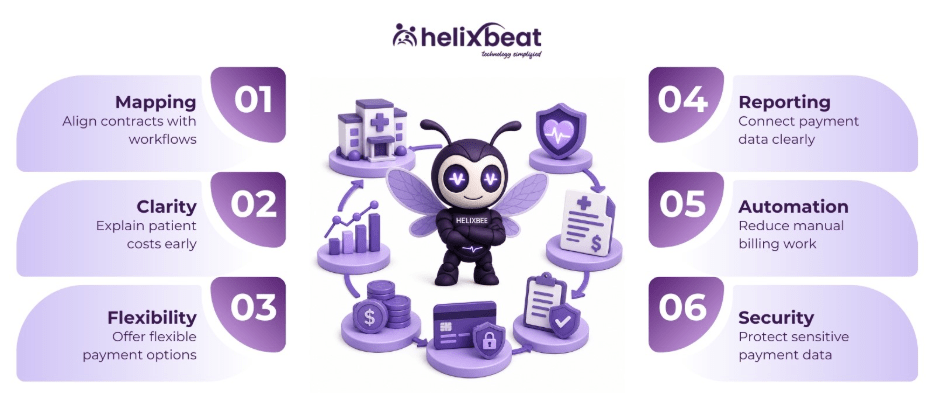
Table of Contents
Why Traditional Billing Creates Risk
Traditional billing works best when payment is linked to service volume. A visit happens, a claim goes out, and the practice waits for reimbursement. Healthcare value based reimbursement changes that mindset because payment may depend on quality measures, patient outcomes, cost control, and contract performance.
Many practices struggle because payment data sits in different places. The EHR shows clinical activity. The billing system shows claims. The payment processor shows collections. Staff then reconcile records, chase balances, and answer billing questions.
Disconnected workflows create real risk:
- More claim corrections and delayed collections
- Less visibility into contract performance
- Higher administrative workload
- More patient confusion about balances
- Slower action when payment trends change
Healthcare value based reimbursement rewards practices that connect financial activity with measurable performance. Poor billing visibility makes that harder.
Step 1: Map Payment Workflows to Contract Requirements
Healthcare value based reimbursement starts with understanding what each contract measures. Some agreements focus on reduced readmissions. Others focus on preventive care, chronic disease management, patient satisfaction, or total cost of care.
Payment teams should map each contract to the financial steps that support it. That includes eligibility checks, claim submission, patient balance collection, refund handling, payment plans, and reporting.
The reference guide from AMS Solutions explains that value-based care billing requires stronger attention to documentation, coding accuracy, payer requirements, and performance tracking: AMS Solutions Value-Based Care Billing Guide. A practice cannot improve what it cannot track.
Step 2: Improve Patient Financial Clarity Early
Patient confusion becomes more expensive under healthcare value based reimbursement. When patients do not understand what they owe, payments slow down and staff spend more time resolving disputes.
Patient billing transparency should begin before the bill arrives. Practices should give patients clear estimates, payment expectations, and simple options for paying balances. Patient billing transparency also helps reduce frustration after care, especially when deductibles, co-pays, or out-of-pocket costs are involved.
Practical improvements include clear balance explanations, digital payment links, itemized statements, upfront payment estimates, and easy access to payment history. A better payment experience supports patient trust, and trust matters when reimbursement is tied to experience and outcomes.
Step 3: Offer Flexible Payment Options
Value-based contracts do not remove patient responsibility. In many cases, practices still need to collect co-pays, deductibles, and remaining balances without creating financial friction.
Patient payment solutions help practices collect more predictably while giving patients a manageable path to pay. Payment plans, recurring payments, card payments, ACH, and digital wallet options can reduce missed payments and manual follow-ups.
Patient payment solutions are not just convenience features. They affect cash flow, staff workload, and patient satisfaction. When patients can pay in the way that works for them, the practice has fewer unpaid balances sitting in the revenue cycle.
Step 4: Connect Payment Data with Operational Reporting
Healthcare value based reimbursement requires better reporting than standard transaction summaries. Leaders need to see where revenue is delayed, which balances remain open, how payment plans perform, and whether collections support contract goals.
Provider reimbursement models can vary by payer, specialty, and contract type. A practice may work with fee-for-service payments, shared savings, bundled payments, capitation, or hybrid arrangements at the same time. Provider reimbursement models become harder to manage when reporting is delayed or incomplete.
Payment reporting should help answer which payer contracts create delays, where patient balances are increasing, how many payments are collected digitally, and which billing issues create repeat follow-up work. Better reporting turns payment operations into a management tool, not just a back-office task.
Step 5: Reduce Manual Work That Slows Reimbursement
Manual payment work creates cost and risk. Staff may enter data twice, reconcile payments by hand, send reminders manually, or track disputes across spreadsheets. These tasks become harder as quality based reimbursement contracts expand.
Quality based reimbursement rewards performance, but performance depends on reliable operations. If the team spends too much time fixing billing gaps, fewer resources are available for proactive patient engagement, follow-up, and financial planning.
Automation can help practices reduce routine work such as reminders, recurring payments, payment posting, and reporting. The goal is not to remove people from the workflow. The goal is to let staff focus on exceptions, patient support, and higher-value financial decisions.
Step 6: Make Security Part of Payment Alignment
Healthcare value based reimbursement also depends on trust. Patients need confidence that their financial and personal information is handled carefully. Practices need payment workflows that support HIPAA-aware and PCI-DSS-aligned handling of sensitive information.
Secure processing matters because value-based care often connects payment workflows with patient records, billing details, and care history. Weak security can create compliance risk, reputational damage, and operational disruption.
A payment partner should support encrypted transactions, controlled access, fraud protection, secure digital payments, and clean reporting. Security should be part of the payment process, not an afterthought.
Where PayNova Fits
Healthcare value based reimbursement becomes easier to manage when payment workflows are accurate, connected, transparent, and patient-friendly. PayNova supports healthcare practices with secure payment processing, multiple payment methods, recurring payments, payment plans, patient portals, EHR/PMS integration, real-time reporting, and compliance-focused workflows.
For practices moving toward value-based contracts, PayNova can help reduce payment friction through faster digital collections, better visibility into balances, fewer manual follow-ups, clearer patient billing communication, and more connected payment data.
Conclusion
Healthcare value based reimbursement pushes practices to think beyond claims and collections. Payment workflows must support quality goals, patient trust, financial visibility, and lower administrative waste.
The practical starting point is simple: map contracts, improve patient clarity, add flexible payment options, connect reporting, reduce manual work, and strengthen payment security. With PayNova, practices can align payment operations with the financial demands of value-based care.
Talk to a PayNova payment workflow expert to see how your practice can prepare for value-based reimbursement with cleaner, more patient-friendly payment operations.
FAQs
1. What are the best practices for payment posting in a healthcare setting?
Best practices include posting payments quickly, matching payments with EOBs/ERAs, reviewing denials, checking patient balances, reconciling deposits, and correcting posting errors before they affect revenue reports.
2. What is the most common reimbursement method in healthcare?
The most common reimbursement method is fee-for-service, where providers are paid for each service, test, consultation, or procedure delivered.
3. What are the key elements that support accurate reimbursement for the healthcare organization?
Key elements include correct patient information, insurance verification, accurate coding, clean claim submission, proper documentation, timely payment posting, denial tracking, and regular reconciliation.
4. What is the reimbursement method of payment?
A reimbursement method is the way healthcare providers are paid for services. Common methods include fee-for-service, value-based reimbursement, bundled payments, capitation, and shared savings models.