

Factory gates are under more pressure than most front desks. Contractors arrive before shifts begin, vendors bring parts, auditors need escort approvals, and delivery teams ask for fast access. When the process depends on paper logs and phone calls, the gate becomes a delay point and a risk point. A visitor management system for factory operations helps admin and security teams control entry without slowing production.
Table of Contents
Why Factory Visitor Control Needs a Different Approach
Factory visitor control is different because visitors are not always headed to a lobby or meeting room. A guest may need access to a maintenance zone, warehouse dock, production floor, lab, or restricted office.
A visitor management system for factory environments should support identity checks, host approvals, contractor access management, vendor entry tracking, and audit-ready records. Security teams need to know who entered, why they entered, who approved the visit, where the visitor was allowed to go, and whether the visitor exited.
Where Manual Logs Break Down
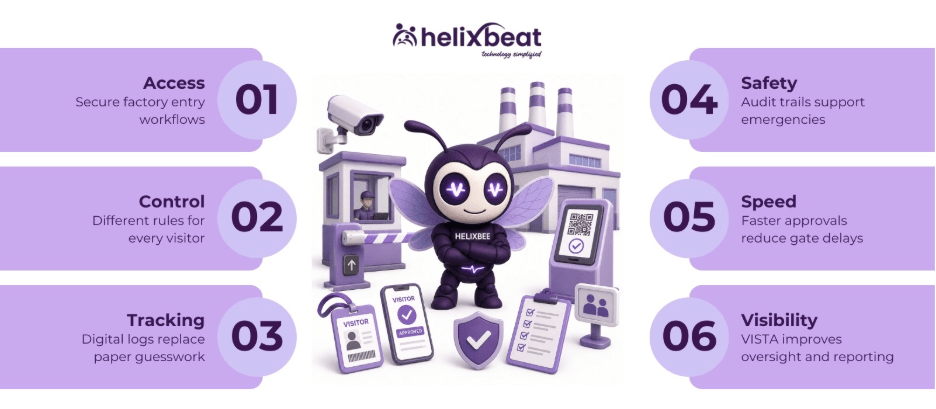
Manual visitor logs fail because busy gates leave little room for accurate recordkeeping. Names are written differently, phone numbers are missed, IDs are checked inconsistently, and exit times are often forgotten.
Digital visitor management creates a time-stamped log for every entry. Security teams can search past visits quickly instead of flipping through binders. Admin teams can review visitor movement, recurring contractors, approval delays, and gate traffic patterns from one dashboard.
Missing records also create problems during audits or investigations. When an incident happens, management needs reliable answers, not handwritten guesswork.
Buyer Checklist 1: Gate-Level Security
Gate-level security should be the first buying filter. A visitor management system for factory sites must work for guards during real gate traffic, not only during a clean product demo.
Check for these capabilities:
- Digital visitor registration
- QR visitor pass
- Photo or ID verification
- Role-based access control
- Real-time host approval
- Clear check-out tracking
- Live dashboard for active visitors
The best factory gate security tools make the guard’s job easier while giving management better control.
Buyer Checklist 2: Contractor and Vendor Workflows
Contractors and vendors create more risk than one-time visitors because they often return, work in operational areas, and interact with equipment or inventory. A visitor management system for factory use should separate contractor workflows from guest workflows.
Useful contractor features include recurring access schedules, approval mapping, purpose-based entry, QR validation, expired approval alerts, and visit history. Vendor entry tracking should capture company details, contact person, visit reason, approval status, and exit status.
Factory teams should avoid systems that treat every visitor the same. A maintenance contractor, raw material supplier, consultant, and auditor each need different access rules.
Buyer Checklist 3: Audit Trails and Emergency Readiness
Audit readiness depends on clean records. A visitor management system for factory operations should maintain a complete audit trail for check-in, approval, entry, denial, and exit activity.
For U.S. workplaces, emergency planning and accountability are important. OSHA’s emergency action plan guidance explains that emergency plans include evacuation procedures, emergency reporting, and accounting for employees after evacuation: OSHA Emergency Action Plan Guidance.
A strong visitor system helps teams pull active visitor lists during emergencies and review historical records after an incident. Accurate logs support EHS, security, compliance, and operations teams.
Buyer Checklist 4: Identity and Privacy Controls
Identity checks should be strong, but data handling should be controlled. A visitor management system for factory buyers should allow administrators to define what data is collected, who can access it, and how long records are retained.
NIST’s digital identity guidance covers identity proofing, authentication, federation, security, privacy, and customer experience considerations for digital identity systems: NIST Digital Identity Guidelines.
Practical privacy controls include admin permissions, limited guard access, secure visitor records, restricted exports, and clear data retention settings. Security teams need enough information to verify visitors, while administrators need controls that reduce unnecessary data exposure.
Buyer Checklist 5: Speed at the Gate
A slow gate hurts production because the delay spreads quickly. Trucks wait, contractors lose work time, hosts get repeated calls, and guards become overloaded.
A visitor management system for factory teams should support pre-registration, QR check-in, automatic host alerts, and fast approval workflows. Frequent visitors should not restart from zero every time, but repeat access must still follow policy.
Digital visitor management improves speed because approvals and records move through one workflow. The guard can focus on verification and access control instead of handwriting, calling, and searching.
Buyer Checklist 6: Reporting for Leaders
Factory leaders need visibility across gates, shifts, visitor types, and approval patterns. A visitor management system for factory administration should show live visitors, daily entry volume, peak gate times, rejected entries, overdue check-outs, and vendor frequency.
Useful reporting helps answer important questions: which vendors visit most often, which departments delay approvals, how many contractors are inside, and which visitors did not check out properly.
Clear reporting turns visitor data into security and operations insight.
Where VISTA Fits for U.S. Factories
VISTA helps factories replace paper visitor logs with secure digital visitor workflows. The platform supports QR check-in, instant host notifications, digital ID verification, role-based access, visitor dashboards, visitor analytics, and clear check-out records.
The selected platform should not create extra work for guards or administrators. VISTA is designed to simplify check-ins, strengthen access control, improve visitor visibility, and reduce manual follow-ups at busy gates.
For admin teams, VISTA supports better records and faster reporting. For security teams, it creates a controlled gate process. For visitors, it creates a smoother arrival experience.
Final Buying Questions Before Selection
Before choosing a platform, ask whether it can handle contractors, vendors, auditors, and guests separately. Check whether security teams can see active visitors in real time, admins can export audit logs, access permissions can be controlled by role, QR passes are supported, check-outs are tracked clearly, and the platform can scale across multiple gates.
A visitor management system for factory buyers should score well across security, usability, reporting, privacy, and emergency readiness. If a tool only digitizes the sign-in sheet, it may not be enough for industrial visitor management.
Conclusion
Factory visitor control is no longer a simple reception task. U.S. manufacturers need faster approvals, stronger visitor verification, better contractor tracking, and reliable records for audits and emergencies. The right digital visitor workflow helps security and admin teams manage people movement with more speed, control, and accountability.
VISTA gives factories a practical way to move from paper-based entry to digital visitor management without making the gate process complicated.
See how VISTA can improve factory visitor access and gate visibility.
FAQs
1. What is a visitor management system for factory?
A visitor management system for factory is a digital platform that manages visitor check-in, approvals, ID verification, access records, and check-out at factory gates.
2. Why do factories need visitor management software?
Factories need visitor management software to reduce manual gate delays, control contractor and vendor access, maintain audit-ready records, and improve site security.
3. Can VISTA handle contractors and vendors?
Yes. VISTA can help factories manage contractors, vendors, guests, and service teams with digital registration, approval workflows, QR check-ins, and visitor tracking.
4. How does VISTA improve factory security?
VISTA improves factory security by giving admin and security teams better control over visitor approvals, gate entry, role-based access, live visitor records, and check-out tracking.