

If your billing team is spending more time fixing denied claims than collecting revenue, you’re not alone. Across the US, healthcare payments are getting harder to manage — not easier. Denial rates hit nearly 12% in 2024, up from the previous year, and the cost of rework is piling up on already stretched revenue cycle teams.
The good news? A large portion of these denials are preventable. The key is catching payment risks before a claim is submitted — not after it bounces back. That’s exactly what prepay accuracy is designed to do.
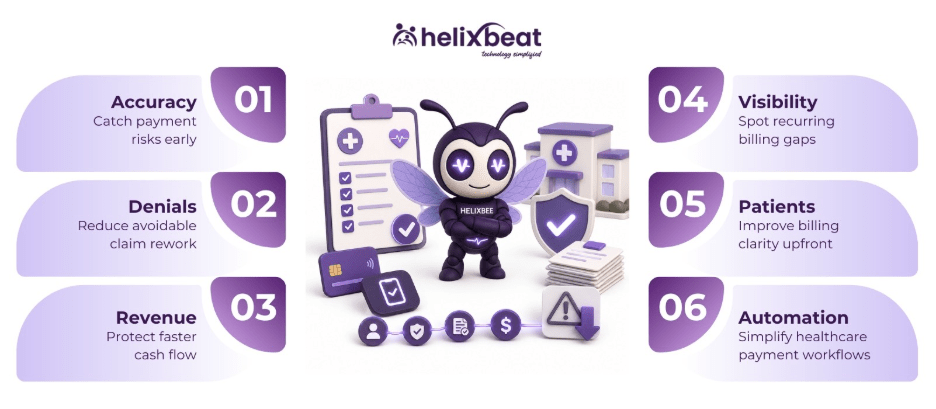
Table of Contents
What Is Prepay Accuracy, and Why Does It Matter?
Prepay accuracy refers to the practice of verifying patient and payer information before a claim is submitted or a patient bill is generated. It covers everything from insurance eligibility and prior authorization to co-pay estimates and coding readiness.
Think of it as a quality check that happens at the front of your revenue cycle — not the back.
When prepay accuracy is strong, your team catches missing authorizations, demographic mismatches, and coverage gaps before they create downstream problems. When it’s weak, those same issues become denied claims, payment appeals, and frustrated patients.
For US healthcare businesses managing high claim volumes, getting this right isn’t optional. It’s one of the most direct ways to protect cash flow and reduce the manual burden on your billing staff.
Where Payment Problems Actually Start
Most billing teams think of payment problems of denials as a back-end problem. In reality, the root cause often lives at the front desk.
A patient whose insurance details weren’t verified before their appointment. A service that needed prior authorization but didn’t get it. A demographic field entered incorrectly at intake. These are small errors that create big downstream friction.
According to HFMA research, among the top reasons for claim denials are missing or inaccurate data, authorization failures, and incomplete patient information — all issues that originate before a claim is ever submitted.
By the time a denial arrives, your team has to pull records, review payer rules, correct the error, resubmit, and follow up. Each step in that process costs time and delays healthcare payments that should have already been collected.
Prepay accuracy shifts the focus upstream. It gives your team a structured way to check the details that influence payment before the claim or bill moves forward.
The Real Cost of Getting It Wrong
Poor prepay accuracy doesn’t just create more work — it creates a chain reaction that affects your entire revenue cycle.
Delayed reimbursement is usually the first sign. A claim that should have moved cleanly gets denied because of a coverage gap or an unmet payer requirement. Then the rework begins.
Staff workload increases as billing teams shift attention from new claims to appeals, payer calls, and corrected submissions. This is time that could be spent on higher-value revenue cycle work.
Patient frustration compounds the problem. When patients receive unexpected balances or confusing bills, they delay payment, dispute charges, or flood your front desk with calls. Patient billing accuracy — giving patients clear cost information upfront — directly reduces this kind of friction.
The financial impact is significant. HFMA reports that automated claim-scrubbing and predictive validation can prevent up to 85% of avoidable denials, reducing administrative cost per claim by nearly a quarter. For most practices, that represents a meaningful improvement in both revenue and staffing efficiency.
What a Strong Prepay Accuracy Process Covers
Prepay accuracy isn’t a single checkbox — it’s a set of practical controls your team runs before a claim or patient bill moves forward. A complete process should cover:
- Active insurance eligibility and coverage details
- Prior authorization requirements by payer and service type
- Patient co-pay, deductible, and out-of-pocket responsibility
- Accurate demographic and contact information
- Coding and documentation readiness
- Medical necessity indicators
- Outstanding patient balances and payment plan eligibility
- Duplicate or conflicting billing records
When these checks happen consistently, your claim denial prevention rate improves, your first-pass acceptance rate goes up, and your team spends less time reacting to problems.
Why Visibility Is the Missing Piece
Many practices have some version of these checks in place. The problem is that checks without visibility don’t improve over time.
If your billing manager can’t quickly see which denial types are recurring, which payer rules are causing the most rework, or which front-end gaps are driving the most appeals — the same errors keep happening.
Better visibility means your team can act on patterns, not just individual cases. A front-desk supervisor can see which eligibility gaps are most common and adjust the intake process. A revenue cycle manager can identify which payers require extra documentation and build that into the workflow. A finance leader can track where healthcare payments are slowing down before it affects monthly cash flow.
For US healthcare businesses, this kind of proactive revenue cycle management isn’t a luxury — it’s what separates practices that consistently collect on time from those that are always catching up.
How PayNova Supports Prepay Accuracy
PayNova is built specifically for US healthcare businesses that need payment workflows designed around accuracy, compliance, and patient convenience.
The platform brings together insurance benefits verification, patient billing automation, real-time payment dashboards, EHR and practice management system integration, and multi-payer support — all in one HIPAA-compliant, PCI-DSS-certified system.
For practices working to reduce appeals, PayNova supports cleaner healthcare payments by:
- Automating insurance verification before the visit
- Giving patients clear balance information upfront to support patient billing accuracy
- Reducing manual collection follow-up through automated reminders and payment plans
- Providing real-time reporting so revenue cycle teams can spot denial patterns early
- Streamlining claim denial prevention through tighter pre-submission checks
PayNova customers have reported meaningful results — collections improving by over 35%, staff workloads dropping due to automated billing workflows, and faster EHR integration that reduces administrative errors from day one.
Where to Start
You don’t need to rebuild your entire revenue cycle to see results. Start by answering a few questions internally:
- Which denial types show up most often?
- Which payer rules create the most rework for your billing team?
- Which patient billing questions repeat every week at your front desk?
- Which balances are aging into follow-up or bad debt?
The answers will show you where prepay accuracy can make the fastest impact. For most US healthcare businesses, the biggest wins come from insurance verification, clearer patient estimates, automated payment reminders, and better payment reporting.
The Bottom Line
Healthcare payments don’t have to be this hard. Most appeals aren’t inevitable — they’re the result of information gaps that could have been caught earlier in the process.
Prepay accuracy gives your team a practical, repeatable way to reduce those gaps before they become denied claims, payment disputes, or uncollected balances. When accuracy, visibility, and patient communication work together, the results show up in your cash flow, your staff’s workload, and your patients’ experience.
PayNova is designed to help US healthcare businesses make that shift — from reactive billing follow-up to proactive payment management.
Ready to reduce appeals and strengthen your revenue cycle? Talk to a PayNova expert today.
FAQs
What is payment accuracy in healthcare?
Payment accuracy in healthcare means ensuring that claims are paid correctly — the right amount, to the right provider, under the right payer rules — with no overpayments, underpayments, or billing errors.
What are the best practices for payment posting in a healthcare setting?
Post payments daily, match EOBs to claims before posting, flag underpayments immediately, reconcile deposits against posted amounts, and use automated tools to reduce manual entry errors.
What is the meaning of cost containment in healthcare?
Cost containment in healthcare refers to strategies that control or reduce spending without compromising patient care — such as reducing claim denials, eliminating billing errors, cutting administrative overhead, and improving revenue cycle efficiency.
What is denial management in healthcare?
Denial management is the process of identifying, appealing, and resolving claim denials from payers — and more importantly, analyzing denial patterns to prevent the same errors from recurring in future claims.