

Patients now ask billing questions before they commit to care, and many practices still answer those questions with disconnected tools. A front desk estimate, an insurance response, and a post-visit bill may all tell slightly different stories.
That gap creates confusion for patients, extra work for staff, and slower collections for the practice.
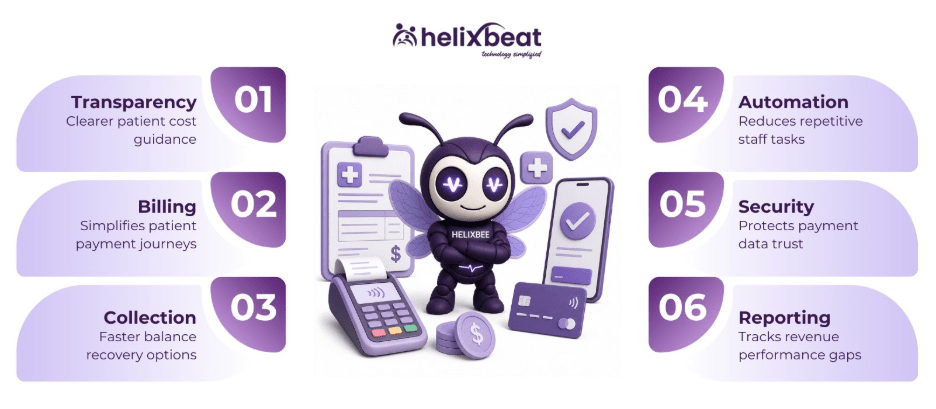
Table of Contents
Price transparency is now a billing operations issue
Price transparency is no longer just a compliance item. For practice leaders, it has become part of scheduling, financial counseling, collections, patient retention, and revenue-cycle performance.
Patients want to know what care may cost, what insurance may cover, and what they may owe personally. Staff need a way to explain those numbers without creating false certainty or manually checking several systems.
Healthcare payment processing helps practices turn price transparency from a static estimate into a clearer payment journey. The goal is not to remove every billing variable. The goal is to give patients a practical path from estimate to bill to payment. For busy administrators, healthcare payment processing becomes the bridge between transparency promises and daily collections.
Why traditional billing workflows create confusion
Traditional billing workflows create confusion because they were built around claims first and patients second. Many practices still rely on manual eligibility checks, paper statements, phone reminders, separate card terminals, and spreadsheets for follow-up.
A patient may receive an estimate before care, a different amount after insurance, and a delayed statement weeks later. Each step may be explainable, but the full experience feels unclear.
Healthcare payment processing becomes important when practices need consistency across estimates, payment collection, reminders, refunds, and reporting. Without that connection, billing teams spend too much time explaining avoidable gaps. In that environment, healthcare payment processing gives the practice a single payment process patients can recognize.
The result is familiar: more billing calls, slower payments, more disputes, and staff frustration.
Patient responsibility has become harder to collect
Patient responsibility is harder to collect because deductibles, co-insurance, co-pays, and plan rules vary widely. Even insured patients may owe a meaningful amount after care.
Practices that wait until the final statement cycle often lose momentum. Patients may forget the visit, misunderstand the bill, or delay payment because the balance feels unexpected.
Healthcare payment processing can support earlier and clearer collection by offering digital payment links, card-on-file options, ACH, digital wallets, recurring payments, and payment plans. Payment flexibility gives patients a manageable next step instead of one large balance with no clear option.
For the practice, clearer payment options can improve cash flow timing and reduce manual follow-up.
Price estimates need a connected payment path
Price estimates are useful only when patients can act on them. A number shown before care does not solve the billing problem unless it connects to eligibility, patient responsibility, collection rules, and payment choices.
Healthcare payment processing helps practices connect those pieces. Staff can collect co-pays before or during the visit, send payment links for known balances, and offer plans when the patient share is higher than expected.
A connected workflow helps practices manage:
- Pre-visit estimates
- Co-pays and deductibles
- Self-pay balances
- Out-of-network responsibility
- Post-insurance balances
- Payment plans
- Refunds and adjustments
- Digital receipts and history
The value is operational. Staff stop rebuilding the payment conversation from scratch at every stage.
Insurance verification and billing clarity must work together
Insurance verification affects billing clarity because patient estimates depend on accurate coverage information. Outdated eligibility, missed preauthorization requirements, or incorrect plan details can turn a reasonable estimate into a disputed bill.
Healthcare payment processing is stronger when it connects with EHR, PMS, and billing systems. Staff can work from better information, identify likely patient responsibility earlier, and collect the right amount at the right point in the visit cycle.
A practice still needs to explain that estimates may change after payer review. Clear communication plus connected payment tools can reduce surprise, even when final responsibility changes.
Better verification support can reduce missed co-pays, incorrect upfront collections, coverage-related delays, and avoidable patient frustration.
Digital billing reduces patient friction
Digital billing reduces patient friction because patients can review and pay bills without calling the office during business hours. Paper statements often arrive late, lack context, and make small questions feel harder than they should.
Healthcare payment processing with a patient-facing payment experience can show balances, payment history, receipts, and available options in one place. A clear billing screen should answer four questions quickly:
- What was charged?
- What did insurance adjust or pay?
- What do I owe now?
- How can I pay?
When patients understand the bill, they are more likely to pay on time. When they do not understand it, they are more likely to pause, call, dispute, or ignore it.
Automation protects staff time
Automation protects staff time because billing teams should not spend their day chasing routine payments manually. Repetitive tasks such as reminders, receipts, recurring payments, and reconciliation can drain hours from teams that already handle payer follow-up and patient questions.
Healthcare payment processing can automate common billing steps while leaving complex conversations to people. Automated reminders, scheduled payment plans, payment posting, and real-time transaction records reduce repetitive work.
The operational benefits are practical:
- Fewer manual calls for routine balances
- Faster payment posting
- Cleaner reconciliation
- More consistent reminders
- Better visibility into unpaid balances
- Less pressure on front desk teams
Automation does not replace the billing team. It removes low-value work so the team can focus on exceptions, disputes, and patient support.
Security and compliance shape patient trust
Security and compliance shape patient trust because healthcare payments involve both financial information and sensitive care-related context. Practices need payment workflows that support privacy, controlled access, audit-ready records, and secure transactions.
Healthcare payment processing built for healthcare should support encrypted transactions, role-based access, secure payment storage, and PCI-DSS aligned card handling. Practices also need workflows that respect HIPAA-related privacy expectations when payment activity connects with patient data.
Patients are more likely to use digital payment options when the experience feels professional and safe. Staff are more confident when they do not need to manage payment details through notes, spreadsheets, or unsecured manual steps.
Reporting helps leaders manage revenue
Reporting helps leaders manage revenue because billing problems are hard to fix when the practice cannot see where balances get stuck. A monthly revenue number is not enough.
Healthcare payment processing can give leaders visibility into unpaid balances, collection timing, payment plan performance, refund volume, dispute trends, and patient payment behavior.
Useful reporting helps answer important questions:
- Which services create the most billing confusion?
- Which locations collect co-pays consistently?
- Which reminders lead to faster payment?
- Which balances are aging fastest?
- How many patients choose payment plans?
- Where do refunds or disputes happen most often?
Better reporting helps practices move from reactive cleanup to active revenue-cycle management. Modern healthcare payment processing turns payment details into management signals instead of scattered transaction records.
PayNova’s role in price transparency and patient billing
PayNova helps practices manage the practical side of price transparency by making patient payments easier to explain, collect, track, and report. The value is not simply accepting cards. The value is building a smoother financial workflow around the patient journey.
PayNova can support practices with multiple payment methods, payment plans, recurring payments, patient-friendly billing experiences, secure payment handling, and reporting that gives leaders a clearer view of collections.
With PayNova, healthcare payment processing can become a more patient-friendly part of care operations. For practices dealing with high patient responsibility, PayNova can help reduce confusion at the point of payment. Patients get more ways to pay. Staff get fewer manual tasks. Leaders get better control over payment performance.
What to look for in a payment partner
A payment partner should improve the patient billing workflow, not just process transactions. Basic payment acceptance does not solve price transparency challenges if estimates, balances, reminders, and reporting remain disconnected.
A strong partner should support:
- EHR, PMS, and billing-system integration
- Cards, ACH, digital wallets, and recurring payments
- Payment plans for larger balances
- Digital statements and payment links
- Secure handling of patient and payment data
- Automated reminders and receipts
- Refund and dispute workflows
- Reporting for revenue-cycle decisions
- Telehealth and remote payment support
The right partner reduces friction for patients and staff at the same time.
Final takeaway
Price transparency is not only about showing patients a number. It is about helping patients understand their financial responsibility and giving staff a reliable way to manage that responsibility from estimate to payment.
Healthcare payment processing closes the gap between what patients are told, what they are billed, and how they pay. For practices facing rising patient responsibility and growing billing complexity, that gap is where revenue, trust, and staff time are often lost.
Talk to a healthcare payment expert about making patient billing clearer, faster, and easier to manage.
FAQs
1. What is healthcare payment processing?
Healthcare payment processing helps practices collect patient payments, manage co-pays, deductibles, payment plans, and track billing in one system.
2. How does healthcare payment processing support price transparency?
It connects estimates, patient responsibility, and payment options so patients understand costs more clearly before or after care.
3. Why is healthcare payment processing important for patient billing?
It reduces billing confusion, speeds up collections, and gives patients easier ways to pay their medical bills.
4. What should practices look for in a healthcare payment processing partner?
Practices should look for secure payments, payment plans, EHR/PMS integration, automated reminders, and clear reporting.
For more answers, visit the PayNova FAQ page.