

The payment security rules your practice thought were optional are becoming mandatory — and most clinics aren’t ready.
Healthcare practices across the US are heading into 2026 facing a collision of two pressures: patients expecting faster, more flexible digital payments, and regulators tightening expectations around how that payment data is handled. If your clinic is still running credit card transactions through a general-purpose payment system — one not built for healthcare — you are carrying compliance risk that can translate into six-figure penalties, data breach liability, and patient trust you cannot recover.
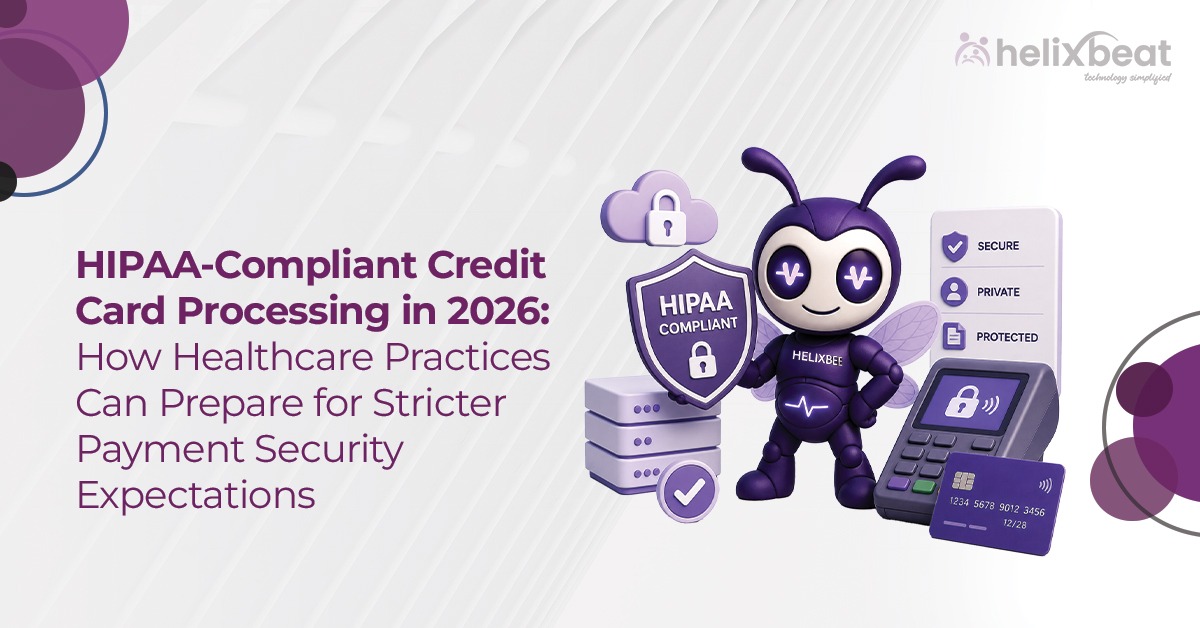
HIPAA compliant credit card processing is no longer a nice-to-have feature on a vendor checklist. In 2026, it is the baseline expectation for any practice that accepts card payments — which is nearly every clinic, hospital outpatient department, and specialty practice in the country.
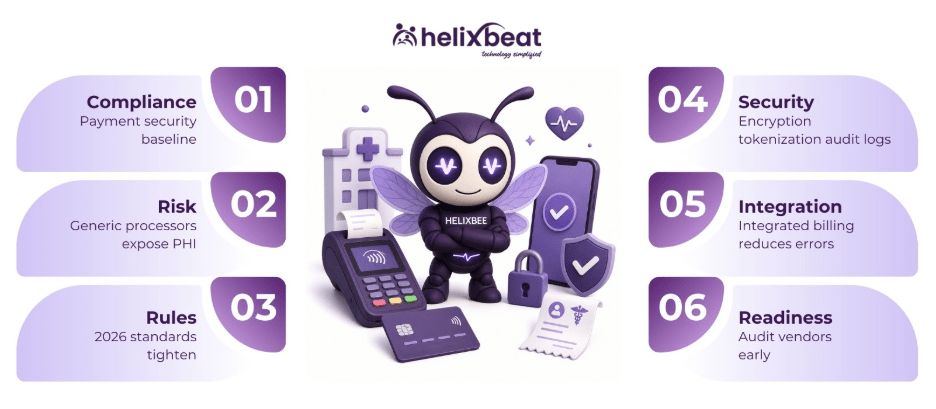
Table of Contents
Why General Payment Systems Create Hidden Compliance Risk
Most payment processors were built for retail, e-commerce, or hospitality. They handle PCI-DSS requirements competently. But healthcare payment environments carry an additional layer of obligation that generic processors were never designed to address.
When a patient pays for a cardiology visit or a lab draw, that transaction is not just a financial event. The payment record is linked to a clinical encounter — and that linkage puts it within the scope of HIPAA’s Privacy and Security Rules. A processor that stores, transmits, or accesses any data that could connect a payment to a diagnosis or treatment record is handling Protected Health Information (PHI).
General processors do not sign Business Associate Agreements (BAAs). Without a BAA, your practice has no documented compliance coverage for how that vendor handles data connected to patient care. In an HHS audit or a breach investigation, the absence of a BAA with your payment processor is a serious finding — not a technicality.
HIPAA compliant credit card processing requires processors that understand this distinction, execute BAAs, and operate infrastructure designed to keep payment data and clinical context separate or protected under the same compliance umbrella.
What Changed Going Into 2026
Regulatory pressure on healthcare payment security has been building for three years. Several developments are shaping the 2026 environment:
HHS enforcement activity has increased. The Office for Civil Rights has been pursuing smaller practices and mid-size clinics — not just large hospital systems. Fines for smaller organizations have ranged from $25,000 to over $1 million, depending on the nature of the violation and whether the practice had documented controls in place.
PCI-DSS v4.0 is now fully enforced. The updated standard, which became mandatory in March 2025, introduces stricter requirements around authentication, encryption, and monitoring. Practices that assumed their existing card processing setup was compliant may find gaps when assessed against v4.0 requirements.
Patient payment behavior has shifted. More patients now pay through digital channels — mobile wallets, patient portals, payment links sent via text. Each of these touchpoints creates a new surface area for data exposure if the underlying system is not purpose-built for healthcare.
For practices that have not reviewed their payment infrastructure in the last 18 months, 2026 is the year that review becomes urgent.
The Operational Cost of Getting This Wrong
Beyond regulatory penalties, non-compliant payment processing creates operational drag that affects day-to-day practice performance.
When patients receive unexpected bills, unclear invoices, or payment confirmations that don’t match what they remember from their visit, disputes follow. Each dispute requires staff time to investigate, reconcile, and resolve. In practices without automated payment audit trails, this process is slow and error-prone.
Claim denials compound the problem. When payment and billing data are handled in disconnected systems, coding errors and eligibility mismatches go undetected until the insurer rejects the claim. The rework cycle — correcting, resubmitting, waiting for reprocessing — can push reimbursement timelines out by weeks.
HIPAA compliant credit card processing systems designed for healthcare reduce this friction by integrating payment workflows with billing and eligibility data from the start, catching errors before they become denials.
What HIPAA-Compliant Credit Card Processing Actually Requires
Understanding what qualifies as HIPAA compliant credit card processing helps practices evaluate vendors and close gaps in their current setup.
Business Associate Agreement. Any vendor that processes, stores, or transmits payment data connected to PHI must execute a BAA with your practice. This is non-negotiable and cannot be substituted by a vendor’s general privacy policy.
End-to-end encryption. Payment data must be encrypted in transit and at rest. This includes card entry at the point of service, data transmission to the processor, and any stored transaction records.
Access controls and audit logs. Only authorized personnel should be able to access payment records, and every access event should be logged. This supports both HIPAA Security Rule compliance and internal fraud prevention.
Tokenization. Card numbers should never be stored in their original form. Tokenization replaces sensitive card data with a non-sensitive reference token, reducing breach exposure significantly.
Breach notification readiness. Your processor should have documented procedures for notifying your practice in the event of a data incident — within HIPAA’s required 60-day window, or faster if your BAA specifies it.
Practices evaluating vendors should request documentation on each of these capabilities — not just verbal assurances.
How PayNova Addresses the 2026 Compliance Environment
PayNova is a healthcare-specific payment gateway built to meet the compliance, integration, and operational requirements that general processors cannot address.
PayNova executes Business Associate Agreements as a standard part of its onboarding process. HIPAA compliant credit card processing is not an add-on module — it is the architecture the entire platform is built on.
Key capabilities that address the 2026 environment include:
- Real-time insurance verification that confirms coverage before the patient pays, reducing billing errors and patient confusion at checkout
- EHR and PMS integration that pulls accurate patient and encounter data into the billing workflow, removing manual re-entry and the errors that come with it
- Multiple payment channels — card-present, patient portal, mobile, and ACH — all routed through the same compliant infrastructure
- Automated payment plans and recurring billing that reduce missed payments without requiring staff follow-up
- Detailed audit trails and financial reporting that support both internal controls and external compliance documentation
HIPAA compliant credit card processing through PayNova also includes PCI-DSS v4.0 aligned controls, so practices address both regulatory frameworks through a single vendor relationship.
Steps Your Practice Can Take Before the End of Q1 2026
Preparing for stricter payment security expectations does not require a full technology overhaul. These steps create a structured path forward:
Audit your current processor relationship. Confirm whether your payment processor has signed a BAA. If one is not in place, that gap requires immediate attention regardless of your other compliance posture.
Review your payment touchpoints. Map every channel through which patients submit payment — front desk terminal, online portal, payment link, phone-based entry. Each touchpoint should be evaluated for encryption and access control compliance.
Assess your PCI-DSS v4.0 status. If your last PCI assessment was completed before March 2025, it was conducted against the previous standard. A gap assessment against v4.0 will identify areas requiring remediation.
Evaluate integration between payment and clinical systems. Disconnected systems are both a compliance risk and an operational inefficiency. HIPAA compliant credit card processing delivers full value when payment data flows accurately from the clinical encounter through to reconciliation.
Document your vendor agreements. Maintain current copies of all BAAs, service agreements, and compliance certifications from payment-related vendors. This documentation is the first thing an auditor or investigator will request.
The Practices That Will Be Ready Are the Ones Acting Now
2026 is not a soft deadline. Regulatory enforcement, patient expectations, and payment security requirements are converging in ways that will distinguish compliant, operationally efficient practices from those still running payment infrastructure designed for a different industry.
HIPAA compliant credit card processing is the foundation that makes compliant digital payments possible. Practices that establish this foundation now will spend less time managing billing disputes, fewer resources on claim rework, and carry less regulatory exposure heading into a year when auditors are paying attention.
See how PayNova’s HIPAA-compliant payment infrastructure works for practices like yours — request a walkthrough with a healthcare payments specialist.
People Also Ask
What payment systems are HIPAA compliant?
Payment systems are not automatically HIPAA compliant; it depends on how PHI is handled, stored, and shared.
For healthcare practices, hipaa compliant credit card processing should include secure payment links, limited PHI exposure, and clear vendor controls.
What are some strategies that healthcare professionals can use to comply with HIPAA regulations?
Healthcare professionals can reduce PHI in billing workflows, verify patient identity, train staff, and use approved secure channels.
Hipaa compliant credit card processing also helps by reducing manual card handling and keeping payment workflows more controlled.
Which regulation strengthens HIPAA rules by addressing privacy and security concerns associated with electronic health information?
The HITECH Act strengthens HIPAA rules by addressing privacy and security concerns linked to electronic health information.
For practices using hipaa compliant credit card processing, HITECH makes secure digital workflows and vendor accountability even more important.
How should we implement the HIPAA Security Rule?
Start with a risk review, limit system access, train staff, document policies, and monitor how patient data moves across workflows.