

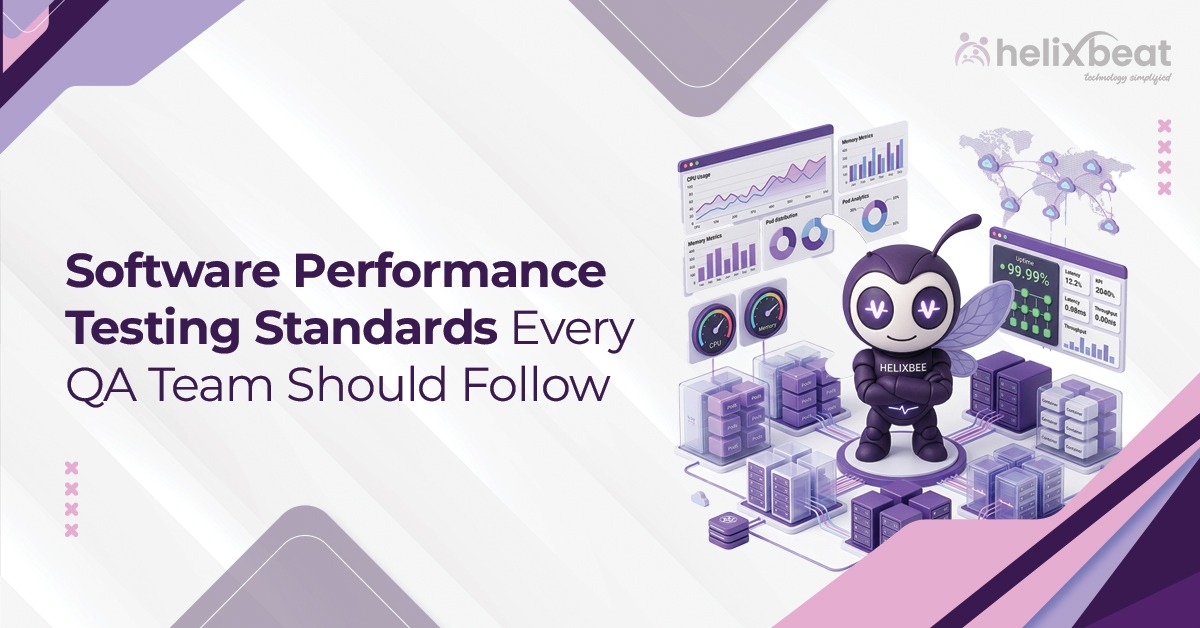
Most software failures under real-world conditions are not bugs in the traditional sense. They are performance failures. These problems damage user trust, cost companies revenue, and surface in post-mortems. Yet many QA teams still treat performance testing as an afterthought.
That approach does not work anymore. Users expect applications to load in under two seconds. Enterprise clients expect systems to handle tens of thousands of concurrent users without degrading. And regulatory bodies increasingly tie software quality standards to demonstrable performance benchmarks. If your QA team does not operate from a defined set of standards, you are shipping risk, not software.
In this blog, we break down what those standards look like in practice.
Table of Contents
Why Software Performance Testing Standards Cannot Be Optional
Performance issues discovered in production are much more expensive to fix than those caught during testing. Financial costs are only part of the equation; regulatory adherence is equally important. Today, fields like banking, medical care, and online retail are subject to rigorous oversight. If your application serves users under data-protection legislation, outages and slow performance can trigger legal consequences.
This is where structured software performance testing standards become non-negotiable.
The Core Types of Performance Testing Every QA Team Must Execute
Before defining standards, your team needs clarity on what they are testing. There are six foundational test types that any robust performance testing strategy must include:
- Load Testing validates that the system performs correctly under anticipated user load. You are verifying that the system delivers acceptable response times when 1,000 or 10,000 users are active simultaneously.
- Stress Testing deliberately pushes the system beyond its normal operating capacity to find where and how it breaks. This reveals failure modes and recovery behavior, which are as important as peak capacity metrics.
- Spike Testing subjects the system to sudden, extreme surges in load, the kind that occur during flash sales, viral content events, or live broadcasts. The goal is to observe whether the system recovers gracefully or collapses.
- Soak Testing (Endurance Testing) runs the system under sustained load over an extended period (typically 8–24 hours) to identify memory leaks, database connection exhaustion, and gradual performance degradation.
- Scalability Testing determines how the system performs as resources scale up or down, which is necessary for cloud-native applications and SaaS platforms.
- Scalability Testing determines how the system performs as resources are scaled up or down, which is critical for cloud-native applications and SaaS platforms.
- Volume Testing evaluates behavior when the system processes large data volumes. It’s important for systems managing databases, file processing pipelines, and analytics workloads.
Each of these test types has specific entry criteria, execution procedures, and exit criteria. Your performance testing guidelines must document all three for each type.
ISO Performance Testing Standards: What They Actually Require
Under the SQuaRE standard series, ISO/IEC 25010:2011 is the definitive global benchmark for defining and evaluating software performance quality. It defines software product quality characteristics. Within this model, “performance efficiency” is a primary quality characteristic with three measurable sub-characteristics:
- Time Behavior refers to response and processing times and throughput rates during function execution under stated conditions.
- Resource Utilization measures the amounts and types of resources used by a product when performing its functions.
- Capacity defines the maximum limits of a system parameter that meets requirements.
ISO/IEC 25010 does not prescribe specific benchmark numbers. It mandates that each of these sub-characteristics must be measurable, testable, and documented with thresholds before testing begins. Therefore, your QA team can’t rely on vague approvals after running a load test. Instead, testing outcomes must be measured against specific, pre-established performance metrics.
Complementary to this, ISO/IEC 29119-4 provides the standard for software test techniques, including performance test design. It specifies how test conditions, test cases, and test procedures should be documented for performance testing specifically.
For quality assurance teams, adhering to these ISO benchmarks separates a verifiable, evidence-based testing strategy from one built on institutional habit and guesswork.
The Non-Negotiable Performance Testing Guidelines
1. Define Performance Acceptance Criteria Before Testing Begins
This is the most frequently skipped step. Many teams start testing without agreed-upon pass/fail criteria, which means results become subjective. Standards-compliant performance testing guidelines require that you document specific thresholds. For example, “95th percentile response time must remain below 2 seconds under 1,000 concurrent users,” or “CPU utilization must not exceed 80% under peak load,” before a single test runs.
Teams must derive these thresholds from business requirements, user expectations (often informed by Google’s Core Web Vitals benchmarks), and infrastructure specifications.
2. Use Production-Representative Test Environments
Running performance tests against under-provisioned staging environments produces misleading data. Your test environment should mirror production in terms of hardware configuration, network topology, database size, and third-party integrations. Where full mirroring is not feasible (common in cloud environments), the delta must be documented and accounted for in result analysis.
3. Baseline Before Every Major Release
A baseline establishes the system’s “normal” performance profile. Without a baseline, regression analysis is impossible. Standards-compliant teams run baseline tests after every big architectural change, but after database schema changes, infrastructure migrations, third-party service updates, and significant code refactors.
Automated testing solutions can help maintain consistent baseline runs as part of CI/CD pipelines.
4. Monitor Infrastructure Metrics Concurrently With Application Metrics
Application-level metrics (response time, throughput, error rate) tell only half the story. CPU utilization, memory consumption, disk I/O, network bandwidth, garbage collection frequency, and database connection pool exhaustion tell the other half. A response time degradation that is not accompanied by high CPU usage might point to a database lock, an external API timeout, or a caching miss.
Therefore, your performance testing guidelines must mandate that infrastructure monitoring runs concurrently during all performance tests. Tools like Grafana, Prometheus, Datadog, or cloud-native monitoring suites fulfill this requirement.
5. Establish a Formal Test Data Strategy
Using production data directly in performance tests creates privacy and compliance risks. However, using synthetic data that does not reflect realistic data distribution produces inaccurate results. Therefore, the solution is a documented test data strategy that generates realistic, production-representative data while complying with data protection requirements. This includes database record counts, data variety, data relationships, and data volatility patterns.
6. Apply Realistic Think Time and Ramp-Up Profiles
A performance test that sends 1,000 simultaneous requests the moment it starts does not reflect real user behavior. Real users browse, pause, fill forms, and navigate. Therefore, applying realistic think times (pauses between user actions) and ramp-up curves (gradually increasing virtual user counts) produces results that are actually predictive of production behavior. Tools like Apache JMeter, Gatling, and k6 all support configurable think time and ramp-up profiles.
7. Automate Performance Regression Testing in CI/CD
Performance testing should not be a pre-release ceremony performed by a specialist team once per quarter. Modern software quality standards call for performance regression tests to run automatically on every big commit or merge to main branches. These automated runs may not replace full-scale load tests, but they catch performance regressions introduced by individual changes before they accumulate into production incidents.
Test Reporting Standards: Making Results Actionable
A performance test that produces a 200-page report nobody reads is worthless. Standards-compliant reporting follows these principles:
Test reports must include clearly stated pass/fail verdicts against each predefined acceptance criterion.
- Reports must present percentile distributions (50th, 90th, 95th, 99th) rather than averages, since averages mask outliers.
- Every identified bottleneck must include a root cause hypothesis and a recommended remediation action.
- Trend data across multiple test runs must be presented graphically so that regression patterns are visually obvious.
API and Integration Performance: The Hidden Bottleneck
Many modern applications are performance-constrained not by their own code but by the APIs and third-party services they depend on. An application that performs perfectly in isolation can fail spectacularly when a downstream payment gateway, identity provider, or data service degrades.
Therefore, performance testing guidelines must extend to include API and integration testing under realistic load conditions. This includes testing timeout handling, retry logic, circuit breaker behavior, and graceful degradation when external dependencies are slow or unavailable.
A Practical Checklist for QA Teams
Before marking a release as performance-cleared, your team should be able to answer yes to each of the following:
- Are performance acceptance criteria documented and approved by stakeholders before testing begins?
- Does the test environment accurately reflect the production environment’s configuration?
- Have load, stress, spike, and soak tests all been executed?
- Were infrastructure metrics captured alongside application metrics during all test runs?
- Have results been compared against the established baseline?
- Has a formal test report been produced with pass/fail verdicts against each criterion?
- Have all identified bottlenecks been root-caused and prioritized for remediation?
- Have regression tests been added or updated in the CI/CD pipeline?
If any answer is no, the release carries performance risk that has not been adequately quantified.
Final Thoughts
Software performance testing standards are practical necessities, not bureaucratic overhead. They are the difference between discovering performance problems in a controlled test environment. Whether you align with ISO/IEC 25010 or build your own internal framework, the requirement is the same: performance must be measurable, the thresholds must be defined before testing, and the process must be repeatable and automated.
For QA teams looking to build or mature their performance testing capability, get in touch with our support team!
FAQs
1. What are software performance testing standards?
Software performance testing standards are structured guidelines and best practices that help QA teams evaluate an application’s speed, stability, scalability, and resource usage under different load conditions. Standards such as ISO/IEC 25010:2011 and ISO/IEC 29119-4 provide frameworks for defining measurable performance requirements and documenting testing procedures.
2. Which types of performance testing should every QA team perform?
Every QA team should conduct six core types of performance testing: load testing, stress testing, spike testing, soak (endurance) testing, scalability testing, and volume testing. Each type helps identify different performance risks, from handling expected user traffic to managing sudden traffic spikes and large datasets.
3. Why is defining performance acceptance criteria important before testing?
Performance acceptance criteria establish clear pass/fail benchmarks before testing begins. Metrics such as response time, throughput, error rate, and CPU utilization make test results objective and measurable.
4. Why should performance tests be run in a production-like environment?
A production-representative environment provides realistic insights into how an application will behave after deployment. Differences in hardware, network configurations, databases, or third-party integrations can produce misleading results and cause unexpected performance issues in production.
5. How can QA teams integrate performance testing into CI/CD pipelines?
QA teams can automate performance regression testing within CI/CD pipelines by running lightweight performance tests on major commits or code merges. This approach helps identify performance degradations early.