

Your customers do not wake up wanting to watch another polished ad. They scroll, search, compare, listen to people they trust, and then decide. That is why Creator Marketing in 2026 is becoming a serious growth channel, not a side experiment.
Brands are realizing that attention has moved from brand-owned pages to creator-owned communities. Creator Marketing in 2026 matters because creators already have what most businesses are trying to build: trust, attention, consistency, and influence.
For HelixBeat’s Marketing-as-a-Service model, the opportunity is clear. Brands need campaigns that combine strategy, creator selection, content planning, paid amplification, analytics, and conversion tracking. Random influencer posts are not enough.
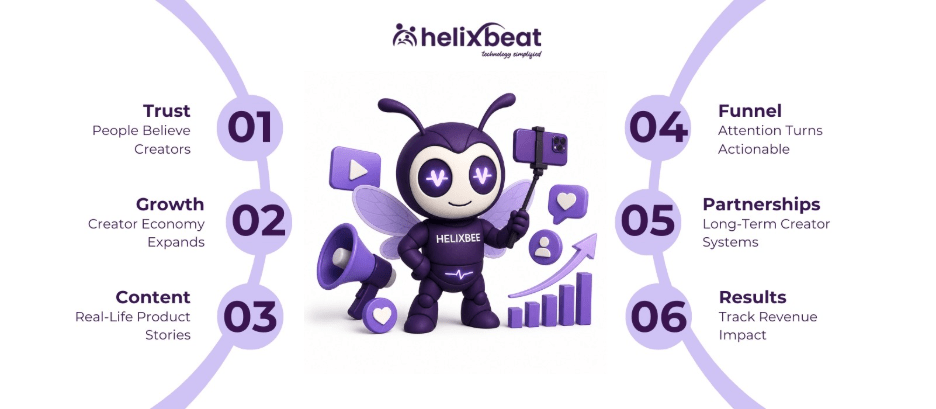
Table of Contents
Why Creator Marketing Is Getting Bigger
Creator Marketing in 2026 is growing because consumer behavior has changed. People no longer rely only on search ads or brand websites. They look for real opinions, product demos, reactions, tutorials, reviews, and social proof before buying.
The creator economy is also expanding fast. Grand View Research estimates the global creator economy will grow from USD 310.4 billion in 2026 to USD 1,345.5 billion by 2033. That growth explains why brands are adding creator budgets to annual marketing plans.
Creator marketing trends in 2026 show a clear shift from celebrity-only campaigns to smaller, more trusted creators. EMARKETER reports that micro- and nano-influencers are expected to claim 45.5% of influencer marketing spending in 2026.
Smaller creators often have tighter communities. Their audiences ask questions, share experiences, and trust recommendations.
The Big Problem with Traditional Ads
Traditional ads are not dead, but they are less persuasive when used alone. Most people can spot a sales message instantly. They skip it, mute it, scroll past it, or ignore it.
Creator Marketing in 2026 works because it places the message inside content people already want to watch. A skincare product explained through a morning routine feels different from a static banner ad. A SaaS tool shown inside a founder’s workflow feels more useful than a generic product claim.
Social media creators also understand platform behavior better than most brands. They know what hooks work, how long people watch, which formats feel natural, and what kind of language drives comments.
That is the difference. Brands often create campaigns. Creators create conversations.
Why Brands Trust Creators More Now
Creator marketing trends in 2026 are moving toward credibility, not just reach. Brands want creators who can explain products clearly, match audience intent, and generate content that feels natural.
Brand creator partnerships work when the creator is not treated like a media slot. The creator should understand the product, the audience pain point, the brand promise, and the action the campaign needs to drive.
At HelixBeat, this is where Marketing-as-a-Service becomes useful. Creator Marketing in 2026 needs more than a list of influencers. It needs strategy, creative direction, outreach, content review, tracking links, landing pages, reporting, and campaign optimization.
Creator Marketing in 2026 is not about “pay someone famous and hope for sales.” It is about building a repeatable engine that connects audience trust with measurable business outcomes.
What Makes Creator Content Perform Better
Content creator marketing works because buyers can see the product in context. Instead of reading a claim, they watch someone use the product, explain the result, and show how it fits into daily life.
For example, imagine a growing fitness brand launching a high-protein snack. A normal ad might say, “Healthy protein snack for active people.” Clear, but not memorable.
Now imagine five fitness creators showing the snack in real situations: after a workout, inside a work bag, during a road trip, as a late-night craving swap, and as part of a meal prep routine. One product now has multiple stories, use cases, and reasons to buy.
That is the power of Creator-led marketing. The creator turns the product into a relatable moment, which is why Creator-led marketing can outperform scripted promotion.
Why One-Off Posts Are Losing Value
One sponsored post rarely changes a market. People need repeated exposure before they trust a brand. That is why Creator Marketing in 2026 is becoming more long-term.
Brand creator partnerships are moving from single posts to multi-month collaborations. Brands ask creators to build series, support launches, test products, collect feedback, and create reusable ad assets.
HelixBeat’s influencer marketing perspective also supports long-term collaborations and performance tracking. You can read more about Brand creator partnerships and how data improves creator selection.
Creator marketing trends in 2026 also show that brands are becoming more selective. Follower count alone is not enough. Brands now look at audience fit, engagement quality, content style, sentiment, and conversion potential.
The Rise of Creator-Led Funnels
Creator-led marketing does not stop after someone watches a video. The real value comes when creator content connects to a complete funnel.
Creator Marketing in 2026 turns creator attention into a smart funnel:
- Creator builds awareness through short-form video
- Audience clicks to a landing page
- Brand captures the lead or sale
- Retargeting ads reuse the creator content
- Email or WhatsApp follow-up answers objections
- Analytics shows which creator drove real revenue
Creator Marketing in 2026 requires this kind of connected setup. Without tracking, brands only know reach and likes. With tracking, they see leads, sales, and return on spend.
Social media creators bring the audience. The brand still needs the system that turns attention into action.
Why Social Platforms Favor Creator Content
Social platforms reward content that keeps people watching and interacting. Creators are good at this because they test hooks, formats, posting times, captions, reactions, and story angles every day.
Social media creators understand that attention is earned in seconds. They start with a problem, question, result, emotion, or curiosity gap.
Creator Marketing in 2026 benefits from this platform-native thinking. Instead of forcing a TV-style ad into Instagram, TikTok, YouTube Shorts, or LinkedIn, brands can work with creators who already know the language of the platform.
Content creator marketing also gives brands more creative variety. One campaign can produce tutorials, testimonials, unboxings, product comparisons, day-in-the-life clips, FAQs, and behind-the-scenes content.
The B2B Creator Opportunity
Creator Marketing in 2026 is not only for fashion, food, fitness, or beauty. B2B brands are also investing in creators because trust matters in complex buying decisions.
A cybersecurity company can work with security educators. A healthcare technology brand can work with clinicians who explain workflow problems. A SaaS company can work with operators, founders, consultants, and LinkedIn educators.
Creator-led marketing works especially well in B2B when the creator simplifies a complex topic. Buyers may not want a brochure, but they will watch a trusted expert explain what is changing in their industry.
Creator marketing trends in 2026 point to more professional creators entering the space. Executives, consultants, product experts, analysts, and niche educators are becoming powerful voices with high-intent audiences.
What Brands Should Measure
Creator Marketing in 2026 needs better measurement. Likes and views matter, but they are not the full story.
Track:
- Engagement quality
- Comment sentiment
- Click-through rate
- Cost per lead
- Cost per sale
- Landing page conversion rate
- Retargeting performance
- Content reuse value
- Revenue by creator
Brand creator partnerships become stronger when both sides understand performance. The creator knows what message works. The brand knows which audience and content format drives business.
HelixBeat’s Marketing-as-a-Service approach can help connect creator campaigns with SEO, paid ads, content marketing, email, WhatsApp, landing pages, and analytics. That connection makes creator spend more predictable.
How to Choose the Right Creators
Do not start with follower count. Start with relevance.
The best creator is not always the biggest creator. The best creator has the right audience, trust, engagement, and category fit.
Before choosing a creator, ask:
- Does the audience match our buyer?
- Do comments show real trust?
- Has the creator promoted too many unrelated products?
- Can their content style fit our brand?
- Can we use the content across ads and landing pages?
- Can we track clicks, leads, and sales?
Content creator marketing works best when creators are treated like strategic partners. Give them clear goals, but leave room for their voice. If the content feels scripted, the audience will notice.
Where HelixBeat Fits In
Creator Marketing in 2026 creates opportunity, but many brands struggle with execution. They do not know whom to choose, what brief to write, how to track results, or how to turn creator content into ongoing marketing assets.
Creator Marketing in 2026 needs a structured operating model. HelixBeat’s Marketing-as-a-Service can support creator strategy, campaign planning, content direction, performance tracking, landing pages, retargeting, and reporting.
For brands that need stronger storytelling, Content creator marketing should connect with content strategy, SEO, and conversion-focused messaging.
Social media creators start conversations, and HelixBeat helps connect those conversations to growth.
Final Thoughts
Creator Marketing in 2026 is growing because people trust people more than ads. Brands are investing more because creators bring attention, context, community, and credibility.
Creator marketing trends in 2026 show that smaller creators, long-term collaborations, platform-native videos, and better measurement are becoming more important. Brand creator partnerships are moving from one-off sponsored posts to structured growth programs.
Content creator marketing helps brands explain products in real-life situations. Social media creators help brands enter conversations customers already care about. Creator-led marketing helps businesses turn trust into traffic, leads, and sales.
The brands that win will not simply hire creators. They will build creator systems.
Talk to HelixBeat’s Marketing-as-a-Service team to plan creator campaigns that connect content, trust, performance, and measurable growth.
People Also Ask
What is the 3 7 27 rule of branding?
The 3 7 27 rule means people form quick brand impressions through repeated exposure. A strong brand needs clear visuals, messaging, and recall across multiple touchpoints.
Why are brands increasingly sponsoring influencers?
Brands sponsor influencers because creators already have audience trust. Their recommendations often feel more personal, relatable, and useful than traditional ads.
What is the 5 3 2 rule on Instagram?
The 5 3 2 rule suggests sharing five helpful posts, three brand-related posts, and two personal or human posts to keep Instagram content balanced.
What are the 3 R’s of influencer marketing?
The 3 R’s are relevance, reach, and resonance. Brands should choose creators whose audience fits the product, has enough visibility, and actively engages.