

Picture this: your sales team closes a deal, but the finance system doesn’t know about it yet. Your warehouse ships the wrong quantity because the inventory data lives in a spreadsheet that nobody updated. Your customer calls support, and the agent has no idea what they purchased last month. Sound familiar?
These indicators point to a deeper structural problem. And the fix isn’t more meetings or more manual reconciliation. The fix is system integration.
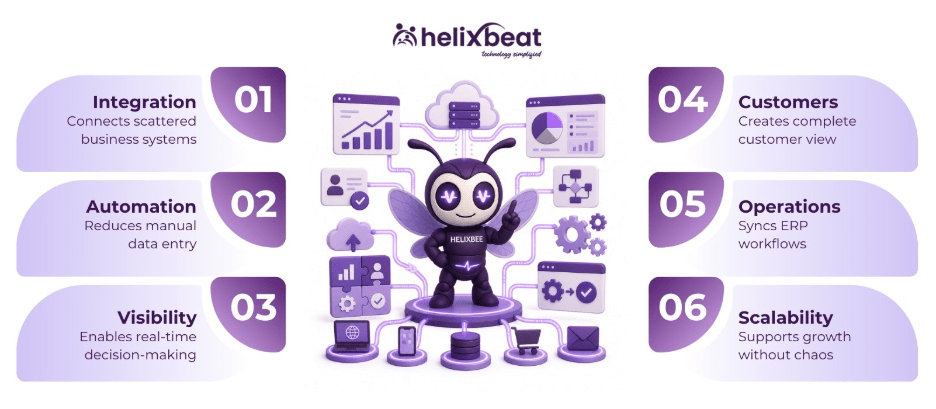
Table of Contents
What System Integration Actually Means (and Why It’s Misunderstood)
System integration is the process of connecting separate software applications, databases, and platforms so they communicate, share data, and operate as a coordinated whole. It’s an architectural decision that defines how efficiently a business can operate at scale.
Many companies treat it as optional. They patch disconnects with workarounds: spreadsheets, copy-paste workflows, email threads, and manual data entry. For a while, this works. But as the business grows, these patches become the bottleneck. Data discrepancies multiply, teams work in silos, and the cost of manual reconciliation quietly eats into margins.
The Real Cost of Disconnected Systems
According to a study by MuleSoft, organizations now use an average of 976 applications, but fewer than 30% of those are integrated. The result? Teams spend hours per week re-entering the same data across different tools. Errors compound. Decisions get made on stale information.
The cost isn’t just operational. Disconnected systems erode customer experience. When a CRM doesn’t talk to your billing platform, your customer support agent is flying blind. When your e-commerce store isn’t synced with your ERP, you’re promising stock you don’t have.
This is where professional system integration services add value by making existing software work together intelligently.
Enterprise Integration: The Foundation for Scalable Operations
Enterprise integration establishes a unified data architecture across the entire organization. It connects HR systems, financial platforms, customer databases, supply chain tools, and operational software into one coherent ecosystem.
The practical effect is significant. When a new employee is onboarded in the HR system, it automatically triggers access provisioning in IT, creates a payroll record in finance, and assigns training modules in the LMS without a single manual step.
It’s the infrastructure that makes scaling possible without proportionally scaling headcount.
API Integration: The Language Machines Use to Talk
Modern software speaks through APIs (Application Programming Interfaces). Every time your payment gateway confirms a transaction, every time your logistics platform updates a delivery status, every time a customer fills out a web form, APIs are doing the heavy lifting in the background.
API integration connects these channels. A well-designed API layer means your marketing automation platform knows when a customer makes a purchase, your support tool knows when a payment fails, and your analytics dashboard reflects real-time activity.
API development and integration services help businesses build robust, secure, and scalable API layers.
CRM Integration: Giving Every Team the Full Customer Picture
Your CRM holds the relationship history. Your billing system holds the transaction history. Your support tool holds the complaint history. Without CRM integration, each team sees a fragment, and nobody sees the whole customer.
CRM integration connects your customer relationship platform with marketing tools, sales pipelines, support desks, billing systems, and e-commerce platforms. When a sales rep opens a contact, they see recent support tickets. When a marketer segments a campaign, they can filter by purchase history. When finance issues a renewal reminder, they know if there’s an open complaint.
This 360-degree customer view directly improves customer retention, because clients feel understood rather than constantly re-explaining themselves.
ERP Integration: Connecting the Operational Backbone
An ERP system manages the core operational data of a business: inventory, procurement, manufacturing, finance, and logistics. If an ERP sits alone, disconnected from your CRM, your e-commerce platform, or your field service tools, it creates data islands.
ERP integration solves this by making your operational backbone visible to every department. Finance can see real-time inventory value. Sales can check live stock levels before committing to delivery dates. And procurement can trigger automatically when thresholds are hit.
Business Process Integration: Where Technology Meets Workflow
Technology integration only creates value when it maps to actual business workflows. Business process integration is the discipline of aligning your integrated systems with how work actually gets done — from lead generation through to invoice payment, from hire to retire, or from order to delivery.
When your workflows are integrated end-to-end, approval chains happen automatically, status updates propagate in real time, and exceptions get flagged without manual review. The result is faster cycle times, fewer errors, and the ability to audit any process at any point.
Five Tangible Business Outcomes of System Integration
1. Faster decision-making: When data flows in real time across departments, leaders work with accurate, current information instead of last week’s exports.
2. Reduced operational costs: Eliminating manual data entry and reconciliation directly reduces labor costs and the cost of errors.
3. Better customer experience: Integrated CRM and support tools give frontline teams a unified view, which leads to faster resolution and higher satisfaction scores.
4. Improved compliance and auditability: Integrated systems create a consistent, traceable data trail, which is critical for industries like finance and healthcare.
5. Scalability without chaos: As the business grows, integrated systems scale together. Adding a new sales channel or product line doesn’t require building parallel manual processes from scratch.
Where to Start: A Practical Approach
Not every business needs to integrate everything at once. A phased approach works better:
Start by identifying your highest-friction data handoff — the point where information most often gets lost, delayed, or duplicated. That’s your first integration priority. From there, map the downstream systems that depend on that data, and build the integration layer outward.
Working with experienced system integration services like Helixbeat means you’re not starting from scratch. The patterns, the pitfalls, and the architecture decisions have already been navigated — and the right solution gets implemented faster, with less risk. Get in touch with our team!
FAQs
1. Why is system integration important for business efficiency?
System integration eliminates data silos, reduces manual data entry, improves information accuracy, and enables teams to make faster decisions based on real-time data.
2. What problems can arise from disconnected business systems?
Disconnected systems can lead to duplicate data entry, communication gaps, delayed decision-making, inventory errors, poor customer experiences, and increased operational costs.
3. What is enterprise integration?
Enterprise integration is the process of connecting various organizational systems, like HR, finance, supply chain, and customer management platforms, into a single, coordinated ecosystem.
4. What is business process integration?
Business process integration aligns connected technologies with actual workflows, automating processes such as order fulfillment, approvals, onboarding, and invoicing to reduce errors and increase productivity.
5. What are the key benefits of implementing system integration services?
The main benefits include reduced operational costs, faster decision-making, improved customer experiences, better compliance and auditability, and scalable business growth.