

Table of Contents
Introduction
Your customers are already talking about your brand.
They are posting photos, writing reviews, sharing reels, recording unboxing videos, and telling friends what they like or dislike. The question is simple: are you using that content to grow, or are you letting it disappear in the feed?
That is why User-Generated Content Marketing has become one of the smartest moves for brands that want trust, reach, and conversions without sounding like they are shouting ads all day.
The old marketing playbook was simple: create a campaign, publish the message, and wait for people to believe it. But today, people do not trust brands as quickly as they trust other people. A polished ad can create awareness, but a real customer story can create belief.
According to Coursera’s guide on UGC campaigns, UGC campaigns are built around content created by people rather than the brand itself. And Grand View Research projects the global user generated content platform market to reach USD 32.6 billion by 2030.
That growth is not accidental. It is happening because User-Generated Content Marketing turns everyday customer experiences into proof.
For Helixbeat’s Marketing as a Service model, this is powerful. Instead of treating UGC as random social media noise, Helixbeat helps brands turn it into a structured growth asset through strategy, content planning, social distribution, performance tracking, and conversion-focused campaigns. You can explore Helixbeat’s digital marketing services to see how integrated campaigns support brand growth.
What is user generated content?
User-generated content is any content created by customers, users, fans, employees, or community members instead of the brand’s internal team.
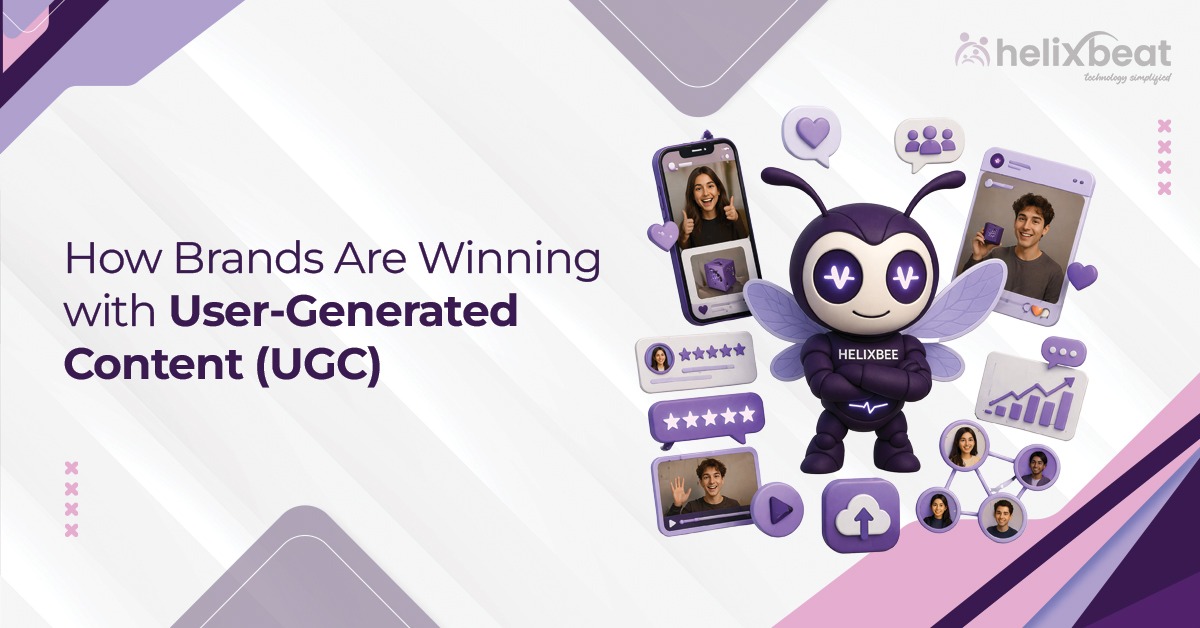
It can include product reviews, social media posts, unboxing videos, customer photos, testimonials, comments, case studies, community stories, before-and-after results, and short-form videos.
In simple words, User-generated content is proof that real people are using, experiencing, and reacting to your brand.
That is what makes User-Generated Content Marketing different from traditional advertising. A brand ad says, “We are good.” A customer post says, “I tried this, and here is what happened.”
That difference matters.
When a brand speaks, people listen with caution. When a customer speaks, people listen with curiosity. That is why UGC marketing has become a serious part of modern brand building.
Why brands are investing in User-Generated Content Marketing
Brands are not using UGC just because it looks authentic. They are using it because it solves a real marketing problem.
Customer acquisition is getting expensive. Paid ads are more competitive. Organic reach is unpredictable. Audiences scroll fast. And branded content often feels too perfect to be believable.
User-Generated Content Marketing helps brands break through that resistance.
It gives buyers what they actually want before making a decision: real proof.
Think about your own buying behavior. Before you purchase a product, book a service, or choose a company, you probably check reviews, photos, comments, videos, or social proof. That is UGC content strategy in action, even if the brand does not call it that.
Customer-generated content reduces doubt because it feels closer to real life. It shows the product in a home, office, clinic, factory, store, or daily routine, not just in a studio.
That is why brands that use User-Generated Content Marketing well do not just get more content. They get more trust.
Types of user-generated content brands can use
A strong UGC content strategy does not depend on one format. It uses different content types for different stages of the customer journey.
1. Reviews and ratings
Reviews are one of the simplest forms of Customer-generated content. They work because they answer the buyer’s silent question: “Can I trust this?”
A good review can support product pages, landing pages, ads, emails, and social posts.
2. Social media posts
When customers tag your brand or use your hashtag, they are giving you content that can be reshared, curated, and repurposed.
This type of UGC marketing works especially well for lifestyle, ecommerce, SaaS, healthcare, hospitality, education, and local service brands.
3. Video testimonials
Video creates emotional proof. A written review is useful, but a customer explaining their experience in their own voice often feels more believable.
This is where User-Generated Content Marketing becomes more human.
4. Unboxing and product experience videos
For ecommerce brands, unboxing videos show packaging, first impressions, product quality, and customer excitement.
Helixbeat’s ecommerce digital marketing agency approach can help online brands connect UGC with product pages, ads, retention campaigns, and conversion funnels.
5. Community stories
Community-led content works well when brands want to build long-term loyalty, not just quick sales.
This could include customer success stories, employee advocacy, user spotlights, or social challenges.
Organic UGC vs paid UGC
Not all UGC is the same.
Organic UGC happens when customers naturally create content about your brand. They are not paid. They post because they genuinely want to share an experience.
Paid UGC happens when a brand works with creators to produce content that looks and feels like customer-led content. It may not come from a regular customer, but it is still designed to feel relatable and platform-native.
Both can work in UGC marketing.
The key is honesty. If content is sponsored, disclose it. If content is organic, get permission before republishing it. This approach should build trust, not create confusion.
A smart UGC content strategy often uses both. Organic content gives raw authenticity. Paid creator content gives speed, control, and consistency.
How brands are winning with User-Generated Content Marketing
Winning brands do not wait for random posts. They create systems that make UGC easier to collect, manage, and reuse.
1. They give customers a clear reason to share
People need a prompt.
Do not just say, “Tag us.” Give them a reason.
Ask them to share their first result, favorite feature, transformation, workspace setup, recipe, travel moment, event photo, or product experience.
The clearer the prompt, the better the content.
2. They make participation easy
A good UGC marketing campaign should be simple.
Use one hashtag. Give one instruction. Keep the call-to-action clear. Make it easy for customers to upload, tag, review, or respond.
If people need five steps to participate, they will drop off.
3. They collect permission properly
Before using Customer-generated content in ads, websites, emails, or landing pages, brands should ask for permission. A simple message can protect the brand and respect the creator.
Trust is the whole point of UGC. So the process must be clean.
4. They repurpose content across channels
Customer-generated content can travel far beyond the original platform. A single customer video can become a reel, story, website testimonial, email section, paid ad, landing page proof point, or sales enablement asset.
This is where User-generated content becomes more than a post. User-generated content also helps teams learn which customer stories deserve more visibility.
5. They track what performs
Do not measure UGC only by likes.
Measure saves, shares, click-through rates, conversion rates, cost per acquisition, landing page performance, and assisted revenue.
That is where Helixbeat’s Marketing as a Service approach helps. Strategy, creative, publishing, ads, analytics, and optimization work together instead of operating in separate silos.
Example: How a skincare brand can use UGC
Let’s say a skincare brand wants to promote a new vitamin C serum.
The brand could run a normal ad saying, “Get brighter skin in four weeks.” That may work, but it sounds like every other skincare claim.
Now imagine a User-Generated Content Marketing campaign called “My 30-Day Glow Routine.”
Customers are invited to share short weekly videos showing how they use the product, what their routine looks like, and what changes they notice. The brand creates a simple hashtag, gives customers posting guidelines, and reshapes the best videos into reels, website testimonials, product page proof, and retargeting ads.
The result?
The campaign does not depend only on the brand’s voice. It uses User-generated content from real customers to show real routines, real concerns, and real experiences.
That is the power of Customer-generated content. It makes the message feel lived, not scripted.
Building a UGC content strategy with Helixbeat
Random UGC is useful. Structured UGC is scalable.
A good UGC content strategy should answer seven questions:
- What business goal are we trying to support?
- Which audience are we targeting?
- What type of content do we want customers to create?
- Where will we collect it?
- How will we get permission?
- Where will we repurpose it?
- How will we measure success?
Helixbeat’s Marketing as a Service can help brands build this system from planning to execution.
That includes campaign strategy, content calendars, creator briefs, social media management, performance marketing, landing page content, email campaigns, and analytics.
This matters because User-Generated Content Marketing works best when it is connected to the full funnel.
At the awareness stage, UGC helps people discover the brand.
At the consideration stage, UGC builds trust.
At the conversion stage, UGC reduces hesitation.
At the retention stage, UGC makes customers feel like part of the community.
That is why UGC marketing should not sit only with the social media team. It should support sales, customer success, paid ads, SEO, email, and brand strategy.
Common mistakes brands make with UGC
Many brands like the idea of User-Generated Content Marketing but fail in execution.
- The first mistake is being too controlling. If every customer post is forced to look like a brand ad, it loses authenticity.
- The second mistake is not giving direction. Customers may love your brand, but they may not know what to post. Give them a theme, prompt, hashtag, or challenge.
- The third mistake is ignoring legal permission. Never assume every tagged post is free to use everywhere.
- The fourth mistake is not organizing content. Brands need a system to store, categorize, approve, and reuse UGC.
- The fifth mistake is not connecting UGC to revenue. Good content should not only look nice. It should help move people closer to action.
User-Generated Content Marketing is not about collecting random praise. It is about turning customer voices into a reliable marketing engine.
Final thoughts
The brands winning today are not always the loudest.
They are the brands that let their customers speak with them.
That is why User-Generated Content Marketing is becoming more important for growth-focused companies. It gives brands something paid ads alone cannot create: believable proof from real people.
But UGC does not become powerful by accident.
You need the right prompt, the right platform, the right permission process, the right content flow, and the right measurement system.
That is where Helixbeat’s Marketing as a Service becomes valuable. It helps brands move from scattered content to structured growth.
If your customers are already sharing stories, reviews, photos, and videos, your brand may already have the raw material for its next high-performing campaign.
Now it is time to turn that content into strategy.
With User-Generated Content Marketing with Helixbeat, your best marketing message may not come from your brand at all.
It may come from your happiest customer.
People Also Ask
What is the purpose of user-generated content?
The purpose of user-generated content is to build trust using real customer experiences. It helps brands show social proof, increase engagement, and influence buying decisions.
What are the types of user-generated content?
The main types of user-generated content include reviews, testimonials, social media posts, unboxing videos, customer photos, ratings, comments, and case studies.
Why is user-generated content winning?
User-generated content is winning because people trust real customers more than branded ads. It feels authentic, relatable, and helps buyers make faster decisions.
What is the user-generated content process?
The process includes encouraging customers to share content, collecting their posts or reviews, getting permission, repurposing the content, and tracking performance.