

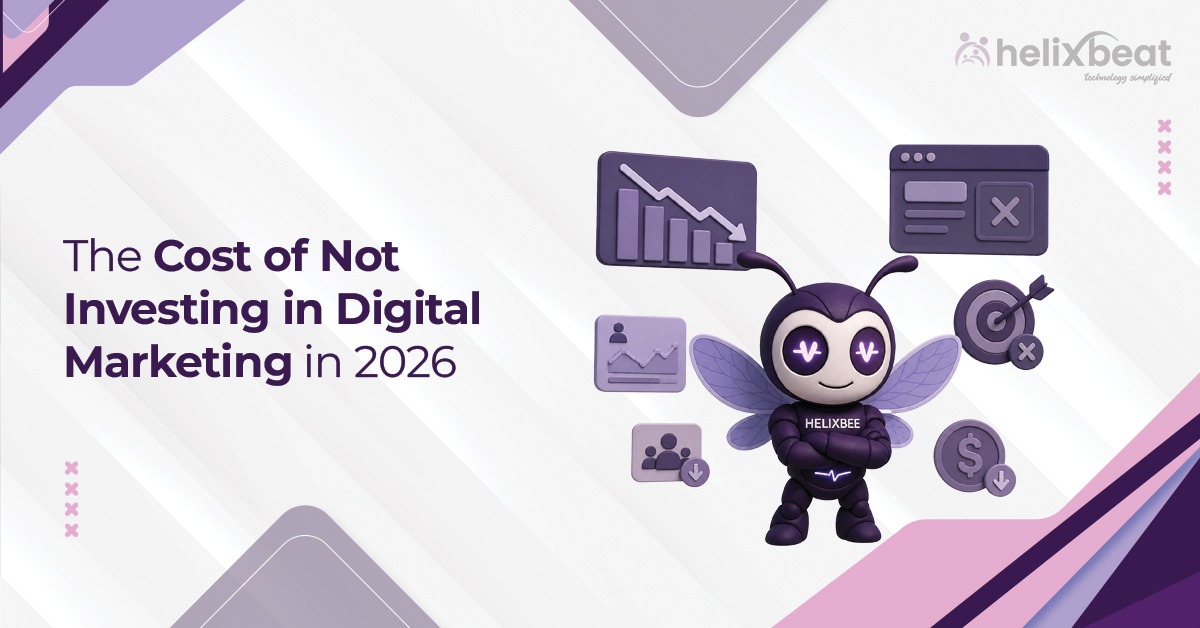
The Cost of Not Investing in Digital Marketing in 2026
Your competitor just closed a deal with a client who found them through Google. That client searched for exactly what your business offers. Your website did not show up. Your competitor’s did.
Digital marketing ROI is not just about what you gain when you invest. It is also about what you lose every month you do not.
In 2026, the cost of inaction is no longer theoretical. It is measurable, and for most businesses, it is significant.
Table of Contents
Why Businesses Still Hesitate
Most businesses that avoid digital marketing investment fall into one of three camps:
- They tried it once, saw no immediate results, and stopped
- They believe their industry runs on referrals and word of mouth
- They see it as a cost, not an investment
All three positions share the same flaw — they treat digital marketing return on investment as unpredictable. In reality, when campaigns are built correctly and tracked properly, digital marketing ROI is one of the most measurable returns in any small business budget.
The businesses that hesitate are not saving money. They are handing pipeline to competitors who are willing to show up where buyers are looking.
What the Numbers Actually Show
The data on digital marketing ROI is consistent across industries and company sizes.
- Email marketing delivers an average return of $36 for every $1 spent, making it one of the highest-performing channels for average ROI for digital marketing
- SEO generates over 1,000% more traffic than organic social media, according to BrightEdge research
- Businesses that blog consistently generate 67% more leads per month than those that do not, per HubSpot
- Google Ads delivers an average of $2 in revenue for every $1 spent, with top-performing campaigns reaching significantly higher
- Companies using data-driven marketing strategies are six times more likely to be profitable year over year, according to Forbes
These are not best-case outcomes. These are averages. The digital marketing return on investment available to most businesses is being left on the table simply because investment never started.
The Hidden Costs of Not Investing
Not investing in digital marketing does not mean spending zero. It means paying a different kind of cost — one that rarely appears on a balance sheet but accumulates every quarter.
Lost organic visibility
Search rankings take months to build. Every month without SEO investment is a month your competitors are compounding their authority while your domain stays stagnant. Catching up later costs more and takes longer.
Shrinking referral reliability
Referral pipelines are finite and unpredictable. As buyer behaviour shifts online, even traditionally referral-heavy industries — legal, consulting, construction — are losing business to competitors with stronger digital presence.
Higher customer acquisition costs later
Paid media ROI improves significantly with historical data. Accounts with six to twelve months of campaign data convert at lower cost per lead because the algorithm has learned what works. Starting from zero later means paying higher CPCs and CPAs while competitors benefit from optimised, seasoned accounts.
Brand invisibility at the decision moment
Most B2B buyers shortlist vendors before making first contact. If your business is not appearing in search results, industry content, or social feeds during the research phase, you are not being considered — regardless of how good your product or service is.
Where Digital Marketing ROI Is Highest in 2026
Not all channels deliver equal returns. Understanding where best ROI digital marketing comes from helps businesses prioritise spend and avoid wasted budget.
SEO and content marketing
The best ROI digital marketing channel for long-term, compounding growth. Content published today continues generating traffic and leads for years. A well-optimised blog post can deliver hundreds of qualified visits monthly at near-zero marginal cost. For businesses with longer sales cycles, organic content also builds the trust that converts cold prospects into buyers.
Email marketing
Consistently delivers the highest average ROI for digital marketing across industries. Low cost, high control, and direct access to an audience that has already expressed interest. Automated sequences — welcome flows, nurture campaigns, re-engagement emails — generate revenue without ongoing manual effort.
Performance marketing
Paid media ROI has improved significantly with AI-powered bidding, audience targeting, and creative testing tools. Google Ads, Meta Ads, and LinkedIn Ads now offer more precise targeting than ever. Businesses that invest in performance marketing ROI tracking — cost per lead, cost per acquisition, revenue per campaign — can optimise in real time and scale what works. For businesses that understand how to read the data, performance marketing is the fastest path to measurable, predictable pipeline.
Content marketing
Content marketing costs 62% less than traditional marketing and generates approximately three times as many leads, according to Demand Metric. For businesses that want sustainable digital marketing ROI without dependence on paid spend, content marketing builds the organic authority that keeps working long after a campaign ends.
The Compounding Disadvantage
Digital marketing ROI is not linear. It compounds.
A business that invests consistently over twelve months does not just have twelve months of results. It has domain authority built on hundreds of indexed pages, ad accounts seasoned with conversion data, email lists warmed through consistent communication, and a brand that buyers recognise before they ever reach out.
A business that starts investing in month thirteen is not one month behind. It is twelve months of compounding behind.
Performance marketing ROI improves as accounts mature. SEO gains accelerate as domain authority rises. Email revenue grows as lists scale and sequences are refined. Every month of inaction widens the gap between you and competitors who started earlier.
According to HubSpot’s State of Marketing Report, companies with documented marketing strategies are 313% more likely to report success than those without one. Strategy alone — not just spend — is a significant multiplier on digital marketing return on investment.
What Measuring Digital Marketing ROI Actually Requires
One reason businesses undervalue digital marketing is that they measure it incorrectly — or not at all.
Tracking digital marketing ROI properly means going beyond impressions and clicks. The metrics that matter are:
- Cost per lead (CPL): What does it cost to generate one qualified enquiry?
- Cost per acquisition (CPA): What does it cost to convert a lead into a paying customer?
- Customer lifetime value (CLV): How much revenue does an acquired customer generate over time?
- Return on ad spend (ROAS): For every rupee or dollar spent on paid media, how much revenue is returned?
- Organic traffic value: What would it cost to replicate organic search traffic through paid channels?
Businesses that track these metrics consistently make better decisions, eliminate wasted spend faster, and achieve higher average ROI for digital marketing over time. According to Google’s Think with Google, brands that use measurement frameworks across their full marketing funnel are twice as likely to exceed their revenue goals.
What Helixbeat Tracks for Every Client
Helixbeat’s approach to digital marketing ROI starts with measurement infrastructure before a single campaign goes live. Every engagement includes:
- Goal and KPI definition aligned to business outcomes
- Conversion tracking across paid and organic channels
- Monthly reporting on CPL, CPA, ROAS, and pipeline contribution
- Campaign optimisation based on performance data, not assumptions
Paid media ROI is tracked at the campaign, ad set, and creative level — so budget is continuously shifted toward what converts and away from what does not. For businesses that have never had this visibility before, the reporting alone changes how marketing decisions are made.
The Decision Has a Cost Either Way
Most businesses frame the digital marketing investment decision as: spend money, or save money.
The correct frame is: invest now at a known cost, or pay later at a higher cost with a larger gap to close.
In 2026, with AI-driven search changing how buyers find vendors, with paid media becoming more competitive, and with organic authority taking longer to build, the cost of waiting is higher than it has ever been.
Digital marketing ROI is not guaranteed by spending alone. It is built through strategy, consistency, and measurement. But for businesses willing to invest in all three, the return is both measurable and compounding.
The businesses winning right now started earlier. The question is whether you start today, or hand another quarter to competitors who already did.
Ready to Know What Your Marketing Is Actually Returning?
If you cannot answer what your current cost per lead is, or what your best-performing channel generated last quarter, your marketing is not being measured — and unmeasured marketing is unoptimised marketing.
Talk to the Helixbeat team about building a digital marketing strategy that tracks what matters, cuts what does not, and compounds over time.
See how Helixbeat builds measurable digital marketing ROI for growing businesses.
FAQs
What is a good digital marketing ROI?
A good digital marketing ROI varies by channel. Email marketing typically averages $36 return per $1 spent. Google Ads averages around 200%. SEO, measured over time, often delivers the highest long-term returns. A healthy benchmark is a 5:1 revenue-to-spend ratio across paid channels.
How long does it take to see digital marketing return on investment?
Paid channels like Google Ads and Meta Ads can show returns within weeks. SEO typically takes three to six months to show meaningful movement. Content marketing compounds over twelve to twenty-four months. The timeline depends on channel mix, budget, and how well campaigns are structured from the start.
What is the average ROI for digital marketing across industries?
The average ROI for digital marketing varies by industry and channel. Email marketing leads at approximately 3,600% ROI. SEO and content marketing deliver strong long-term returns. Paid media ROI averages 200% on Google Ads but varies significantly based on targeting, industry, and landing page quality.
What affects performance marketing ROI the most?
Performance marketing ROI is most affected by audience targeting precision, landing page conversion rate, offer clarity, and campaign data maturity. Accounts with longer histories and more conversion data consistently outperform newer accounts, which is why starting earlier gives a compounding advantage.
Is paid media ROI trackable in real time?
Yes. Platforms like Google Ads, Meta Ads Manager, and LinkedIn Campaign Manager provide real-time data on impressions, clicks, conversions, and spend. When properly connected to CRM and analytics tools, paid media ROI can be tracked from first click through to closed revenue.