

What if the way enterprises handled data five years ago is already outdated today?
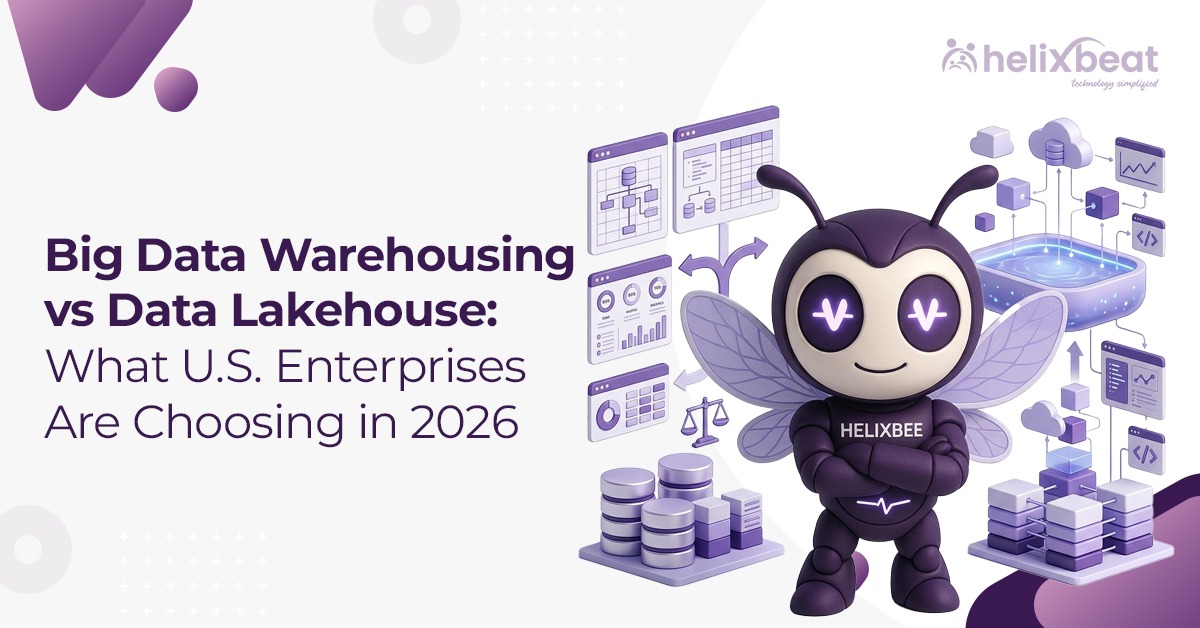
In 2026, big data warehousing is undergoing a major transformation as U.S. enterprises rethink how they store, process, and analyze massive datasets at scale. With the rise of hybrid models and AI driven insights, traditional big data warehousing approaches are now being compared with modern lakehouse architectures for greater flexibility and performance.
At the same time, platforms like Helixbeat DWaaS are redefining how organizations approach big data warehouse and analytics modernization. This shift is not just about technology. It reflects a broader change in speed, agility, and competitiveness in a data first economy where big data warehousing plays a central strategic role.
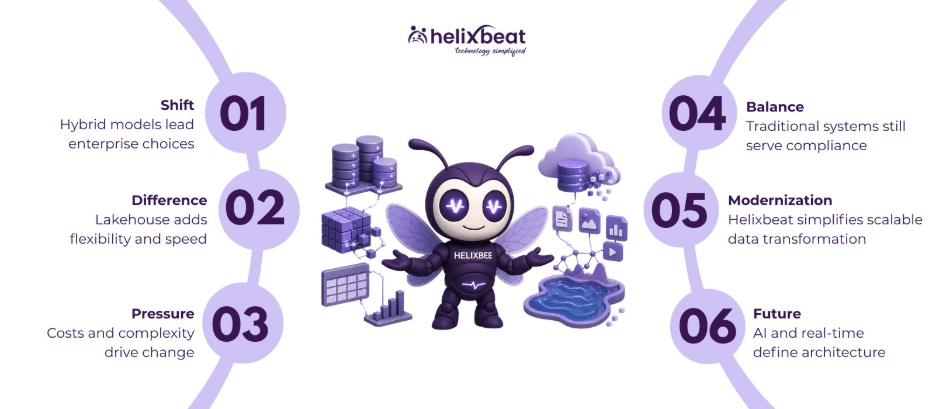
Table of Contents
What Is the Actual Difference Between Big Data Warehousing and Data Lakehouse?
Understanding the core difference helps enterprises make smarter infrastructure decisions. It also explains why many organizations are rethinking long-established systems in modern data architecture planning.
Big Data Warehousing vs Data Lakehouse: A Clear Comparison
| Feature | Big Data Warehousing | Data Lakehouse |
| Data Type | Structured data | Structured, semi structured, unstructured |
| Schema Approach | Schema on write | Schema on read and write |
| Cost Structure | Higher due to duplication | More optimized and flexible |
| Flexibility | Limited | High flexibility |
| Processing Style | Batch processing | Batch and real time processing |
| AI and ML Support | Limited | Strong support |
Why This Difference Matters in Real Use Cases
Traditional database and data warehouse systems were designed primarily for structured reporting, which works well in controlled enterprise environments. However, modern organizations now handle diverse and high velocity data sources from applications, sensors, and digital platforms.
Lakehouse architectures reduce rigidity by enabling raw data ingestion and flexible processing. This makes them more suitable for AI driven applications and real time decision making compared to traditional big data warehousing models.
What Are U.S. Enterprises Choosing in 2026?
U.S. enterprises are no longer committed to a single architecture. Instead, they are adopting hybrid strategies that combine stability and innovation in their database and data warehouse ecosystems.
A Shift Toward Hybrid Data Systems
Most organizations are not fully replacing big data warehousing systems. Instead, they are integrating them with lakehouse models to achieve both governance and advanced analytics capability.
This hybrid approach strengthens big data warehouse and analytics capabilities while supporting AI driven workloads and real time insights.
Industry Wise Adoption Trends
Different industries are evolving at different speeds based on compliance, scalability, and innovation needs:
- Banking and finance continue to rely on big data warehousing due to strict regulatory frameworks
- Healthcare uses hybrid systems for patient insights and compliance reporting
- Retail and e commerce are rapidly adopting lakehouse models for personalization and forecasting
- Technology companies are leading modern building the data warehouse transformations at scale
Why Cloud Is Driving This Change
Cloud adoption has completely reshaped how enterprises design database and data warehouse systems. On premise infrastructure is being replaced by scalable cloud native platforms.
This shift allows organizations to:
- Scale faster
- Reduce operational overhead
- Improve performance of big data warehouse and analytics workloads
Why Are Enterprises Moving Toward Lakehouse Models?
This transformation is driven by practical limitations in traditional systems and increasing business demands.
1. Explosion of Data Sources
Enterprises now collect data from applications, IoT devices, websites, and customer interactions. Managing this complexity with isolated systems creates inefficiencies in big data warehousing environments.
2. Need for Unified Data Access
Multiple disconnected systems create data silos across teams. Lakehouse platforms unify access and improve collaboration across analytics and operations teams.
3. Cost Efficiency Pressure
Maintaining separate storage and processing layers increases infrastructure costs. Lakehouse models reduce duplication and optimize building the data warehouse strategies for modern enterprises.
4. Demand for AI and Real Time Insights
AI driven applications require access to both raw and processed data simultaneously. Modern architectures improve big data warehouse and analytics performance for predictive use cases.
5. Faster Decision Making
Today’s enterprises cannot rely on delayed batch reports. Real time insights are essential for competitive advantage in dynamic markets.
Is It Time for Enterprises to Move Away from Traditional Big Data Warehousing?
This is a complex question because the answer depends on business requirements rather than technology trends alone.
Limitations of Traditional Systems
Many organizations still rely on big data warehousing, but they often face operational constraints such as:
- Rigid data models that slow down innovation
- High maintenance costs across infrastructure
- Difficulty integrating with modern analytics tools and cloud platforms
These challenges highlight why legacy database and data warehouse systems are increasingly being reassessed in modern enterprise environments.
Where Big Data Warehousing Still Works Best
Despite its limitations, traditional big data warehousing continues to play a critical role in structured enterprise operations, especially in regulated industries.
Key use cases include:
- Financial reporting and audits
- Compliance-heavy environments
- Historical data storage and analysis
In these scenarios, stability and governance remain more important than flexibility in data warehouse technology.
The Smarter Approach Today
Instead of replacing systems entirely, enterprises are evolving them through hybrid strategies that enhance existing infrastructure.
Modern organizations are improving building the data warehouse practices by integrating cloud-native capabilities, AI readiness, and real-time processing layers.
This balanced approach allows businesses to maintain system stability while gradually adopting innovation in big data warehouse and analytics capabilities.
How Does Helixbeat DWaaS Fit into This Transformation?
Helixbeat DWaaS is designed for enterprises transitioning between traditional architectures and modern cloud-native ecosystems.
A Unified Data Platform
Helixbeat DWaaS combines big data warehousing and lakehouse capabilities into a single unified platform.
This eliminates the need for multiple disconnected systems and simplifies enterprise data architecture across database and data warehouse environments.
Simplifying Enterprise Data Management
Complex infrastructure often slows down innovation and increases operational overhead.
Helixbeat streamlines building the data warehouse process by providing managed, scalable infrastructure that reduces complexity and improves efficiency.
Advanced Analytics Capabilities
Helixbeat DWaaS supports modern big data warehouse and analytics workloads, including:
- Artificial intelligence
- Machine learning pipelines
- Predictive analytics
This enables enterprises to move from descriptive reporting to intelligent decision systems.
Seamless Integration Across Systems
Helixbeat connects multiple database and data warehouse environments, ensuring smooth data flow across departments, applications, and analytics platforms.
This improves interoperability and reduces data silos.
Scalable for Enterprise Growth
As data volumes increase, scalability becomes critical.
Helixbeat ensures consistent performance even as big data warehousing demands grow across enterprise ecosystems.
Future-Ready Architecture
The platform aligns with modern trends in data warehouse technology, including:
- Real-time analytics
- Cloud-first adoption
- AI-driven decision systems
If you are planning long-term data transformation, Helixbeat DWaaS helps you modernize your big data warehouse and analytics ecosystem without operational disruption.
What Does the Future Hold for Data Architectures?
The future of enterprise data systems is not about choosing one model over another but about building adaptable, intelligent ecosystems.
Lakehouse Becoming the Default Choice
Lakehouse architectures are emerging as the preferred model due to their flexibility in handling both structured and unstructured data.
Evolution of Big Data Warehousing
Traditional big data warehousing will not disappear. Instead, it will evolve and integrate with modern cloud and AI-driven systems.
Rise of Unified Platforms
Enterprises are moving toward platforms that combine storage, analytics, and AI within a single data warehouse technology ecosystem.
AI-Driven Data Ecosystems
Artificial intelligence is becoming central to how organizations manage database and data warehouse systems, enabling predictive insights and automation.
Real-Time Everything
Real-time analytics is no longer optional. It is becoming a baseline requirement for modern big data warehouse and analytics systems.
Wrapping Up
The shift from traditional big data warehousing to lakehouse-driven architectures is not a replacement story, but an evolution driven by scalability, intelligence, and speed.
Key Takeaways
- Hybrid architectures are becoming the standard for U.S. enterprises
- Lakehouse models are leading innovation in AI and real-time analytics
- Traditional systems still support regulated and structured workloads
- Modern data warehouse technology is focused on flexibility and intelligence
As enterprises rethink their strategy, upgrading building the data warehouse practices becomes essential for staying competitive.
FAQs
1. What is the main difference between big data warehousing and data lakehouse?
Big data warehousing focuses on structured data and predefined models, while lakehouses support multiple data types and flexible processing.
2. Are enterprises fully replacing big data warehousing in 2026?
No, most enterprises are using a hybrid approach that combines both architectures.
3. Why are lakehouse models becoming popular?
They offer flexibility, lower cost, and better support for AI and real-time analytics.
4. What role does Helixbeat DWaaS play in modern data systems?
It simplifies building and managing modern data infrastructure while supporting advanced analytics and scalable data warehouse technology.