

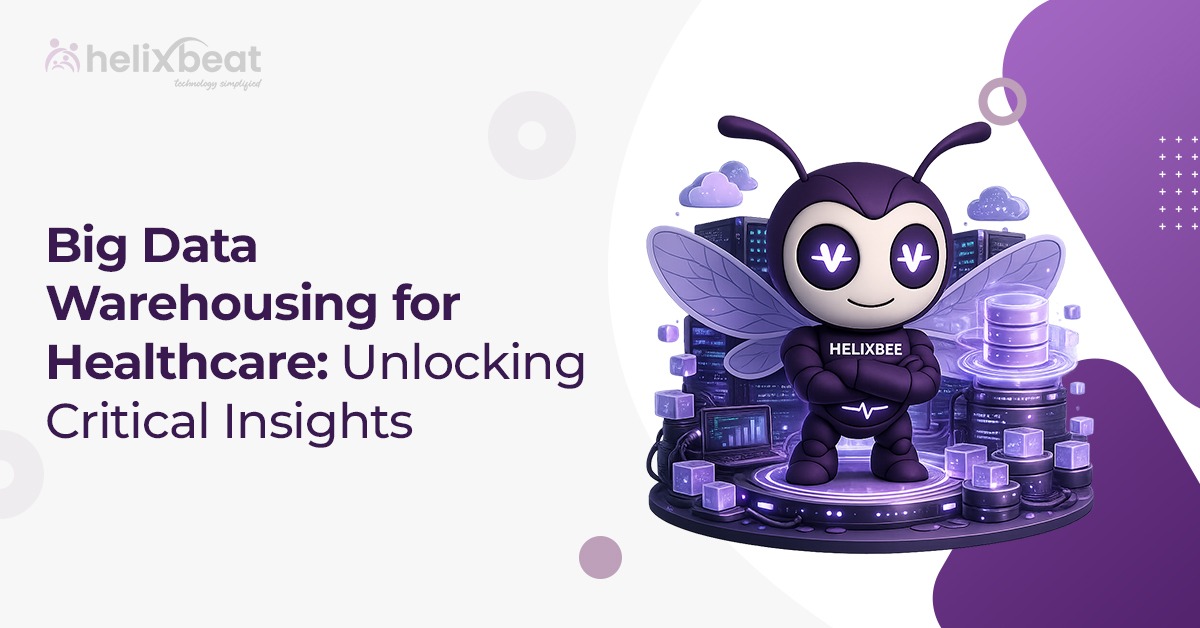
The exponential growth of patient data has made it increasingly difficult for hospitals to unify and process information efficiently, often leaving vital insights untapped. Big data warehousing is changing this landscape by integrating massive, fragmented datasets into a single, actionable system. With solutions like those offered by Helixbeat, healthcare organizations can now transform raw data into meaningful intelligence, enhancing patient outcomes, streamlining operations, and enabling data-driven care that is more accurate, timely, and impactful than ever before.
Table of Contents
Why Healthcare Data Feels Overwhelming—and How Big Data Warehousing Solves It
Healthcare organizations are sitting on an enormous volume of data, yet much of it remains underutilized. The challenge is not the quantity of data—it’s the difficulty in managing, interpreting, and deriving actionable insights from it.
The Growing Data Complexity in Healthcare
Every touchpoint within a healthcare system generates data. From patient consultations and lab results to imaging scans and wearable devices, the volume continues to expand rapidly. Beyond the sheer size, the diversity of this data makes it even more complex:
- Structured data: Electronic health records (EHRs), billing information
- Unstructured data: Doctor notes, medical images
- Semi-structured data: Outputs from IoT and wearable devices
This fragmented nature makes it challenging for healthcare providers to gain a unified view of patient information, which is crucial for accurate diagnosis and timely treatment.
How Big Data Warehousing Brings Clarity
Big data warehousing solutions act as centralized repositories, integrating, cleaning, and storing all types of healthcare data. This creates a single source of truth, allowing providers to make informed decisions without delays.
With data warehousing in big data:
- Data becomes easily searchable and accessible
- Insights are generated more efficiently
- Clinical and operational decision-making improves significantly
As a result, healthcare providers can shift from reactive care to proactive and anticipatory healthcare management.
How Delayed Insights Can Affect Patient Care—and How Real-Time Warehousing Fixes It
In healthcare, timing is critical. Delayed insights can lead to postponed diagnoses, inappropriate treatments, or complications in emergency situations. Traditional systems often rely on batch processing, which updates data at intervals rather than in real time.
This leads to:
- Limited access to the latest patient information for doctors
- Decisions made with incomplete or outdated data
- Reporting and analysis delays
Real-time big data warehousing addresses these challenges by ensuring continuous data flow and instant processing. This enables:
- Immediate access to updated patient records
- Real-time alerts for critical conditions
- Faster clinical decision-making and response
Hospitals leveraging real-time analytics with integrated big data and data warehouse systems have observed improvements in responsiveness and overall patient care.
Why Big Data and Data Warehouse Integration is Essential in Modern Healthcare
Healthcare today is not only about treating illnesses but also about predicting and preventing them. The integration of big data and data warehouse solutions makes this possible, enabling advanced analytics that drives proactive care.
Key capabilities include:
- Predictive Analytics: By analyzing historical and current data, providers can identify patterns and anticipate health risks before they escalate.
- Population Health Management: Hospitals can monitor trends across patient groups, supporting better public health planning and resource allocation.
- Personalized Treatment Plans: Insights derived from integrated data allow doctors to tailor care based on patient history, genetics, and lifestyle.
Data-Driven Healthcare Outcomes
| Use Case | Impact with Data Warehousing and Big Data Analytics |
| Disease Prediction | Early detection supports timely interventions and improved outcomes |
| Patient Monitoring | Real-time alerts help reduce critical incidents and enhance patient safety |
| Resource Allocation | Optimizes staffing, equipment use, and operational efficiency |
| Clinical Research | Streamlined data access accelerates research and discovery |
By combining data warehousing and big data analytics, healthcare organizations can make decisions that are not just reactive but strategic, ensuring care that is timely, precise, and patient-centric.
Why Data Accuracy and Compliance Remain the Biggest Concerns in Healthcare Analytics
While the benefits of big data warehousing in healthcare are immense, organizations must address critical challenges related to data accuracy, security, and regulatory compliance to ensure safe and effective care.
Challenges Faced
Healthcare data must be:
- Accurate and consistent to support precise diagnoses and treatment plans
- Secure and confidential to protect patient privacy
- Compliant with regulations to meet legal and ethical standards
Even minor inaccuracies can result in incorrect clinical decisions, while breaches can have serious consequences for both patients and providers.
How Big Data Warehousing Addresses These
Modern big data data warehouse solutions are specifically designed to meet these challenges.
Centralized Data Governance
A unified system ensures data is standardized and consistent across all departments, eliminating discrepancies and enhancing reliability.
Advanced Security Measures
Encryption, role-based access, and continuous monitoring protect sensitive patient data from unauthorized access, ensuring confidentiality.
Regulatory Compliance
Built-in compliance frameworks help healthcare organizations adhere to national and global standards, minimizing legal and operational risks.
By addressing these concerns, data warehousing in big data builds trust among healthcare providers, patients, and stakeholders.
How Big Data Warehousing Improves Operational Efficiency Across Hospitals
Beyond clinical benefits, big data warehousing plays a critical role in optimizing hospital operations.
Key Operational Challenges
Hospitals often face:
- Inefficient workflows
- Long patient wait times
- Administrative bottlenecks
- Resource mismanagement
These issues increase operational costs and can negatively affect patient satisfaction.
Efficiency Gains with Data Warehousing
| Area | Without Data Warehousing | With Big Data Warehousing |
| Patient Data Access | Fragmented | Unified and instant |
| Reporting Time | Hours to days | Real-time |
| Resource Utilization | Inefficient | Optimized |
| Decision Making | Reactive | Predictive and proactive |
How It Transforms Operations
With big data and data warehouse systems in place:
- Staff can access patient data instantly
- Administrative tasks are streamlined and automated
- Resources are allocated based on real-time demand
These improvements lead to faster service delivery, reduced costs, and enhanced patient experiences.
Why Healthcare Leaders Are Turning to Helixbeat for Big Data Warehousing
Choosing the right technology partner is crucial for successfully implementing big data warehousing in healthcare.
How Helixbeat Stands Out
At Helixbeat, we understand the unique challenges of healthcare data. Our solutions handle complex datasets while ensuring security, scalability, and compliance.
What We Deliver
- End-to-end big data warehousing solutions
- Seamless integration with existing healthcare systems
- Real-time analytics dashboards
- AI-driven insights for smarter decision-making
Real Impact We Create
Our approach focuses on measurable outcomes:
- Faster reporting and analysis
- Improved clinical decision-making
- Enhanced patient care through actionable insights
We don’t just provide technology—we enable transformation.
What the Future Holds for Data Warehousing and Big Data Analytics in Healthcare
Healthcare is becoming increasingly data-driven, and organizations that embrace this transformation will lead in patient care and operational excellence.
Emerging Trends to Watch
- AI-Driven Diagnostics: Combining artificial intelligence with big data warehousing enables faster, more accurate diagnoses.
- Cloud-Based Data Warehousing: Cloud platforms provide scalability, flexibility, and cost efficiency, making advanced analytics accessible to more providers.
- Interoperability: Seamless data exchange between systems eliminates silos and enhances collaboration across healthcare networks.
The Road Ahead
As healthcare data continues to grow, big data data warehouse solutions will become even more vital. Predictive analytics, automation, and real-time insights will guide clinical decisions, resource management, and innovation.
Organizations investing in data warehousing and big data analytics today will be better equipped to:
- Improve patient outcomes
- Reduce operational costs
- Drive healthcare innovation
Wrapping Up
Big data warehousing is transforming healthcare by converting complex, fragmented data into actionable intelligence. With Helixbeat, organizations can make faster, more accurate decisions, improve operational efficiency, and enhance patient care. The future of healthcare relies on data, and those who leverage it effectively will lead the way.
Transform Your Healthcare Data into Actionable Insights Today – Connect with Helixbeat Now!
FAQs
1. What is big data warehousing in healthcare?
It is a system that stores and processes large healthcare datasets to generate insights for better decision-making and patient care.
2. How does data warehousing improve patient outcomes?
It enables real-time access to accurate data, helping doctors make faster and more informed treatment decisions.
3. What is the role of big data in healthcare analytics?
Big data provides large volumes of information that can be analyzed to identify patterns, predict diseases, and improve care delivery.
4. Is big data warehousing secure for healthcare organizations?
Yes, modern systems include advanced security features like encryption, access control, and compliance frameworks.
5. How does Helixbeat support healthcare data management?
We provide scalable, secure, and real-time big data warehousing solutions tailored to healthcare needs.
6. Can small healthcare providers use data warehousing?
Yes, cloud-based solutions make it affordable and scalable for small and medium-sized healthcare organizations.
7. What are the key benefits of data warehousing in big data?
Faster insights, improved efficiency, better decision-making, enhanced patient care, and reduced operational costs.