

Most businesses do not have a content problem. They have a relevance problem.
They publish blogs, social posts, videos, emails, landing pages, and case studies, but often without asking one simple question: What does the buyer need right now?
That is where stage-aligned content makes the difference.
Someone who has just discovered a problem needs education. A prospect comparing vendors needs evidence and clarity. A buyer ready to act needs proof, confidence, and a clear next step.
A strong content marketing funnel connects these needs so every asset has a purpose. For a full-service partner like HelixBeat, this approach fits naturally because its digital marketing offering combines SEO and SEM, content marketing, social media, performance marketing, email campaigns, website optimization, and analytics.
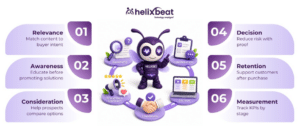
Table of Contents
What Is Buyer Journey Content?
Buyer journey content is content created around the questions, motivations, objections, and actions people have as they move from discovering a problem to evaluating solutions, making a purchase, and becoming a customer.
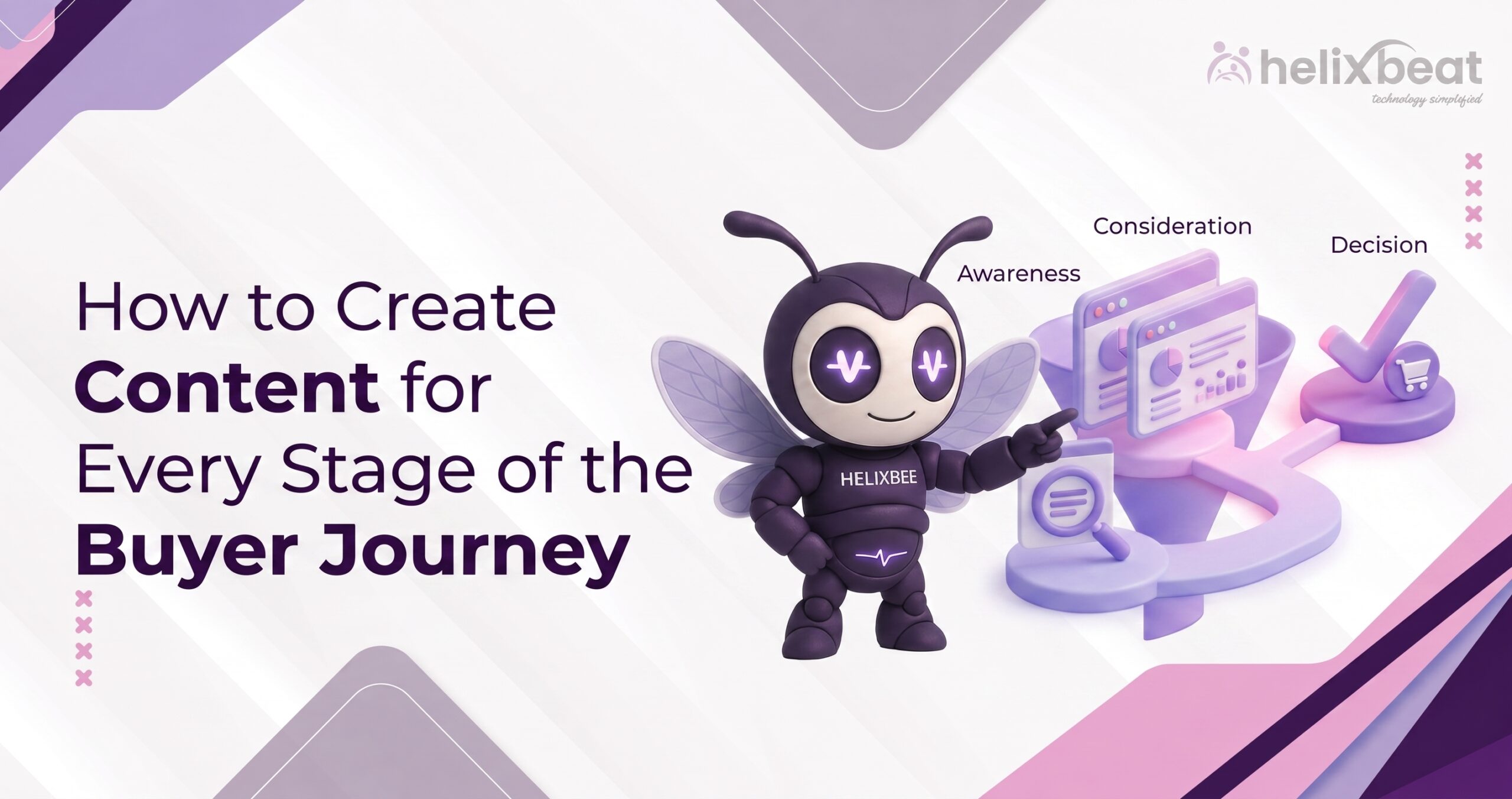
The journey is usually grouped into three core stages:
- Awareness: “I have a problem or goal.”
- Consideration: “What are my options?”
- Decision: “Which option should I choose?”
Modern journeys are rarely linear. A buyer may move between social media, Google, AI assistants, email, comparison pages, and sales conversations before converting.
That is why buyer journey mapping should focus on intent, not just the channel. The goal is to create the best next answer for the buyer.
Stage 1: Create Content for Awareness Stage Needs
At the awareness stage, buyers often know the symptom before they know the solution.
A marketing leader might search “why are website leads declining?” before searching for a digital marketing agency. The job of content for awareness stage audiences is therefore to educate, clarify, and build trust without pushing for an immediate sale.
Useful formats include educational blogs, beginner guides, checklists, short videos, infographics, research summaries, and “What is” or “Why” articles.
Your buyer journey content at this stage should target problem-aware questions and explain them clearly.
Make Awareness Content ASO-Friendly
Answer Search Optimization, or ASO, is increasingly used to describe strategies aimed at increasing visibility in answer-driven search experiences. However, the terminology around ASO, AEO, GEO, and AI search is still evolving. Google’s current guidance is simpler: foundational SEO practices remain relevant for AI Overviews and AI Mode.
Use question-based headings, concise definitions, short paragraphs, lists, descriptive subheads, and direct answers near the beginning of important sections.
Instead of a vague heading such as:
Understanding the Problem
Use:
Why Are Website Leads Declining?
Then answer the question immediately.
This makes buyer journey content easier for readers, search engines, and AI-powered discovery systems to interpret.
Google also recommends creating unique, useful, non-commodity content instead of producing large volumes of pages designed primarily around search variations.
Stage 2: Build Consideration Stage Content That Helps Buyers Compare
Once people understand the problem, their mindset changes.
Now they want to compare possible solutions.
Effective consideration stage content should answer questions about available approaches, advantages, disadvantages, features, costs, implementation, expected outcomes, and overall fit.
Useful formats include:
- Comparison articles
- Buyer guides
- Case studies
- Webinars
- Expert interviews
- Templates
- Service explainers
- ROI frameworks
At this stage, buyer journey content should not simply say what you offer. Explain who the solution is for, when it makes sense, what alternatives exist, and what results a buyer can reasonably expect.
This is also a strong internal-linking opportunity.
HelixBeat’s guide on buyer journey content and content marketing strategy discusses audience research, SEO-driven content creation, distribution, personalization, analytics, and mapping content types across the buyer journey.
Good mid-funnel content reduces research effort. If buyers have to leave your website to understand the basic differences between available solutions, you risk losing influence during the evaluation process.
Stage 3: Create Decision Stage Content That Removes Risk
At the decision stage, education matters less than confidence.
Buyers are now asking:
- Can this company solve my exact problem?
- What will implementation involve?
- What will it cost?
- What evidence proves the solution works?
- Why should I choose this company over another?
- What happens after I sign?
Strong decision stage content includes case studies, testimonials, demos, pricing information, ROI calculators, implementation guides, FAQs, service pages, and consultation offers.
Your buyer journey content here should reduce perceived risk.
Do not bury customer proof underneath generic marketing language. Put outcomes, process clarity, differentiators, evidence, and next steps where prospects can find them quickly.
A strong decision page can follow a simple flow:
Problem → Solution → Proof → Process → Objections → CTA
That is far more persuasive than repeatedly claiming that your business is “the best.”
Continue the Relationship with Customer Journey Marketing
The journey does not end when the purchase happens.
Effective post-purchase marketing supports onboarding, adoption, retention, cross-sell, renewal, and advocacy.
Post-purchase content can include welcome emails, onboarding checklists, tutorials, knowledge-base articles, usage tips, newsletters, and referral campaigns.
HelixBeat’s article on customer journey marketing and customer experience transformation looks at the broader customer journey through discovery, engagement, conversion, service, and loyalty.
The lesson is simple: marketing should continue creating value after the lead becomes a customer.
Use Buyer Journey Mapping Before You Build a Content Calendar
Do not begin with:
“We need four blogs this month.”
Begin with buyer journey mapping.
Create a simple matrix:
| Stage | Buyer Question | Best Content | Main CTA |
| Awareness | What is causing my problem? | Guide, blog, video | Learn more |
| Consideration | What solutions are available? | Comparison, webinar, case study | Explore solution |
| Decision | Why should I choose you? | Service page, demo, proof | Book a call |
| Retention | How do I get more value? | Tutorial, email, support content | Use, upgrade, refer |
This makes buyer journey content more strategic because every asset has a specific job.
It also exposes gaps.
You may discover that you have dozens of top-of-funnel blogs but only two case studies, no competitor comparisons, weak service pages, and very little customer education.
More content is not always the answer. Better coverage of buyer intent is.
Build a Content Marketing Funnel Around Intent
A good content marketing funnel does not require publishing everywhere. It requires continuity.
Imagine a B2B SaaS company selling workflow automation.
At the awareness stage, it publishes:
“7 Signs Manual Approval Processes Are Slowing Your Team.”
At consideration:
“Workflow Automation vs. Hiring More Operations Staff.”
At decision, it publishes a case study showing measurable outcomes, implementation details, integrations, and a demo CTA.
After purchase, it sends onboarding and adoption guides.
That sequence works because every asset answers the next question.
This is exactly what buyer journey content should do: move buyers forward without forcing them forward.
Add E-E-A-T Signals at Every Stage
Google recommends creating helpful, reliable, people-first content and suggests evaluating content using the questions of Who created it, How it was created, and Why it was created.
Importantly, Google also clarifies that E-E-A-T itself is not one specific ranking factor. Instead, its systems use multiple signals that can identify qualities associated with experience, expertise, authoritativeness, and trustworthiness.
Use E-E-A-T as a content quality framework.
Experience
Add real examples, first-hand lessons, original observations, screenshots, experiments, or practical workflows.
Expertise
Use qualified authors or reviewers, accurate terminology, detailed explanations, and subject-matter knowledge.
Authoritativeness
Build topical depth, connect related resources, reference reliable sources, and demonstrate consistent expertise around your core subjects.
Trust
Support important claims, show clear authorship, keep information updated, distinguish facts from opinions, and make commercial intent transparent.
For buyer journey content, these signals vary by stage.
Awareness needs accuracy and useful explanations.
Consideration needs balanced analysis.
Decision needs verifiable proof.
Post-purchase content needs dependable instructions.
Make Content Visible in Generative Search
AI-powered search is changing how buyers discover and evaluate brands.
Instead of thinking only about traditional rankings, marketers increasingly need to consider whether information about their brands can be understood, verified, and surfaced in generated answers.
Google’s 2026 guidance states that its generative search experiences continue to rely on core Search ranking and quality systems. It recommends strong SEO foundations, crawlable pages, unique content, good page experiences, and information that genuinely helps users.
If your team uses Generative Search Intelligence or GSI-style measurement, the objective should be to understand how consistently your brand and content appear within AI-generated answers rather than chasing unsupported optimization “hacks.” GSI is one emerging framework used to measure AI citation performance rather than a Google-defined ranking system.
For stronger generative-search visibility:
- Answer important questions directly.
- Use consistent brand, product, and service descriptions.
- Add original evidence and first-hand insights.
- Structure comparisons clearly.
- Keep claims specific and verifiable.
- Cite authoritative sources.
- Build meaningful internal links.
- Update outdated examples and statistics.
- Make important content crawlable and indexable.
This gives buyer journey content a stronger foundation across both traditional search and answer-driven discovery.
Match KPIs to Each Stage
One of the biggest measurement mistakes is expecting every article to produce an immediate lead.
Each stage has a different job.
For content for awareness stage campaigns, monitor:
- Search impressions
- Organic reach
- New users
- Engagement
- Video views
- Assisted conversions
For consideration stage content, measure:
- Return visits
- Content downloads
- Webinar registrations
- Email signups
- Case study engagement
- Visits to high-intent pages
For decision stage content, focus on:
- Demo requests
- Consultation bookings
- Qualified leads
- Conversion rates
- Sales opportunities
- Revenue influence
For customer journey marketing, monitor adoption, retention, repeat engagement, referrals, expansion, and customer lifetime value.
When metrics match intent, it becomes much easier to understand what content is actually working.
How HelixBeat Can Build a Full-Funnel Content System
Creating isolated content assets is relatively easy.
Connecting them into one measurable growth system is harder.
HelixBeat combines content marketing with SEO, SEM, paid media, social media, email marketing, website optimization, and performance analytics. Its content services include blogs, website content, e-books, social media posts, case studies, and content performance analysis.
A strong buyer journey content strategy can therefore connect content creation with distribution, search visibility, lead generation, nurturing, conversion, and performance measurement.
Instead of asking:
“What should we post next?”
Ask:
What is the buyer trying to solve?
What information do they need next?
Which format will answer that question best?
What proof will increase confidence?
What action should follow?
Those questions turn content production into a growth system.
Final Takeaway
The best content does not try to sell at every stage.
It earns the right to sell.
Awareness creates understanding.
Consideration builds preference.
Decision reduces doubt.
Post-purchase content strengthens the relationship.
When these stages work together, buyer journey content becomes the connective tissue between SEO, AI search, social media, email, paid campaigns, sales, and customer experience.
Start with real buyer questions. Map intent. Add expert evidence and first-hand value. Structure answers for both people and modern search systems. Then measure whether every asset is accomplishing the job it was created to do.
That is how buyer journey content turns attention into trust—and trust into sustainable growth.
FAQs
- What is buyer journey content?
Buyer journey content is content designed to answer customer needs at the awareness, consideration, decision, and post-purchase stages.
- Why is buyer journey mapping important?
Buyer journey mapping helps businesses understand customer questions, pain points, and content needs at each stage of the buying process.
- What content works best for the awareness stage?
Effective content for awareness stage audiences includes educational blogs, guides, videos, infographics, and problem-solving articles.
- What is consideration stage content?
Consideration stage content helps prospects compare solutions through case studies, comparison guides, webinars, reviews, and detailed service information.
- What type of content works at the decision stage?
Effective decision stage content includes testimonials, case studies, demos, pricing information, FAQs, and strong service or product pages.