

Accurate financial workflows are critical for maintaining efficient healthcare operations. When healthcare providers use the right payment systems, insurance claims move faster; reimbursements arrive on time, and patient collections become easier to manage.
However, even small billing inefficiencies, such as delayed payment processing, disconnected billing systems, or limited insurance integration, can lead to administrative overload, slower cash flow, and patient dissatisfaction.
In an industry governed by strict compliance requirements and complex reimbursement structures, healthcare organizations need more than standard payment processors.
They require specialized healthcare payment solutions designed specifically for medical workflows. This is why many healthcare providers in 2026 are actively exploring secure, scalable, and healthcare-focused alternatives to Stripe.
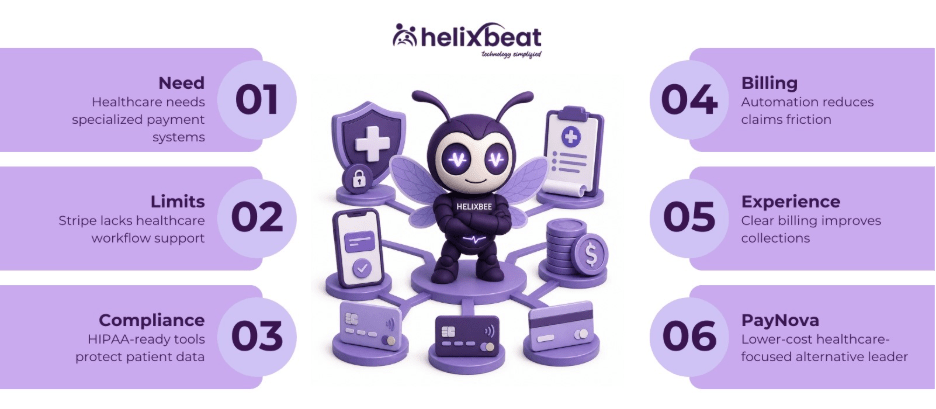
Table of Contents
Why Do Medical Businesses Look for a Stripe Alternative?
Stripe is one of the most widely used payment platforms in the world, especially for eCommerce and SaaS businesses. While it offers flexible APIs and online payment capabilities, healthcare organizations operate in a much more regulated and operationally complex environment.
One of the main reasons providers seek Stripe alternatives for healthcare is compliance. Medical organizations handle highly sensitive patient and financial data every day. A generic payment system may not fully support healthcare-specific security and regulatory workflows. Providers need a secure HIPAA compliant payment gateway that helps maintain compliance while protecting patient information.
Healthcare billing is also significantly more complicated than standard online payments. Providers manage insurance reimbursements, co-pays, deductibles, recurring treatment plans, and out-of-network billing regularly. Without specialized systems, these processes can become time-consuming and error-prone. Modern healthcare payment solutions simplify these workflows through automation and integrated healthcare billing support.
Another challenge is patient payment experience. Patients today expect transparent invoices, digital payment options, and flexible payment plans. Advanced patient billing software helps healthcare providers reduce confusion, improve communication, and increase successful payment collections.
Pricing is another important factor. Stripe charges 2.9% + 30¢ per transaction, which can become expensive for healthcare organizations handling large payment volumes. Healthcare-focused platforms like PayNova provide optimized pricing structures specifically designed for medical businesses.
The rapid growth of telehealth has also increased demand for secure medical payment processing systems that support virtual care, online consultations, recurring subscriptions, and digital healthcare services.
Top Stripe Alternatives for Healthcare Payment Solutions
1. PayNova Healthcare Payments
PayNova Healthcare Payments is emerging as one of the strongest Stripe alternatives for healthcare in 2026. Unlike general-purpose payment gateways, PayNova is specifically built for healthcare organizations and medical payment workflows.
PayNova provides modern healthcare payment solutions that help clinics, hospitals, and telehealth providers simplify billing, improve collections, and automate payment management.
One of its biggest advantages is healthcare-focused pricing. While Stripe charges 2.9% + 30¢ per transaction, PayNova offers healthcare businesses lower transaction costs with pricing starting at 2.60% + $0.10 per transaction. This makes a significant difference for providers handling large transaction volumes.
PayNova also operates as a secure HIPAA compliant payment gateway, helping healthcare organizations maintain compliance while protecting patient financial information.
The platform includes:
- Secure patient payment portals
- Automated payment reminders
- Insurance claims coordination
- Flexible recurring payment plans
- Digital wallet support
- EHR and PMS integrations
- Real-time analytics and reporting
For organizations struggling with delayed reimbursements and manual administrative work, PayNova offers advanced medical payment processing that improves efficiency while reducing billing complexity.
Its intelligent patient billing software also improves transparency for patients, helping providers reduce disputes and increase successful payment collections.
Stripe vs PayNova Comparison
| Feature | Stripe | PayNova |
| Industry Focus | General businesses, SaaS, eCommerce | Specialized for healthcare providers |
| Transaction Fees | 2.9% + 30¢ per transaction | 2.60% + $0.10 per transaction |
| HIPAA Compliance | Limited healthcare-specific workflow support | Built as a healthcare-focused HIPAA-ready platform |
| Best For | Online stores and generic businesses | Hospitals, clinics, telehealth, medical providers |
| Insurance Verification | Not healthcare-native | Integrated insurance verification support |
| Claims Handling | Requires third-party integrations | Supports healthcare claims workflows |
| EHR/PMS Integration | Limited custom integrations | Healthcare system integrations supported |
| Patient Payment Plans | Requires customization | Built-in recurring and installment payment support |
| Patient Billing Experience | Generic invoicing | Advanced healthcare-focused patient billing |
| Digital Wallet Support | Yes | Yes |
| ACH Payments | Supported | Supported with healthcare workflows |
| Telehealth Payment Support | Possible with setup | Designed for telehealth and virtual care |
| Recurring Billing | Yes | Yes, optimized for medical subscriptions and payment plans |
| Compliance Support | PCI-DSS | HIPAA + PCI-DSS focused |
| Revenue Cycle Management | Limited | Healthcare revenue cycle support |
| Fraud Protection | Standard fraud tools | Healthcare-focused security and fraud protection |
| Reporting & Analytics | General business analytics | Healthcare financial reporting and reimbursement insights |
| Administrative Automation | General automation | Billing and payment workflow automation for healthcare |
| Transparent Healthcare Pricing | Not healthcare-specific | Designed for healthcare pricing transparency |
| Main Advantage | Developer-friendly APIs | Healthcare-specific payment ecosystem |
2. InstaMed
InstaMed is a leading healthcare payment platform widely used by hospitals and enterprise healthcare systems.
The platform specializes in secure healthcare payment solutions and payer-provider transaction management. InstaMed simplifies digital billing and patient collections while supporting insurance reimbursement workflows.
Many providers consider InstaMed among the top Stripe alternatives for healthcare because of its healthcare-specific infrastructure and enterprise-grade scalability.
3. Rectangle Health
Rectangle Health focuses on improving patient financial experiences for medical practices and specialty clinics.
Its integrated patient billing software allows providers to automate recurring billing, simplify payment collection, and offer flexible payment plans.
Rectangle Health also functions as a reliable HIPAA compliant payment gateway, making it suitable for healthcare organizations prioritizing secure payment workflows.
4. Cedar
Cedar is known for modernizing patient billing experiences through personalized communication and transparent invoicing.
Healthcare providers use Cedar’s intelligent healthcare payment solutions to reduce billing confusion and improve patient engagement.
Its digital-first approach makes it one of the most innovative Stripe alternatives for healthcare available today.
5. Stax Payments Healthcare
Stax Payments Healthcare offers scalable medical payment processing infrastructure designed for healthcare businesses and multi-location providers.
The platform supports recurring billing, integrated analytics, and healthcare payment automation while helping organizations reduce operational costs.
Why Healthcare-Specific Payment Platforms Matter
Healthcare providers today face increasing administrative burdens, rising claim denials, and growing patient expectations. Generic payment processors often create additional complexity because they are not designed for healthcare workflows.
Modern healthcare payment solutions help providers:
- Reduce billing inefficiencies
- Improve reimbursement timelines
- Simplify insurance coordination
- Enhance patient payment experiences
- Automate recurring billing
- Support telehealth growth
- Improve operational visibility
As healthcare becomes increasingly digital in 2026, specialized payment platforms are becoming essential for maintaining both compliance and financial stability.
Conclusion
Healthcare organizations today require more than basic payment processing tools. They need secure, scalable, and healthcare-focused systems that support compliance, automate collections, and improve patient financial experiences.
While Stripe remains a strong solution for general online businesses, healthcare providers are increasingly turning to specialized healthcare payment solutions like PayNova because of their industry-specific capabilities, optimized pricing, and integrated healthcare workflows.
For organizations searching for reliable Stripe alternatives for healthcare, PayNova delivers a future-ready platform built specifically for medical billing, insurance workflows, telehealth payments, and patient payment management.
What is the best alternative to Stripe payments?
PayNova is one of the best Stripe alternatives for healthcare businesses because it offers HIPAA-compliant healthcare payment workflows, lower transaction fees, and integrated patient billing features.
What are the top 5 best payment gateways?
Some of the top payment gateways in 2026 are:
What is the disadvantage of Stripe?
Stripe can become expensive for high-volume businesses due to transaction fees, and it lacks healthcare-specific workflows like insurance handling, HIPAA-focused billing, and integrated patient payment management.