

Health insurance used to feel simple. Premiums came out of a paycheck, patients paid a manageable copay, and insurance handled the rest. That simplicity is gone. Today, providers operate in a system where patients face rising out-of-pocket costs, complex coverage rules, and frequent policy changes.
For healthcare providers in the U.S., this shift has created a major operational challenge. Payments are slower, billing is more complicated, and patients are more confused than ever. At the center of solving this problem is one powerful tool: a patient pay portal.
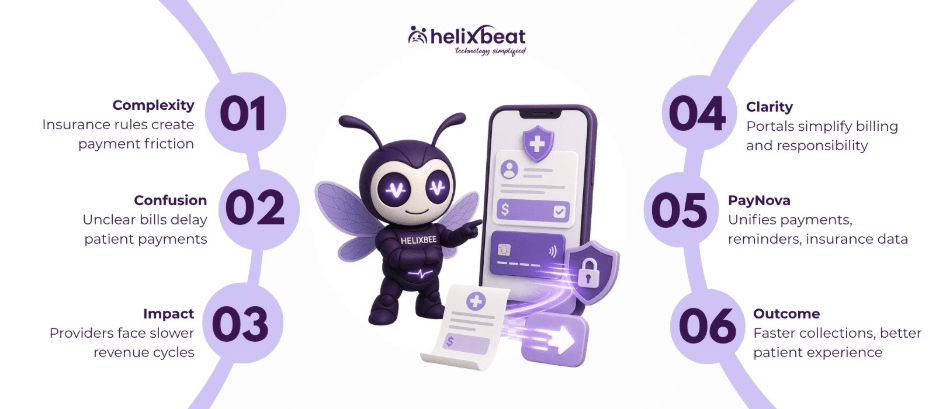
Table of Contents
The Reality of Modern Healthcare Payments
Healthcare providers are now dealing with a system filled with:
- Complex insurance structures
- High patient financial responsibility
- Frequent claim denials
- Administrative overload
In fact, providers face high administrative burdens, frequent claim denials (19% in-network, 37% out-of-network in 2023), and navigating fragmented public/private coverage. These challenges directly impact revenue cycles and patient satisfaction.
This is exactly where a patient pay portal becomes essential—not just as a payment tool, but as a strategic solution.
Why Insurance Confusion Leads to Payment Delays
Insurance confusion is one of the biggest drivers of delayed payments in healthcare. From a provider’s perspective, the issue goes far beyond simple billing—it directly affects revenue cycles, operational efficiency, and patient relationships. When patients don’t clearly understand their financial responsibility, they hesitate to pay, question charges, or delay action altogether.
Patients are often unsure about:
- What their insurance actually covers
- Why they owe a specific amount after insurance
- How their final bill is calculated
This lack of clarity creates friction in the payment journey. Even when providers offer a patient portal pay bill option, patients may still delay payments if they don’t trust or understand the numbers shown.
The Real Impact on Providers
When confusion persists:
- Payments are delayed
- Bills move into collections
- Revenue cycles become unpredictable
- Staff spend more time resolving billing queries
In many cases, providers are forced to explain the same billing details repeatedly. This increases administrative burden and slows down operations.
How Technology Solves the Problem
Understanding how does patient portal work is key to solving this issue. A modern system provides patients with a clear, step-by-step breakdown of their financial journey—from insurance coverage to final payment.
A well-designed platform like a patient gateway pay bill system ensures:
- Real-time visibility into insurance contributions
- Accurate calculation of patient responsibility
- Easy and secure payment options
Centralizing the Payment Experience
By acting as a Patient pay portal center, providers can bring all billing and payment activities into one unified platform. This eliminates confusion caused by fragmented systems and disconnected communication.
Patients no longer have to juggle multiple documents or guess what they owe. Everything is accessible in one place, making the process smoother and more transparent.
A Patient-First Approach to Payments
At its core, reducing confusion requires a patient pay portal for patient first approach. This means:
- Simplifying medical billing language
- Providing clear, itemized charges
- Offering intuitive navigation
When patients feel confident about their bills, they are far more likely to complete payments on time.
Understanding the Problem from the Provider Perspective
Healthcare providers are under pressure to maintain revenue while delivering quality care. However, they constantly face:
High administrative burdens, frequent claim denials (19% in-network, 37% out-of-network in 2023), and navigating fragmented public/private coverage.
These issues are not isolated—they are systemic. Without the right technology, providers are forced to rely on outdated billing methods that increase errors and slow down payments.
How Does Patient Portal Work in Practice?
A common question providers ask is: how does patient portal work in improving payments?
Here’s a simple breakdown:
- Patient receives care
- Insurance processes the claim
- Remaining balance is calculated
- Bill is uploaded to the portal
- Patient logs in and pays
By understanding how does patient portal work, providers can see how it simplifies the payment journey and reduces friction.
PayNova: Turning Complexity into Clarity
PayNova is designed to address the biggest challenges in healthcare payments. Its advanced patient pay portal helps providers streamline billing, improve transparency, and accelerate collections.
Let’s explore how.
1. Transparent Billing That Reduces Confusion
Patients often struggle with unclear bills. PayNova solves this by offering a patient pay portal that provides:
- Clear, itemized charges
- Insurance breakdowns
- Accurate patient responsibility
This transparency encourages faster payments and fewer disputes.
2. Seamless Patient Portal Pay Bill Experience
Convenience is critical. If paying a bill is complicated, patients delay it.
PayNova offers a smooth patient portal pay bill experience with:
- Simple navigation
- Quick payment options
- Mobile accessibility
An easy patient portal pay bill process leads to faster collections.
3. Addressing Industry Challenges Head-On
Providers continue to face high administrative burdens, frequent claim denials (19% in-network, 37% out-of-network in 2023), and navigating fragmented public/private coverage.
PayNova’s patient pay portal reduces these pressures by automating billing workflows and minimizing manual intervention.
4. Flexible Payment Options Improve Collection Rates
Patients are more likely to pay when given options. PayNova’s patient pay portal supports:
- Cards
- Bank transfers
- Digital wallets
- Payment plans
This flexibility enhances the patient portal pay bill experience and reduces unpaid balances.
5. Smarter Insurance Integration
Insurance complexity is a major barrier. PayNova improves the patient gateway pay bill process by:
- Integrating insurance data
- Reducing billing errors
- Ensuring accurate calculations
A smoother patient gateway pay bill system leads to fewer disputes and faster payments.
6. Centralized Operations with a Patient Pay Portal Center
Managing multiple systems creates inefficiencies. PayNova acts as a Patient pay portal center, allowing providers to:
- Manage billing in one place
- Track payments easily
- Reduce administrative workload
A unified Patient pay portal center simplifies operations and improves efficiency.
7. Automated Communication for Faster Payments
Patients often delay payments due to lack of reminders. PayNova’s patient pay portal includes:
- Payment alerts
- Due date reminders
- Follow-up notifications
These features increase patient portal pay bill completion rates significantly.
8. Improving Patient Experience with a Patient-First Approach
Today’s patients expect transparency and convenience. PayNova delivers a patient pay portal for patient first experience by:
- Providing clear billing
- Offering easy access
- Ensuring smooth transactions
A patient pay portal for patient first approach builds trust and encourages timely payments.
9. Reducing Errors and Denials
Billing errors are a major issue. Providers frequently deal with:
High administrative burdens, frequent claim denials (19% in-network, 37% out-of-network in 2023), and navigating fragmented public/private coverage.
PayNova’s patient pay portal minimizes these problems through automation and validation, ensuring accurate billing.
10. Supporting Digital and Telehealth Payments
With telehealth growing rapidly, providers need flexible systems. PayNova enhances the patient gateway pay bill process by supporting:
- Online consultations
- Instant billing
- Secure payments
This ensures seamless transactions across all care models.
11. Strengthening Financial Performance
Ultimately, the goal is better revenue. PayNova’s patient pay portal helps providers achieve:
- Faster collections
- Reduced denials
- Improved cash flow
By simplifying the patient portal pay bill process, providers gain financial stability.
The Bigger Picture: Solving Systemic Challenges
The healthcare system continues to evolve, but providers still face:
High administrative burdens, frequent claim denials (19% in-network, 37% out-of-network in 2023), and navigating fragmented public/private coverage.
These challenges won’t disappear overnight. However, adopting the right technology—like a patient pay portal—can significantly reduce their impact.
Why PayNova Stands Out
PayNova is more than just a payment solution. It is a complete ecosystem that:
- Simplifies billing
- Enhances transparency
- Improves patient experience
- Accelerates revenue cycles
With features like a Patient pay portal center, seamless patient gateway pay bill integration, and a patient pay portal for patient first design, PayNova transforms how providers manage payments.
Final Thoughts
Insurance confusion is one of the biggest barriers to efficient healthcare payments. It affects patients, providers, and the entire revenue cycle.
By implementing a modern patient pay portal, providers can:
- Reduce confusion
- Improve payment speed
- Enhance patient satisfaction
PayNova empowers healthcare providers to move from complexity to clarity—turning insurance confusion into faster, more reliable payments.
FAQs
1. What is a patient pay portal?
A patient pay portal is a digital platform where patients can view and pay their medical bills securely.
2. How does patient portal work?
If you’re wondering how does patient portal work, it allows patients to access billing details, understand insurance coverage, and complete payments online.
3. What is patient portal pay bill?
The patient portal pay bill feature enables patients to pay their bills quickly through an online system.
4. What is a Patient pay portal center?
A Patient pay portal center is a centralized system that manages billing, payments, and financial data in one place.
5. How does PayNova improve patient experience?
By offering a patient pay portal for patient first approach, PayNova ensures transparency, convenience, and faster payments.