


What if the developer you hire becomes the reason your product scales—or struggles?
That’s why companies don’t just hire next js developer blindly anymore; they evaluate skills with precision and structured hiring frameworks. Whether you want to hire Next.js developers for a new project or hire remote Next.js developers for scaling your existing platform, the difference always comes down to technical capability and real-world experience.
With frameworks evolving rapidly, businesses also rely on models like Helixbeat Staff Augmentation to hire dedicated Next.js developers faster and more strategically.
This checklist breaks down the exact skills every Next.js developer must have before you make a confident hiring decision.
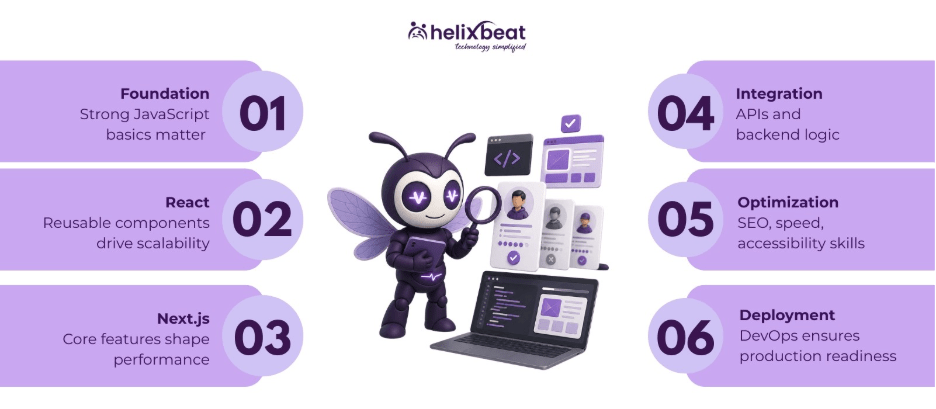
Table of Contents
1. Does the Developer Have Strong JavaScript Fundamentals?
Before Next.js, before React, everything starts with JavaScript. A developer who lacks this foundation will struggle with debugging, optimization, and building scalable applications.
Strong JavaScript skills enable developers to think logically, write efficient code, and manage real-world application complexity—this becomes critical when you hire next js developer for production-grade systems.
ES6+ Concepts Mastery
Modern Next.js development heavily depends on ES6+ features. A skilled developer must understand:
- Arrow functions
- Promises & async/await
- Destructuring
- Spread/rest operators
- Modules (import/export)
These concepts are essential when you hire nextjs developers, as they directly impact code quality and maintainability.
Developers who avoid modern JavaScript patterns often produce tightly coupled code that becomes difficult to scale and maintain.
Clean Coding Practices
Writing code is easy; writing maintainable code is what defines professional developers.
A strong Next.js developer ensures:
- Readable structure
- Reusable functions
- Proper naming conventions
- Minimal code duplication
This becomes especially important when you hire nextjs developers for long-term projects involving multiple contributors.
Clean code improves debugging speed, onboarding efficiency, and long-term scalability.
2. Do They Have Deep Expertise in React?
Next.js is built on React, so weak React fundamentals directly impact application performance and scalability.
This is a critical evaluation step when you hire dedicated next js developers.
Hooks & State Management
Modern React development is built around hooks. A skilled developer should understand:
- useState
- useEffect
- useMemo
- useCallback
- Custom hooks
They should also be familiar with state management approaches like Context API or Redux when required.
Without this expertise, even simple UI components can become inefficient and unstable.
Component Reusability
A professional developer builds systems, not just pages.
They should know how to:
- Break UI into reusable components
- Avoid duplication
- Maintain scalable architecture
- Ensure separation of concerns
This is especially important when you hire remote next js developers, where consistent architecture is crucial for distributed team collaboration.
Reusable components significantly reduce development time and improve maintainability.
3. Are They Proficient in Next.js Core Features?
This is the most critical part of evaluation. Knowing React alone is not enough—Next.js has its own ecosystem and architecture.
When you hire next js developer, this is where true expertise becomes visible.
SSR, SSG & ISR
A strong developer must understand rendering strategies:
- SSR (Server-Side Rendering): for dynamic content
- SSG (Static Site Generation): for performance optimization
- ISR (Incremental Static Regeneration): for hybrid updates
Choosing the right strategy impacts SEO, speed, and scalability.
For example:
- E-commerce platforms rely on SSR
- Blogs perform best with SSG
- News platforms benefit from ISR
Incorrect implementation can lead to performance issues and outdated content delivery.
File-Based Routing
Next.js routing is simple in structure but requires smart implementation.
Developers should understand:
- Dynamic routes
- Nested routes
- Catch-all routes
- Route optimization
Poor routing architecture can make applications difficult to scale over time.
When you hire nextjs developers, routing expertise often determines long-term maintainability.
4. Can They Handle API Integration & Backend Logic?
Modern Next.js is a full-stack framework, not just a frontend tool. That’s why API expertise is essential.
API Routes in Next.js
Developers should be capable of:
- Building backend endpoints within Next.js
- Handling HTTP methods (GET, POST, PUT, DELETE)
- Securing APIs using middleware
This reduces dependency on separate backend services for smaller applications.
When you hire dedicated next js developers, this skill helps streamline architecture and reduce complexity.
Third-Party Integrations
Real-world applications depend heavily on external integrations such as:
- Payment gateways (Stripe, Razorpay)
- Authentication systems (NextAuth, OAuth)
- CMS platforms
- REST and GraphQL APIs
A skilled developer ensures these integrations are secure, scalable, and performance-friendly.
5. Do They Focus on Performance Optimization?
Performance is not optional in modern web applications—it directly impacts conversions, SEO rankings, and user retention.
Image Optimization & Lazy Loading
Next.js provides built-in optimization features, but developers must know how to apply them correctly.
Key capabilities include:
- next/image optimization
- Lazy loading components
- Responsive image handling
These practices significantly reduce load times and improve Core Web Vitals, which is essential when you hire remote next js developers for performance-critical applications.
Proper image handling ensures faster rendering and smoother user experiences across devices.
Code Splitting
Large applications must load only the required resources to maintain speed and efficiency.
A skilled developer should implement:
- Automatic code splitting
- Dynamic imports
- Bundle optimization techniques
This ensures faster initial load times and reduces unnecessary resource consumption.
Poor optimization often leads to higher bounce rates, especially in production environments where performance directly affects business outcomes.
6. Are They Skilled in SEO & Accessibility Best Practices?
A technically strong application is ineffective if it cannot be discovered or accessed easily.
Technical SEO Implementation
A competent developer should understand SEO fundamentals, including:
- Meta tag optimization
- Open Graph configuration
- Structured data (Schema markup)
- Clean URL architecture
These elements are critical when you hire next js developer for public-facing or content-driven applications.
Proper SEO implementation improves visibility and organic reach.
Accessibility Standards
Modern applications must follow inclusive design principles.
Developers should implement:
- WCAG compliance guidelines
- Keyboard navigation support
- Screen reader compatibility
- Semantic HTML structure
This ensures applications are usable by all users, including those with disabilities, improving overall product quality and trust.
7. Do They Have Deployment & DevOps Knowledge?
Development is incomplete without proper deployment and production readiness.
Cloud & Hosting Platforms
A skilled Next.js developer should be familiar with:
- Vercel (preferred for Next.js)
- AWS
- Netlify
- Docker-based deployment environments
Understanding deployment infrastructure ensures smooth scaling and production stability when you hire nextjs developers for enterprise applications.
CI/CD Pipelines
Modern development relies heavily on automation.
Developers should understand:
- GitHub Actions / GitLab CI
- Automated testing pipelines
- Continuous deployment workflows
This reduces manual errors and accelerates release cycles, ensuring faster delivery and stable updates.
Why Choose Helixbeat Staff Augmentation to Hire Next.js Developers?
Hiring skilled developers individually can be time-consuming, expensive, and uncertain. Structured hiring models solve this challenge effectively.
Helixbeat Staff Augmentation simplifies how you hire next js developer by offering pre-vetted, project-ready talent.
Pre-Vetted Talent Pool
We provide developers who are already assessed for:
- Strong JavaScript fundamentals
- React and Next.js expertise
- Real-world project experience
This reduces hiring risk when you hire nextjs developers for critical projects.
Flexible Hiring Models
Depending on your project requirements, you can:
- Hire short-term specialists
- Onboard full-time dedicated engineers
- Scale remote teams efficiently
This flexibility helps businesses hire remote next js developers or hire dedicated next js developers based on evolving needs.
Faster Project Execution
Since developers are pre-screened, onboarding time is significantly reduced.
This allows teams to start delivery quickly with minimal ramp-up time, improving time-to-market and productivity.
Wrapping Up
Hiring a Next.js developer is not just about evaluating resumes—it is about assessing real technical capability and production readiness.
- Strong JavaScript and React fundamentals are essential
- Next.js architecture defines scalability and performance
- SEO, performance optimization, and deployment skills determine real-world success
When you hire next js developer, choosing the right skill combination ensures your product is not only functional but also scalable and production-ready.
FAQs
1. What skills should I prioritize when I hire next js developer?
JavaScript fundamentals, React expertise, Next.js rendering strategies, performance optimization, and deployment knowledge are essential.
2. Why is Next.js better than traditional React for hiring developers?
Next.js offers SSR, SSG, routing, and backend capabilities, making it more scalable and SEO-friendly than plain React.
3. Is it better to hire remote next js developers?
Yes, remote developers offer flexibility, cost efficiency, and access to global talent without compromising quality.
4. How does Helixbeat help in hiring Next.js developers?
Helixbeat Staff Augmentation provides pre-vetted, experienced developers with flexible hiring models for faster project delivery.