
The software industry is more competitive today than ever before. Every week, new SaaS platforms, AI-powered applications, enterprise tools, and cloud-based products enter the market. For software companies, building an innovative product is only half the battle. The real challenge is getting the right audience to notice your product, trust your brand, and eventually become paying customers.
This is why experienced software marketing companies play such a critical role in business growth.
According to Statista, billions of users interact with digital platforms globally, creating massive opportunities for software businesses to reach their ideal customers online. At the same time, competition is increasing rapidly, making strategic digital marketing essential for survival.
Many software companies struggle with:
- High customer acquisition costs
- Low organic visibility
- Poor lead quality
- Long B2B sales cycles
- Weak brand awareness
- Low product adoption
- High churn rates
Without the right marketing strategy, even the best software solutions fail to gain traction.
This is where modern software marketing companies help businesses scale through targeted campaigns, customer-focused messaging, and data-driven growth strategies.
At Helixbeat, software companies gain access to scalable marketing solutions designed specifically for SaaS and B2B technology brands looking to accelerate growth and improve ROI.
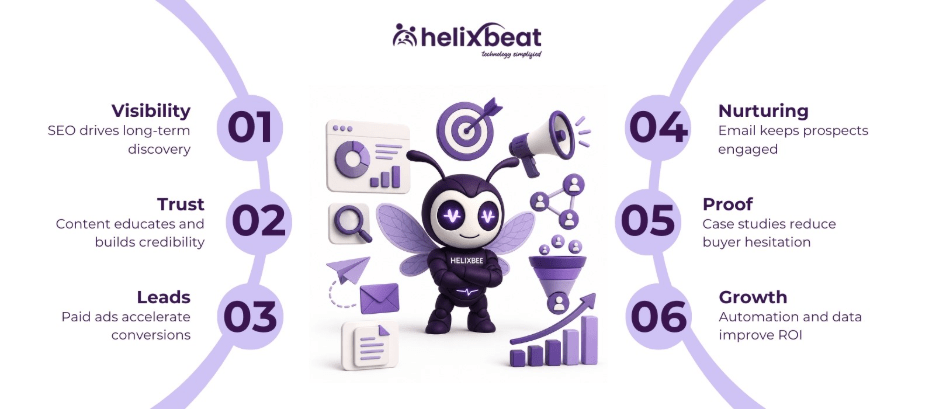
Table of Contents
1. Investing in SEO for Long-Term Visibility
Search engine optimization remains one of the most powerful strategies used by software marketing companies.
When businesses search for:
- “best CRM software”
- “AI accounting tools”
- “cloud HR platform”
- “project management SaaS”
the companies ranking on Google receive the majority of clicks and traffic.
SEO helps software companies:
- Increase organic traffic
- Improve online visibility
- Generate qualified leads
- Build authority
- Reduce advertising costs
Effective SEO includes:
- Keyword research
- Technical SEO
- On-page optimization
- Link building
- SEO-focused content creation
Modern SaaS marketing strategies rely heavily on SEO because it creates sustainable long-term growth.
SEO drives 53% of all website traffic and generates over 1,000% more traffic than organic social media
This is why successful software marketing companies prioritize SEO as a foundation for digital growth.
2. Content Marketing That Builds Trust
Software buyers rarely make instant purchasing decisions. They spend time researching solutions, comparing platforms, reading reviews, and understanding ROI.
This is why content marketing is essential.
Leading software marketing companies create:
- Blog articles
- Whitepapers
- Case studies
- E-books
- Product guides
- Industry reports
- Webinars
Strong content establishes authority while educating potential customers.
For example, a cybersecurity software company can publish blogs explaining how businesses can reduce data breaches. This attracts users actively searching for solutions.
Effective software promotion techniques focus on solving customer pain points instead of simply promoting features.
The best SaaS marketing strategies create educational content that guides prospects throughout the buying journey.
3. Paid Advertising for Faster Lead Generation
SEO is powerful, but it takes time. Paid advertising helps software companies generate immediate visibility and qualified leads.
Modern software marketing companies use:
- Google Ads
- LinkedIn Ads
- Retargeting campaigns
- YouTube ads
- Display advertising
- PPC campaigns
Paid campaigns help software brands:
- Reach targeted audiences
- Increase demo bookings
- Drive trial signups
- Improve lead generation
- Accelerate conversions
However, successful advertising is not just about spending money.
Professional software marketing companies focus on:
- Conversion optimization
- Audience segmentation
- A/B testing
- Performance tracking
- ROI improvement
These software promotion techniques ensure that marketing budgets generate measurable business outcomes instead of wasted ad spend.
4. Social Media Marketing for Software Brands
Social media is no longer just a branding tool. It has become one of the most effective channels for engagement and B2B lead generation.
Platforms like:
- YouTube
help software companies connect directly with decision-makers and industry professionals.
Strong B2B software marketing on social media includes:
- Thought leadership content
- Product updates
- Industry insights
- Customer success stories
- Video tutorials
- Webinar promotions
LinkedIn, in particular, is highly effective for enterprise software brands because it targets professionals and business buyers directly.
Experienced software marketing companies use platform-specific strategies to maximize engagement and improve conversions.
5. Email Marketing for Lead Nurturing
Not every software prospect converts immediately.
Some buyers may need weeks or even months before making a decision. This is why email marketing remains a critical strategy for software businesses.
Modern SaaS marketing strategies use email marketing to:
- Nurture leads
- Educate prospects
- Share product updates
- Promote webinars
- Deliver onboarding support
- Encourage upgrades
Personalized email campaigns help software companies stay connected with potential customers throughout the sales cycle.
Professional software marketing companies often automate these campaigns using:
- Behavioral triggers
- Lead scoring
- Segmentation
- Drip workflows
This creates more efficient and scalable communication.
6. Customer Success Stories and Case Studies
Trust is one of the biggest factors influencing software purchases.
Potential customers want proof that a software product actually works before investing.
This is why successful software marketing companies heavily promote:
- Customer testimonials
- Client reviews
- Video testimonials
- Case studies
- Success metrics
For example, showing how a SaaS platform helped a company reduce operational costs or improve productivity can significantly increase credibility.
These software promotion techniques build confidence and reduce buyer hesitation.
In competitive markets, social proof often becomes a deciding factor for customers.
7. Video Marketing for Product Demonstration
Software products can sometimes be difficult to explain through text alone.
Video marketing simplifies complex concepts and improves customer understanding.
Modern software marketing companies create:
- Product demos
- Explainer videos
- Feature tutorials
- Customer interviews
- Webinar recordings
- Educational videos
Videos improve:
- Engagement
- Conversion rates
- Product understanding
- Brand recall
According to Wyzowl, businesses consistently report that video marketing improves lead generation and customer understanding, making it a highly effective strategy for software companies.
This is why video content is now central to many SaaS marketing strategies.
8. Account-Based Marketing for Enterprise Clients
One of the most effective B2B software marketing approaches is Account-Based Marketing (ABM).
Instead of targeting broad audiences, ABM focuses on high-value accounts.
This strategy includes:
- Personalized campaigns
- Targeted outreach
- Custom landing pages
- Industry-specific messaging
- Direct engagement with decision-makers
Enterprise software companies benefit greatly from ABM because buying decisions often involve multiple stakeholders.
Professional software marketing companies use ABM to:
- Improve lead quality
- Increase enterprise conversions
- Shorten sales cycles
- Strengthen customer relationships
This targeted approach improves efficiency while reducing wasted marketing spend.
9. Marketing Automation for Scalability
As software companies grow, managing leads manually becomes difficult.
Marketing automation helps businesses scale efficiently.
Automation tools help with:
- Email workflows
- Lead nurturing
- CRM integration
- Retargeting
- Customer segmentation
- Analytics tracking
Modern software marketing companies use automation to improve productivity while maintaining personalized customer communication.
Strong SaaS marketing strategies rely on automation to:
- Reduce manual work
- Improve lead management
- Increase engagement
- Enhance customer experience
This allows software companies to scale marketing efforts without increasing operational complexity.
10. Data-Driven Decision Making
The best marketing strategies are built on analytics, not assumptions.
Professional software marketing companies monitor:
- Traffic sources
- Conversion rates
- Customer acquisition costs
- Click-through rates
- Engagement metrics
- ROI performance
Data helps software businesses understand:
- Which campaigns perform best
- Which audiences convert
- Which channels waste budget
- Which messaging drives engagement
These insights improve campaign optimization and long-term business growth.
Effective software promotion techniques rely heavily on continuous analysis and improvement.
11. Guest Blogging and Outreach
Guest blogging remains one of the most valuable SEO and authority-building strategies.
Software companies can publish articles on:
- Industry websites
- SaaS publications
- Tech blogs
- Business platforms
This helps:
- Build backlinks
- Increase brand awareness
- Improve SEO rankings
- Reach new audiences
Many software marketing companies use outreach campaigns to secure partnerships and content placements on high-authority websites.
This strengthens online credibility while improving search visibility.
12. Product-Led Growth Strategies
Product-led growth has become a major trend in SaaS marketing.
Instead of relying only on sales teams, software companies allow users to experience the product directly through:
- Free trials
- Freemium plans
- Interactive demos
- Self-service onboarding
These SaaS marketing strategies reduce friction in the buying process and increase customer trust.
Many successful software marketing companies optimize user onboarding to improve activation and conversion rates.
13. Retargeting Campaigns for Better Conversions
Most visitors do not convert on their first website visit.
Retargeting campaigns help software companies reconnect with potential customers who previously interacted with their brand.
Retargeting ads can:
- Remind users about free trials
- Promote demos
- Highlight features
- Encourage return visits
These software promotion techniques improve conversion rates while reducing acquisition costs.
14. Thought Leadership Branding
Software buyers trust companies that demonstrate expertise.
This is why thought leadership is becoming increasingly important in B2B software marketing.
Thought leadership includes:
- Founder branding
- Industry insights
- Expert webinars
- Research reports
- Opinion articles
Professional software marketing companies help software brands position themselves as industry experts rather than just vendors.
This improves trust and long-term customer relationships.
15. Conversion Rate Optimization
Driving traffic alone is not enough.
Modern software marketing companies also focus on improving conversions through:
- Landing page optimization
- Faster website speed
- Better CTAs
- Simplified forms
- User behavior analysis
Strong conversion optimization improves:
- Demo bookings
- Trial signups
- Customer acquisition
- Revenue growth
These improvements help software companies maximize the value of every marketing campaign.
How Helixbeat Helps Software Companies Grow
Helixbeat supports software businesses with growth-focused marketing solutions tailored for SaaS and enterprise brands.
Their services include:
- SEO optimization
- Content marketing
- Paid advertising
- Social media campaigns
- Lead generation
- Marketing automation
- Analytics and reporting
By combining modern software promotion techniques with ROI-focused execution, Helixbeat helps software companies:
- Increase visibility
- Improve customer acquisition
- Strengthen brand authority
- Scale sustainably
Their expertise in B2B software marketing allows software brands to compete effectively in crowded digital markets.
Final Thoughts
The software industry continues to evolve rapidly, making competition tougher every year. Having a strong product is important, but without the right marketing strategy, software companies struggle to achieve sustainable growth.
This is why experienced software marketing companies are essential for modern SaaS and technology businesses.
From SEO and content marketing to automation and account-based campaigns, today’s most effective SaaS marketing strategies focus on visibility, engagement, trust, and measurable ROI.
The best software promotion techniques combine data-driven insights with customer-focused messaging to generate long-term business growth.
For software brands looking to improve lead generation, increase conversions, and strengthen market positioning, strategic B2B software marketing is no longer optional — it is a necessity.
With the right partner like Helixbeat, software companies can scale faster, optimize marketing investments, and achieve sustainable growth in an increasingly competitive digital landscape.
FAQs
1. Why are software marketing companies important for SaaS businesses?
Software marketing companies help SaaS businesses improve visibility, generate qualified leads, and implement effective SaaS marketing strategies for long-term growth.
2. What are the best SaaS marketing strategies for software companies?
The best SaaS marketing strategies include SEO, content marketing, paid advertising, email marketing, account-based marketing, and conversion optimization.
3. How do software promotion techniques improve lead generation?
Effective software promotion techniques like PPC ads, retargeting campaigns, and SEO help software companies attract targeted audiences and increase conversions.
4. Why is B2B software marketing different from traditional marketing?
B2B software marketing focuses on longer sales cycles, multiple decision-makers, personalized communication, and relationship-building strategies for enterprise clients.
5. How can software marketing companies reduce customer acquisition costs?
Professional software marketing companies use data-driven campaigns, audience targeting, SEO, and automation tools to improve ROI and lower acquisition costs.