

In modern healthcare, interoperability and data exchange have become foundational pillars driving innovation. Therefore, organizations increasingly rely on healthcare APIs to unlock the full value of this information.
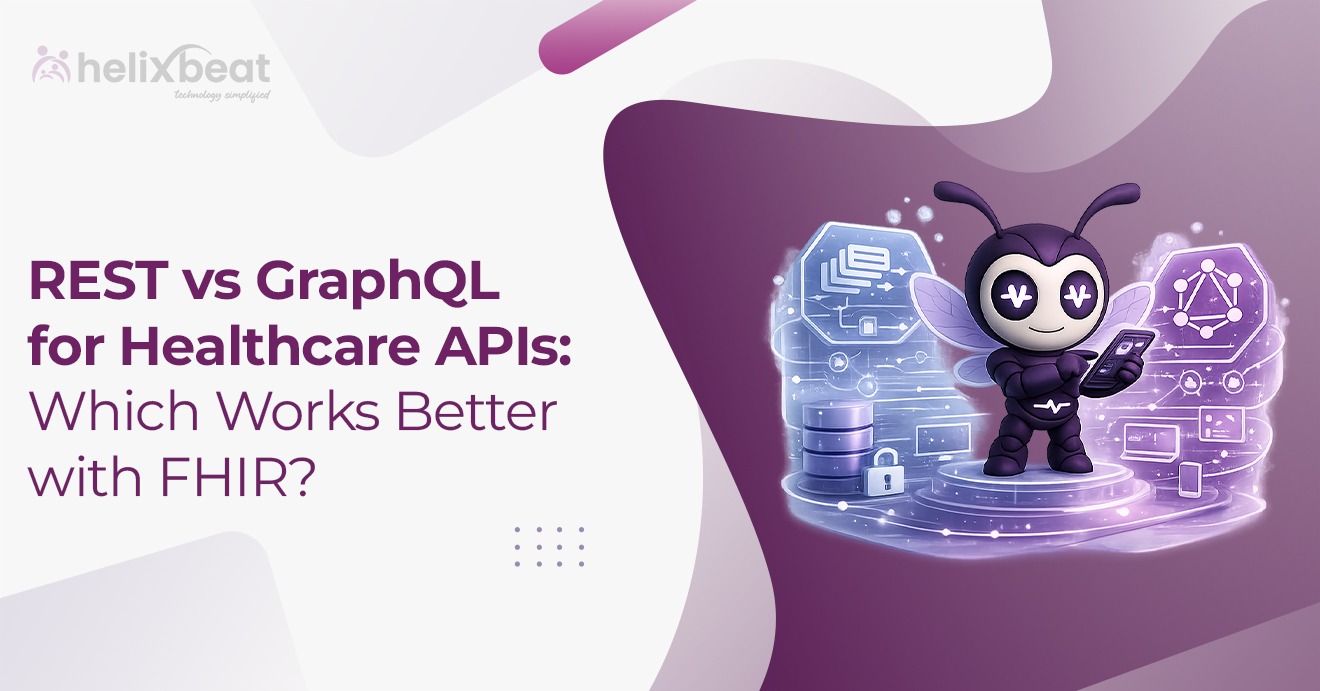
Two of the most discussed API paradigms today are REST and GraphQL. Organizations looking to integrate with modern healthcare standards often ask: Which API approach works better with FHIR (Fast Healthcare Interoperability Resources)? In this comparison, we explore REST and GraphQL, evaluate their compatibility with FHIR, and help you decide the best approach.
Table of Contents
What Are Healthcare APIs?
Healthcare APIs are standardized programming interfaces that enable different software systems to communicate and exchange clinical and administrative data securely. They play a critical role in:
- Connecting EHRs with third‑party applications
- Enabling patient access to health records
- Powering analytics, mobile apps, and population health insights
- Integrating wearable or IoT health devices
Because healthcare data is sensitive and regulated (e.g., under HIPAA in the U.S.), APIs must maintain rigorous security, data integrity, and interoperability.”
REST APIs: The Traditional Standard in Healthcare
What Is REST?
REST (Representational State Transfer) is an architectural style for APIs that uses standard HTTP methods — GET, POST, PUT, DELETE — to perform operations.
In RESTful healthcare APIs:
- Each resource (e.g., patient, encounter) has a unique URI
- HTTP verbs represent actions
- Data is often returned in JSON (or XML) format
REST serves as the backbone of most healthcare APIs, and its patterns define the FHIR API specifications within the core standard.
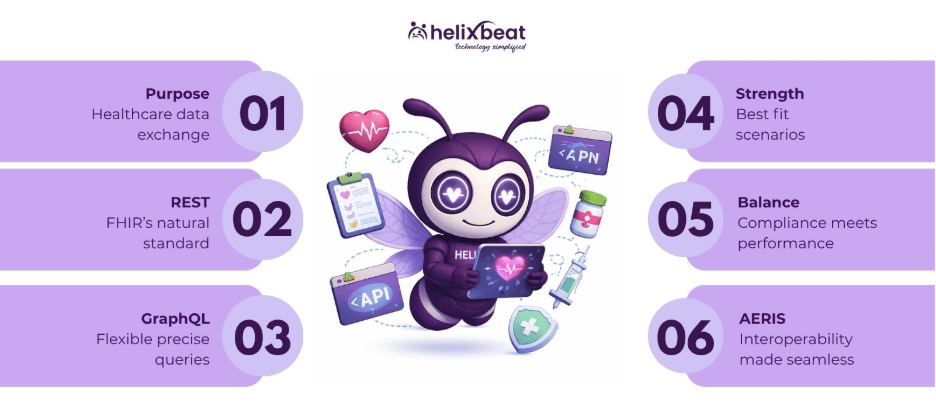
Benefits of REST for Healthcare
- Simplicity and predictability – Its structure is widely understood and easy to implement.
- Native FHIR compatibility – FHIR itself uses REST syntax as its core API model.
- Mature ecosystem – Tools and libraries for REST are abundant across programming languages.
- Caching and intermediaries – REST supports standard HTTP caching mechanisms and easy load‑balancing.
GraphQL: The Modern Query Language
What Is GraphQL?
Developed by Facebook, GraphQL is a query language for APIs that enables clients to request exactly the data they need. In contrast to REST, GraphQL exposes a single endpoint and a flexible query structure.
With GraphQL:
- Clients specify fields and nested data structures in their query.
- The server returns data shaped precisely to that query.
Example:
query {
patient(id: “123”) {
name
allergies {
substance
reactions
}
}
}
Benefits of GraphQL for Healthcare–
- Precise data retrieval: GraphQL avoids over‑fetching by returning only the data requested.
- Single endpoint: Reduces the need for multiple REST endpoints.
- Efficient for mobile or low‑bandwidth clients: Smaller responses mean faster performance.
- Flexible schema evolution: Clients can query new fields without impacting others.
FHIR and REST: The Natural Pair
FHIR was designed with RESTful interactions in mind. The core FHIR RESTful API defines standard operations such as:
- GET to read or search resources
- POST to create resources
- PUT to update resources
- DELETE to remove resources
- $search to perform queries across resources
These standardized interactions mean that most healthcare systems implementing FHIR will adopt REST first. The FHIR specification itself contains detailed REST examples and conventions used worldwide in EHR integrations and third‑party apps.
Healthcare organizations leveraging REST with FHIR benefit from:
- Compliance with FHIR API guidelines
- Proven support from major EHR vendors
- Simplified tooling and developer support
This makes REST a well‑understood and reliable default for healthcare APIs built on FHIR.
GraphQL with FHIR: A Flexible Alternative
While FHIR emphasizes REST, nothing in the FHIR specification precludes using GraphQL. In fact, HL7 International has published FHIR GraphQL specifications that define how FHIR resources can be queried using GraphQL syntax.
FHIR GraphQL Capabilities
With FHIR GraphQL, clients can:
- Navigate complex relationships between resources in a single query
- Retrieve nested data together (e.g., patient plus current medications and observations)
For example, a GraphQL query against FHIR could request:
{
Patient(id: “456”) {
name
birthDate
ObservationList {
code
valueQuantity {
value
unit
}
}
}
}
This structure enables clients to reduce the number of network calls and receive exactly what they need in one response.
When to Choose REST for Healthcare APIs?
REST with FHIR remains the best choice in scenarios where:
- You need standard FHIR compliance with official tooling
- Your developer teams are more comfortable with REST patterns
- You rely on existing EHR vendor platforms built around REST APIs
- You prioritize caching, logging, and simple authorization models
In many enterprise healthcare environments, REST remains the default integration method because of its predictability and strong ecosystem.
When GraphQL Makes Sense
GraphQL can be the better choice when:
- You want highly efficient data retrieval, especially for mobile or low‑bandwidth clients
- Your clients frequently require nested and variable data views
- You’re building custom dashboards, analytics platforms, or rich web applications
- You want to minimize round trips between client and server
GraphQL shines when flexibility and performance matter more than convention.
Why the Hybrid Approach is the Best Choice
Rather than framing REST and GraphQL as exclusive choices, many organizations are implementing both as complementary parts of their API ecosystem:
- Use REST for standardized FHIR endpoints and compliance needs
- Use GraphQL for flexible data aggregation and mobile clients
This flexible architecture can deliver the best of both worlds, compliance and performance, while adapting to modern application use cases.
Final Thoughts
There is no one‑size‑fits‑all answer, but a clear pattern emerges:
REST with FHIR is ideal for broad, standardized healthcare interoperability and compliance. It adheres directly to the FHIR API model, supports caching, and is universally understood in healthcare integration.
GraphQL with FHIR excels in client‑focused applications requiring precise, efficient data retrieval and minimized round‑trips between client and server. It’s especially advantageous for complex user interfaces and mobile solutions.
Therefore, organizations can adopt a hybrid API strategy — leveraging REST for core interoperability and introducing GraphQL where flexibility and performance yield measurable benefits.
How AERIS Revolutionizes Interoperability with FHIR APIs?
Imagine a world where your healthcare organization thrives with seamless, secure, and real-time data exchange. That’s the power of AERIS by Helixbeat, a game-changing platform designed to transform how you connect, collaborate, and care. Built for healthcare providers, clinics, hospitals, and cross-industry partners like pharmacies and insurers, AERIS harnesses FHIR APIs to break down data silos, streamline operations, and put patient care first.
Why AERIS is Your Key to Healthcare Innovation?
- 20+ Years of Expertise: Our team brings decades of healthcare IT experience to ensure AERIS works for you.
- 50+ IT Professionals: A dedicated crew powers AERIS, delivering unmatched support and innovation.
- 1,000+ Customers: Join a thriving community of healthcare leaders already transforming with AERIS.
- 10,000+ Projects Completed: Proven success across countless integrations and workflows.
- 95% Returning Customers: Our clients trust AERIS to deliver, time and time again.
Are you ready to simplify your healthcare data exchange? Partner with Helixbeat and transform your healthcare ecosystem today.
FAQs
1. What are healthcare APIs?
Healthcare APIs are interfaces that allow different healthcare systems to securely exchange medical and administrative data, improving interoperability and patient care.
2. Why is FHIR important for healthcare APIs?
FHIR standardizes how healthcare data is structured and shared, making it easier for systems to communicate efficiently and consistently.
3. Is REST required for FHIR implementation?
No, but REST is the default and most widely used approach because FHIR was originally designed around RESTful principles.
4. Can GraphQL be used with FHIR?
Yes, HL7 provides GraphQL support for FHIR, allowing more flexible and efficient data queries.
5. Which is better for performance: REST or GraphQL?
It depends on the use case. REST performs well with caching, while GraphQL is more efficient for complex, data-heavy queries.