

Are your analytics slowing down just when your business is growing faster? That’s a challenge many enterprises face today. A modern cloud data warehouse can change that by offering speed, scalability, and flexibility without heavy infrastructure.
At Helixbeat, we’ve seen how the right cloud data warehouse architecture helps businesses turn data into real-time decisions. However, scaling analytics isn’t just about adopting tools—it’s about using them strategically.
From selecting the right cloud data warehouse solutions to building efficient workflows, every step plays a crucial role. In this blog, we’ll walk you through practical tips to help growing enterprises scale analytics effectively using the power of the cloud data warehouse and Helixbeat’s expertise.
Start scaling your analytics with Helixbeat today.
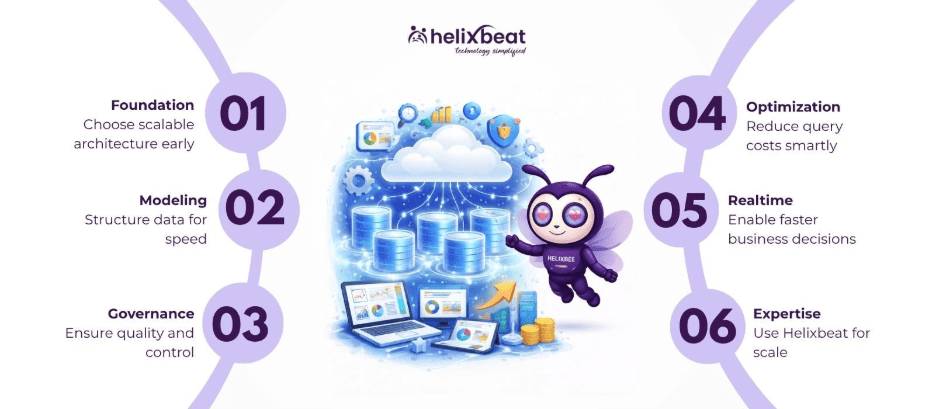
Table of Contents
8 Practical Tips Growing Enterprises Use to Scale Analytics with Cloud Data Warehouse
Scaling analytics isn’t about adding more tools—it’s about making smarter architectural and operational decisions. Here are the most effective, experience-backed tips enterprises rely on when adopting cloud data warehouse solutions.
Tip 1: Choose the Right Cloud Data Warehouse Architecture Early
A strong foundation makes scaling easier and more predictable. Selecting the right architecture ensures your analytics remains fast even as your data grows.
Why architecture decisions define scalability
The foundation of your cloud data warehouse determines how efficiently analytics scale. Choosing between single-cluster, multi-cluster, or serverless architecture directly impacts performance and cost.
A poorly designed system can create bottlenecks as data volume increases. Conversely, a scalable design allows parallel processing, ensuring consistent performance under heavy workloads.
What growing enterprises should focus on
Enterprises should focus on modular architecture that separates workloads. This ensures reporting; ETL processes, and real-time analytics do not compete for resources, maintaining smooth operations.
Tip 2: Prioritize Data Modeling for Performance and Clarity
Data modeling remains crucial for cloud analytics. Clear data structures directly improve query speed and reliability of insights.
Why data modeling still matters in the cloud
Many believe cloud platforms eliminate the need for structured models—but poorly designed schemas slow queries and produce inconsistent results. Well-designed models improve performance and reduce compute costs, which is essential for large datasets in cloud data warehouse solutions.
Best practices enterprises follow
Use dimensional modeling for analytics, normalize only when necessary, and apply data partitioning or clustering to optimize performance. Following these practices ensures your data warehouse scales efficiently.
Maximize query efficiency—get help from Helixbeat’s cloud data warehouse experts.
Tip 3: Implement Smart Data Governance from Day One
Without governance, scaling your cloud data warehouse can become risky and unreliable. Strong governance ensures data quality, compliance, and accessibility across teams.
Scaling data without governance creates chaos
As data volume grows, the risk of duplication, inconsistencies, and security issues rises. A robust governance framework maintains trust in analytics outputs and prevents costly errors.
Key governance practices to adopt
Define clear data ownership, standardize naming conventions, and implement role-based access controls. Automating validation pipelines also strengthens reliability and reduces human errors.
Tip 4: Optimize Query Performance to Control Costs
In cloud environments, performance and cost are interconnected. Efficient queries ensure scalability without overspending.
Why cost optimization is critical in cloud environments
Unlike traditional warehouses, cloud data warehouse solutions charge based on resource usage. Inefficient queries directly increase operational costs, making optimization essential for sustainable scaling.
Techniques that work
Avoid SELECT *, apply proper indexing, and cache frequently accessed data. Many top cloud data warehouse platforms also provide optimization tools to monitor query performance and highlight inefficiencies.
Tip 5: Enable Real-Time Data Processing for Faster Decisions
Speed is a competitive advantage in modern businesses. Real-time analytics ensure enterprises respond instantly to changing conditions and market dynamics.
Batch Processing Is No Longer Enough
Modern enterprises need real-time insights for faster decision-making. Delayed analytics can impact operations, customer experience, and revenue. Implementing cloud based data warehouse services with streaming data pipelines ensures your business reacts instantly.
How to Implement Real-Time Analytics
Integrate streaming tools with your cloud data warehouse. Event-driven architectures and micro-batching reduce latency, enabling faster operational decisions.
Need real-time analytics capabilities? Explore Helixbeat cloud data warehouse solutions.
Tip 6: Build a Scalable Data Integration Strategy
Data growth brings complexity. A strong integration strategy ensures smooth data flow across systems and accurate analytics.
Data Comes from Everywhere—and It Keeps Growing
From CRMs to IoT devices, data sources continuously expand. Without a unified pipeline, scaling analytics becomes challenging.
What Enterprises Should Implement
Adopt ELT (Extract, Load, Transform) over ETL. Leveraging cloud based data warehouse solutions simplify workflows and enhance performance.
Tip 7: Monitor and Tune Performance Continuously
Scaling is an ongoing process, not a one-time setup. Continuous monitoring maintains performance as demand grows.
Scaling Analytics Is Not a One-Time Effort
Even the best cloud data warehouse systems require ongoing performance tuning. As data volume and user demand increase, continuous optimization ensures consistent efficiency.
Tools and Practices That Help
Use built-in monitoring dashboards, track query execution times, and proactively identify bottlenecks. Automated alerts enhance operational control.
Tip 8: Invest in Skilled Talent Through Staff Augmentation
Technology alone cannot scale analytics without the right people. Skilled experts ensure your cloud data warehouse performs at its best.
Technology Alone Cannot Scale Analytics
Even top cloud based data warehouse services need experienced professionals. Without talent, adoption and optimization slow down.
Why Staff Augmentation Works for Growing Enterprises
Access experienced data engineers and architects instantly without long hiring cycles. Faster implementation ensures better ROI and operational efficiency.
Scale faster with Helixbeat staff augmentation experts.
How Helixbeat Helps Enterprises Scale Analytics with Cloud Data Warehouse
Scaling analytics requires more than tools—it needs the right expertise, strategy, and execution. Helixbeat combines cloud technology with skilled professionals to deliver measurable business outcomes.
Helixbeat’s Approach to Cloud Data Warehouse Solutions
A structured approach ensures long-term success. Helixbeat aligns cloud data warehouse solutions with enterprise objectives.
Strategy-First Implementation
We start with business goals, not just tools. This ensures your cloud based data warehouse solutions align with real analytics needs. Scalable architectures are designed for growth, performance, and cost efficiency.
End-to-End Execution
From data ingestion to visualization, Helixbeat handles the full analytics lifecycle. This reduces fragmentation and ensures smooth operations.
Helixbeat Staff Augmentation for Data Teams
Scaling teams quickly is often the biggest challenge. Helixbeat bridges this gap with top cloud data warehouse experts.
Access to Specialized Talent Instantly
Finding skilled data professionals can take months. Helixbeat provides ready-to-deploy experts who integrate with your team and start delivering value immediately.
Flexible and Scalable Engagement
Whether you need short-term support or long-term collaboration, our staff augmentation adapts to your needs.
Key Capabilities Offered by Helixbeat
| Capability | How It Helps Enterprises |
| Data Architecture Design | Builds scalable and future-ready cloud data warehouse systems |
| Data Integration | Connects multiple data sources into a unified pipeline |
| Performance Optimization | Improves query speed and reduces operational costs |
| Real-Time Analytics | Enables faster decision-making with live data |
| Governance & Security | Ensures compliance and data accuracy |
Traditional vs Cloud Data Warehouse Scaling
| Factor | Traditional Data Warehouse | Cloud Data Warehouse |
| Scalability | Limited and hardware-dependent | Elastic and on demand |
| Cost Model | High upfront investment | Pay-as-you-use |
| Performance | Slows down with growth | Optimized for large-scale analytics |
| Maintenance | Manual and resource-heavy | Managed by cloud providers |
| Deployment Speed | Slow | Rapid |
Why Enterprises Choose Helixbeat
Choosing the right partner is critical for measurable results. Helixbeat focuses on delivering outcomes that matter.
Proven Experience in Scaling Analytics
We’ve helped growing enterprises tackle real analytics challenges. Our cloud data warehouse solutions are practical, not theoretical.
Focus on Business Outcomes
Every implementation aligns with measurable outcomes: faster insights, lower costs, and improved decision-making.
Wrapping Up
Scaling analytics with a cloud data warehouse is no longer optional—it’s essential for business growth. With the right strategies, modern cloud data warehouse solutions, and expert support from Helixbeat, enterprises can unlock real-time insights, optimize costs, and build future-ready data systems that drive measurable results.
Key Takeaways
- Strong architecture drives scalability
- Optimization reduces long-term costs
- Real-time analytics improves decisions
- Skilled talent accelerates implementation
FAQs
1. What is a cloud data warehouse?
A cloud data warehouse is a scalable data storage and analytics solution hosted on the cloud, designed for fast query performance and large-scale data processing.
2. How does a cloud data warehouse help in scaling analytics?
It provides elastic scalability, faster processing, and real-time data access, enabling businesses to handle growing data volumes efficiently.
3. What are the best cloud data warehouse solutions available?
Popular solutions include platforms that offer scalability, performance optimization, and seamless integration with modern data tools.
4. Why is data modeling important in cloud environments?
Proper data modeling improves query performance, reduces costs, and ensures consistent and reliable analytics outcomes.
5. What is staff augmentation in data analytics?
Staff augmentation involves hiring external experts to support your in-house team, helping accelerate project execution without long hiring cycles.
6. How does Helixbeat support cloud based data warehouse services?
Helixbeat offers end-to-end solutions including architecture design, data integration, performance optimization, and staff augmentation.
7. Is cloud data warehouse cost-effective for growing enterprises?
Yes, because it follows a pay-as-you-use model, allowing businesses to scale resources based on demand without heavy upfront investment.