

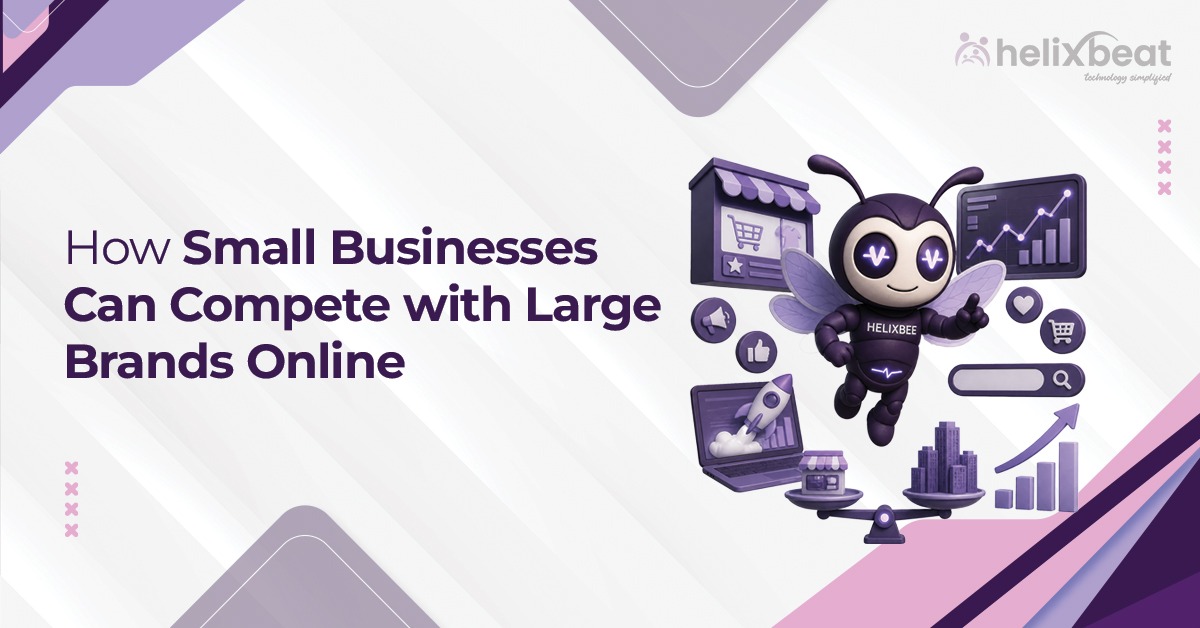
How Small Businesses Can Compete with Large Brands Online
Small businesses lose customers online when larger brands show up first in search results, social feeds, maps, review platforms, and paid ads. You may offer better service, faster support, or stronger local trust, but customers will not choose you if they cannot find you or understand why you are different.
Small Business Marketing solves that gap by turning visibility, trust, and follow-up into one connected growth system. The goal is not to copy big brands. The goal is to use focused Small Business Marketing to reach the right buyers, answer their questions, and make the next step easy.
Table of Contents
Why Large Brands Feel Hard to Beat
Large brands look stronger online because they usually have more budget, bigger teams, and more content. They can run ads, publish blogs, post videos, manage reviews, send emails, and test landing pages at the same time.
Digital marketing for small businesses often fails when owners try to match that volume without a plan. Posting randomly, boosting social posts, or running ads to a weak homepage creates activity, not growth.
Small Business Marketing needs a sharper path. A small brand can compete by owning a specific audience, speaking clearly, and proving value faster than a larger competitor. Small business online marketing becomes powerful when every channel works together instead of acting alone.
Start with a Clear Market Position
A small business cannot afford vague messaging. Customers should know within seconds who you help, what problem you solve, and why your solution is worth trusting.
Small Business Marketing starts with positioning because positioning controls every later decision. Website copy, ad headlines, social media captions, landing pages, emails, and sales scripts all become stronger when the promise is clear.
Small business branding is not only a logo or color palette. It is the reason customers remember you.
Strong Small business branding also reduces price pressure. When customers understand your value, they compare you on trust, expertise, convenience, and outcomes, not only cost.
Win Search Where Buyers Are Ready
Search is where small companies can compete with bigger names because buyer intent is already present. Someone searching for “emergency plumber near me,” “accountant for small business,” or “best pediatric dentist in my area” has a specific need.
Digital marketing for small businesses should focus on high-intent keywords, local pages, service pages, and helpful content rather than broad terms that large companies dominate.
Local business marketing plays a major role here. A complete and active Google Business Profile can help customers find a business on Search and Maps. Accurate business details, fresh photos, service descriptions, posts, and reviews support better local trust.
Small Business Marketing should connect SEO with the sales journey. If a customer lands on your page, the page should clearly explain the service, show proof, answer common concerns, and guide them toward enquiry.
Turn Content into a Sales Asset
Content should not exist only to fill a blog calendar. Good content helps buyers make decisions and helps sales teams handle fewer repeated questions.
Digital marketing for small businesses should include pricing guides, comparison articles, service explainers, checklists, FAQs, customer stories, short videos, and proof-led landing pages. Each piece should reduce doubt and move the buyer forward.
For deeper planning, HelixBeat’s guide on Small Business Marketing explains why small companies need structured digital support. The same thinking applies here: content works when it supports visibility, credibility, and conversion.
Small business online marketing improves when content is built around real buyer questions. A home service company can answer maintenance concerns. A clinic can explain symptoms and treatment options. A software firm can compare tools, costs, and implementation risks.
Use Paid Ads with Discipline
Small Business Marketing should make every paid click easier to convert. Paid ads help small businesses appear quickly in front of active buyers. However, paid traffic can waste money when campaigns are not connected to strong landing pages, tracking, and follow-up.
Small Business Marketing through ads should focus on qualified leads, not just clicks. Landing pages should match the ad promise, show clear benefits, include trust proof, and make enquiry simple through calls, forms, bookings, or WhatsApp.
Small business online marketing also needs retargeting.
Marketing strategies for small businesses should set a clear budget, define target locations, test offers, measure lead quality, and pause weak campaigns early. Paid media works best when learning is fast and waste is controlled.
Build Local Trust Faster Than Big Brands
Local buyers often want more than a famous name. They want a provider nearby, a quick response, personal care, and proof from people like them.
Local business marketing gives smaller companies a real advantage. Reviews, local testimonials, neighborhood-specific pages, community partnerships, event participation, and area-based offers can build trust that national competitors struggle to match.
Local business marketing should also include fast response systems.
Small Business Marketing becomes stronger when local proof appears everywhere: website pages, ads, map listings, social posts, email campaigns, and sales material.
Make Your Brand Consistent Everywhere
Inconsistent branding makes small companies look less reliable. A customer may see one message on Instagram, another on the website, and a different promise in ads. That confusion weakens trust.
Small business branding should create one recognizable experience across all channels. The same core promise, tone, visual direction, proof points, and offer structure should appear wherever customers meet the brand.
Small business branding also helps referrals.
Small Business Marketing uses that consistency to improve conversion. When prospects repeatedly see the same promise backed by proof, they feel more confident taking action.
Choose Fewer Channels and Execute Better
Many small businesses spread effort across too many platforms. They start SEO, Instagram, Facebook, LinkedIn, YouTube, email, ads, and blogs, but none of them gets enough attention to perform.
Marketing strategies for small businesses should begin with buyer behavior. A restaurant may need Instagram, Google Maps, reviews, and local ads. A B2B consultant may need LinkedIn, SEO, email, and webinars.
HelixBeat’s blog on Marketing strategies for small businesses shows how channel choice should connect to business goals. The same principle applies beyond IT: pick the channels your buyers trust most.
Small Business Marketing improves when teams commit to fewer channels, stronger execution, and monthly improvement.
Measure the Numbers That Affect Revenue
Large brands often have more data, but small businesses can act faster. That speed becomes a competitive advantage when tracking is set up correctly.
Small Business Marketing should measure enquiries by channel, cost per qualified lead, booking rate, conversion rate, repeat purchase rate, review growth, local search visibility, and campaign revenue. Vanity metrics such as likes and impressions matter less unless they connect to real business outcomes.
The U.S. Small Business Administration highlights market research and competitive analysis as part of business planning. Practical research helps smaller companies understand customer needs, competitor gaps, and stronger positioning.
Marketing strategies for small businesses become easier to improve when decisions come from evidence.
Why Marketing-as-a-Service Makes Sense
Small Business Marketing needs regular planning, execution, and reporting. Small business owners often know what needs to be done, but they do not have time to manage SEO, ads, design, content, email, analytics, automation, and reporting every week.
A Marketing-as-a-Service model gives small companies access to strategy and execution without hiring a full internal team. HelixBeat supports growth through SEO, SEM, social media marketing, content marketing, performance marketing, email campaigns, and WhatsApp marketing.
Small business online marketing becomes more manageable when one team connects message, creative, targeting, landing pages, tracking, and follow-up. That structure reduces confusion and helps owners see which activities are producing leads.
Digital marketing for small businesses works best when execution is consistent.
A 90-Day Action Plan
A 90-day plan gives small companies a realistic starting point.
First 30 days: review your website, map listing, reviews, competitors, landing pages, analytics, ad accounts, and brand message. Fix unclear calls to action, outdated information, weak service pages, and missing tracking.
Next 30 days: build the core system. Improve high-intent pages, create decision-focused content, optimize local profiles, launch one focused ad campaign, and set up email or WhatsApp follow-up.
Final 30 days: improve based on performance. Strengthen winning pages, pause weak ads, collect reviews, test new offers, and refine follow-up based on lead quality.
Local business marketing, Small business branding, and focused Small Business Marketing should work together through the full 90 days. The plan should create better visibility, stronger trust, and more qualified enquiries.
In nutshell
Small businesses do not need to outspend large brands to compete online. They need sharper positioning, better local visibility, consistent content, stronger proof, cleaner follow-up, and data-backed decisions.
Small Business Marketing gives smaller companies a practical way to compete. Search captures demand. Content builds trust. Ads create immediate visibility. Reviews reduce hesitation. Email and WhatsApp improve follow-up. Brand consistency makes the business easier to remember.
Small business online marketing should be focused, measurable, and connected to revenue. Digital marketing for small businesses should turn limited budgets into steady learning and better decisions. Marketing strategies for small businesses should be simple enough to execute and strong enough to scale. Local business marketing should make nearby buyers choose you with confidence. Brand clarity should make your value easy to recognize.
Talk to a HelixBeat Marketing-as-a-Service expert to build a focused digital growth plan that helps your small business compete with larger brands online.
FAQs
1. How can small businesses use the internet and online tools to compete with larger firms in marketing?
Small businesses can use websites, SEO, social media, email, paid ads, and Google Business Profile to reach the right customers online without needing a large marketing budget.
2. How can a small business compete with larger businesses?
A small business can compete by focusing on a clear niche, strong customer service, local trust, fast response, consistent branding, and targeted Small Business Marketing.
3. How can small businesses use social media platforms to compete with larger companies?
Small businesses can use social media to share helpful content, customer stories, offers, reviews, behind-the-scenes updates, and direct conversations with their audience.
4. How to compete with big brands?
To compete with big brands, small businesses should build trust, improve online visibility, target specific customer needs, collect reviews, create useful content, and stay consistent.