

Moving workloads to the cloud is no longer the hard part. Most IT teams can spin up a virtual machine or connect a SaaS tool within minutes. The hard part is deciding what belongs in the cloud, which provider fits each workload, and how to keep costs from spiraling once everything is live.
That decision-making process is what cloud strategy consulting aims to solve.
In this guide, we break down what cloud strategy consulting actually involves, how it differs from simply hiring a team to “do the migration,” and what businesses should look for before signing a contract with any provider.
Table of Contents
What Is Cloud Strategy Consulting?
Cloud strategy consulting is the advisory work that happens before, during, and after a business moves infrastructure, applications, or data to platforms like AWS, Microsoft Azure, or Google Cloud. Rather than jumping straight into a technical migration, a consultant maps out current infrastructure, business goals, compliance requirements, and budget constraints, then builds a roadmap that ties cloud decisions to measurable outcomes.
This differs from general cloud consulting services in scope. Cloud consulting services can include hands-on configuration, DevOps support, and vendor management. However, cloud strategy consulting defines why and how before anyone touches infrastructure.
Why Skipping the Strategy Step Costs Businesses Later
A common pattern among businesses that struggle with cloud costs is that they migrated first and planned second. Applications were lifted and shifted onto cloud servers without redesigning them for the new environment, so they kept consuming resources in the same wasteful way they did on-premises, except now they are billed by the hour.
A proper cloud migration strategy prevents this by identifying whether an application should be rehosted as-is, refactored to use cloud-native services, replaced with a SaaS alternative, or retired altogether. Businesses that skip this step frequently discover, months later, that their monthly cloud bill has grown well beyond projections, with no clear owner accountable for fixing it.
Core Components of a Strong Cloud Strategy
A credible cloud strategy consulting engagement typically covers:
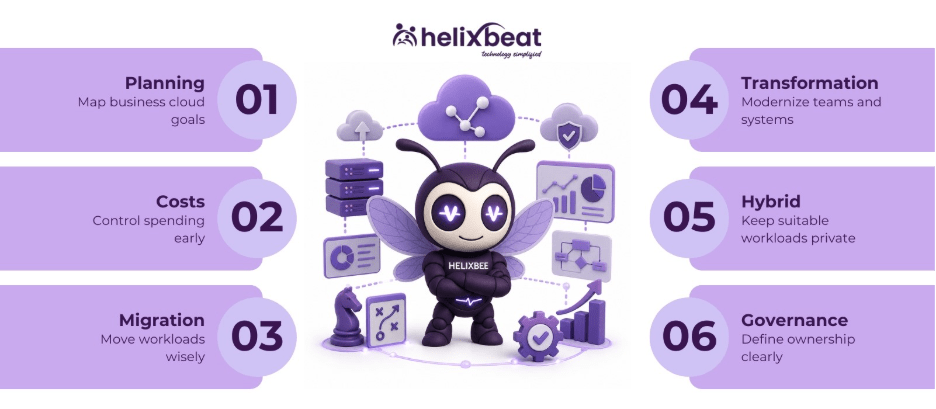
- Infrastructure and readiness assessment – auditing current servers, applications, dependencies, and data flows to spot what can move easily and what needs rework first. This overlaps closely with a broader IT infrastructure assessment, which examines the health of the whole technology stack.
- Migration sequencing – deciding the order in which workloads move, so low-risk applications go first, and business-critical systems move only once the process is proven.
- Cost governance – setting budgets, tagging policies, and monitoring so cloud spend stays predictable. This connects directly to IT cost optimization, which many businesses only address after costs have already gotten out of hand.
- Security and compliance mapping – aligning cloud configurations with regulations like HIPAA, SOC 2, etc., before data ever leaves on-premises systems. A cybersecurity audit run early in the process catches gaps before they become incidents.
- Governance and ownership – naming who approves new cloud resources, who reviews spend, and who is accountable when something breaks.
Cloud Transformation Is Bigger Than Migration
It’s worth separating two terms people often use interchangeably. Cloud migration strategy refers to the technical plan for moving workloads. Cloud transformation is broader: it’s the organizational shift in how a business builds, operates, and scales technology once the cloud becomes the default environment.
A business can complete a migration without achieving transformation. Servers move, but teams keep working the same way, provisioning resources manually and treating the cloud as a rented data center. However, real cloud transformation includes changes to how teams deploy code, monitor systems, and make purchasing decisions, not just where the servers physically sit.
Hybrid Cloud Consulting: Not Every Workload Belongs in Public Cloud
Public cloud gets most of the attention, but it isn’t the right home for every workload. Businesses in healthcare, finance, and manufacturing frequently keep certain systems on-premises or in private cloud environments for compliance, latency, or legacy integration reasons.
Hybrid cloud consulting addresses this reality directly. Instead of pushing a business toward an all-or-nothing cloud model, a hybrid approach identifies which workloads genuinely benefit from public cloud elasticity and which are better left in a controlled, private environment, then builds the networking and identity management needed to make both sides work as one system. This matters most for regulated industries.
When Should a Business Bring in Cloud Strategy Consulting?
A few signals usually point to the right time:
- Cloud costs are rising faster than usage or revenue can explain.
- A merger, acquisition, or new compliance requirement is forcing a re-architecture of existing systems.
- Internal teams lack cloud-specific expertise for the platforms in question.
- A previous “lift and shift” migration left performance or cost problems unresolved.
- Leadership wants a documented roadmap before the next budget cycle, not a reactive scramble.
Choosing the Right Cloud Strategy Consulting Partner
Not every provider offering cloud consulting services operates the same way. Businesses should ask for evidence of past readiness assessments, request a sample migration roadmap, and confirm the consultant has direct experience with their specific industry’s compliance requirements. A consultant who proposes a full migration plan before understanding current infrastructure or business goals is skipping the step that matters most.
It also helps to check whether the firm supports the full lifecycle — assessment, technology roadmap planning, migration, and post-migration cost management — rather than handing off responsibility once the initial move is complete.
Final Thoughts
Cloud strategy consulting isn’t about picking a provider and moving fast. It’s about building a plan that matches technology decisions to business goals, keeps costs predictable, and leaves room for hybrid environments where they make sense. Businesses that invest time in this step before migrating consistently end up with cloud environments that are easier to manage, cheaper to run, and better prepared for whatever comes next.
Get in touch with Helixbeat today to build a cloud strategy that supports digital innovation.
FAQs
1. What does a cloud strategy consulting engagement typically cost?
Cost varies with business size and complexity. A focused readiness assessment costs far less than a multi-phase transformation roadmap, so ask any provider for a scoped estimate tied to specific deliverables rather than a flat quote.
2. How long does building a cloud strategy take before migration starts?
For a mid-size environment, assessment and roadmap work often takes several weeks. However, regulated industries with heavier compliance mapping usually need more time upfront.
3. Is cloud strategy consulting only useful for large enterprises?
No. Smaller businesses often have less budget margin to absorb a poorly planned migration, which makes upfront strategy work just as valuable, if not more so.
4. What’s the difference between cloud strategy consulting and cloud migration services?
Strategy consulting decides what should move, when, and how. Migration services carry out the technical execution once that plan exists.
5. Should a business go fully public cloud or choose a hybrid model?
It depends on compliance obligations, latency needs, and legacy system dependencies. Hybrid cloud consulting evaluates this workload by workload instead of applying one blanket policy.