

A patient arrives at the emergency department unconscious. The triage team searches the system and finds two records for her — one from a visit three years ago, one from last month. The allergy list only lives on the older record, and the current medication list only lives on the newer one. Unfortunately, nobody notices until after the contrast dye is already in her IV line.
This isn’t a hypothetical scenario. It’s what happens when healthcare data quality breaks down across multiple EHRs, and it happens more often than most health systems want to admit.
Table of Contents
Why the Same Patient Ends Up With Three Different Charts?
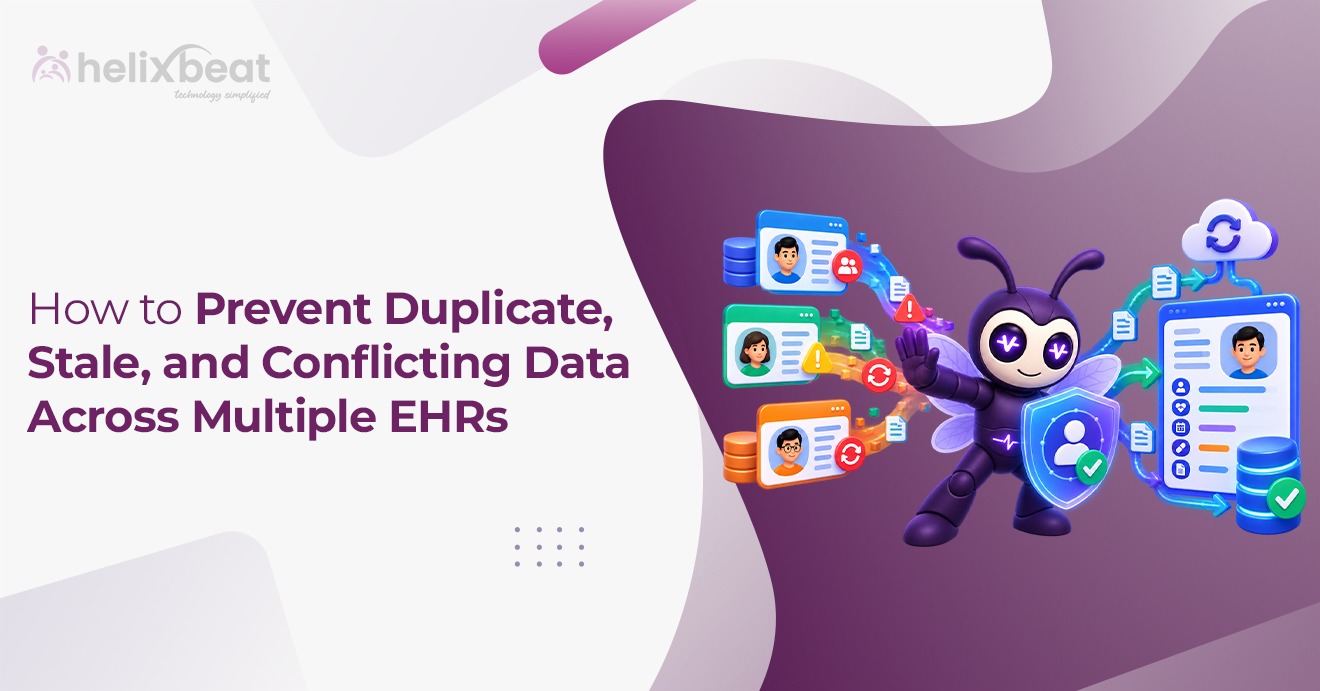
Duplicate, stale, and conflicting records don’t appear by accident. They’re the predictable result of how most health systems grow.
A hospital merges with a physician group. A specialty clinic adds its own scheduling system. A lab vendor sends results in a format nobody fully mapped out. As a result, each addition brings its own patient registration process, and few of them talk to each other in real time. Left unmanaged, healthcare data quality declines across the whole network.
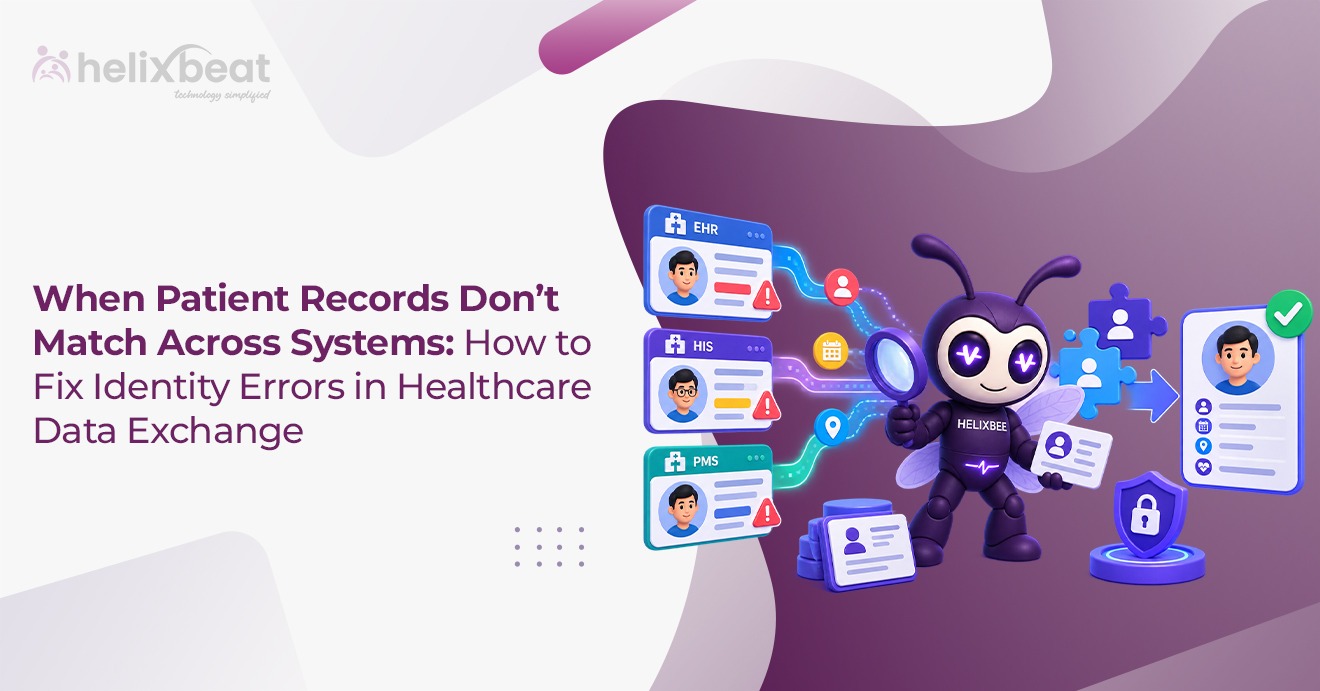
Patient matching is usually the first failure point. Registration staff type “Kathryn” in one system and “Catherine” in another. A middle name gets dropped. That’s how a new address simply slips through without getting linked to the older record on file. As a result, the system creates a new patient rather than recognizing an existing one. Thus, duplicate healthcare data starts piling up.
The second failure point is timing. Many EHR integrations still rely on batch feeds that run once a night. But a medication change made in the morning doesn’t appear anywhere else in the network until the following day, sometimes later. During that window, every other connected system is working from a stale picture. While real-time EHR data synchronization would close that gap, few organizations have it running for every connected source.
The third failure point is meaning, not mechanics. One system stores allergies as free text. Another requires structured codes. A diagnosis written as “heart attack” in one chart and “I21.9” in another looks like two separate facts to a machine, even though a clinician reads them as identical. This is where clinical data normalization becomes the deciding factor.
What This Actually Costs?
The American Health Information Management Association (AHIMA) has tracked this for years. Duplicate record rates in a typical hospital system run between 8 and 12 percent. At larger institutions, that figure can climb to 15 or 16 percent. However, AHIMA has set 1 percent as the achievable benchmark for healthcare data quality.
The financial impact is direct. Industry research puts the average cost of resolving a single duplicate record at close to $1,950, once you count registration rework, denied claims, and staff time spent reconciling the chart. Repeat tests and delayed treatment tied to fragmented records add further cost on top of that.
The clinical impact matters more. A missed allergy, an outdated medication list, or a lab result attached to the wrong chart isn’t a data problem at that point. It’s a patient safety problem. That’s the real argument for treating healthcare data quality as a clinical priority.
Fixing It Without Touching Your Core EHR
None of the fixes below require replacing the EHRs your clinicians already know. They require strengthening the layer that connects them, which is where most healthcare data quality problems actually live.
Build a real patient-matching layer. Exact-match logic on name and date of birth catches the obvious duplicates and misses everything else. A combination of deterministic rules and probabilistic matching catches far more, without merging two different people into one chart. This single change tends to move healthcare data quality metrics faster than anything else on this list.
Move from batch to real-time synchronization. Nightly feeds were reasonable when interfaces ran on point-to-point HL7 v2 connections. They aren’t reasonable now. Therefore, shifting critical data types, like allergies, medications, and problem lists, to real-time EHR data synchronization closes the staleness window where clinicians work from outdated information.
Establish a golden record. Master data management doesn’t mean picking one system as the permanent winner for every field. It means deciding, in advance, which source wins for which data type. Demographics might default to the most recently verified registration. Allergies might default to whichever source has the fullest list, with conflicts flagged for human review instead of silently overwritten.
Normalize to shared clinical vocabularies. Mapping free-text and vendor-specific fields to LOINC, SNOMED CT, RxNorm, and ICD-10 is what actually makes clinical data normalization possible at scale. Once two systems describe the same lab result or diagnosis the same way, both duplicate detection and record matching get more accurate. A FHIR-based interoperability layer like AERIS is usually the fastest route there without rewriting every downstream interface by hand.
Put a data steward on the problem. Someone needs to own conflict-resolution rules and review the records that automated matching flags as uncertain. Without a named owner, fixing bad records becomes nobody’s job, healthcare data quality quietly slides backward, and the duplicate rate creeps back up within a year.
Monitor continuously, not quarterly. Track duplicate rate, match confidence scores, and synchronization lag on a live dashboard. Healthcare interoperability projects tend to lose momentum after the initial cleanup.
Check at the point of entry. A soft alert during registration, such as “a similar patient record already exists,” stops a large share of new duplicates before they’re ever created. This is the cheapest fix on this list and often the most underused one.
The Payoff
None of these steps require a rip-and-replace project. They sit at the integration layer, the same layer that already handles your HL7 interface modernization work. Get those fundamentals right, and clinicians stop wasting time reconciling charts.
Ready to bring data consistency across multiple EHRs? Get in touch with us!
FAQs
- What is healthcare data quality, and why does it matter?
Healthcare data quality refers to how accurate, complete, consistent, and current patient information stays as it moves across systems. Poor quality shows up as duplicate records, outdated medication lists, or conflicting values for the same field.
- What causes duplicate healthcare data across EHR systems?
Duplicatesmainly comefrom weak patient matching at registration, name or identifier variations, and disconnected systems added through mergers or new departments. Without a shared identity layer, each system creates its own version of the same patient.
- How is EHR data synchronization different from a nightly batch feed?
A batch feed sends updates in a scheduled window, often once a day, so other systems work from outdated information in between. Real-time synchronization pushes changes as they happen, closing that gap for allergies and medications.
- What does clinical data normalization actually involve?
It means mapping free-text entries and vendor-specific codes to shared vocabularies such as LOINC, SNOMED CT, RxNorm, and ICD-10. Once two systems describe the same clinical fact the same way, matching and analytics both become more reliable.
- What duplicate record rate should a health system target?
AHIMA has set 1 percent as the achievable benchmark, though the typical range across hospitals sits between 8 and 12 percent, rising to 15-16 percent at some larger institutions. Getting close to the 1 percent mark takes ongoing matching and governance work.