

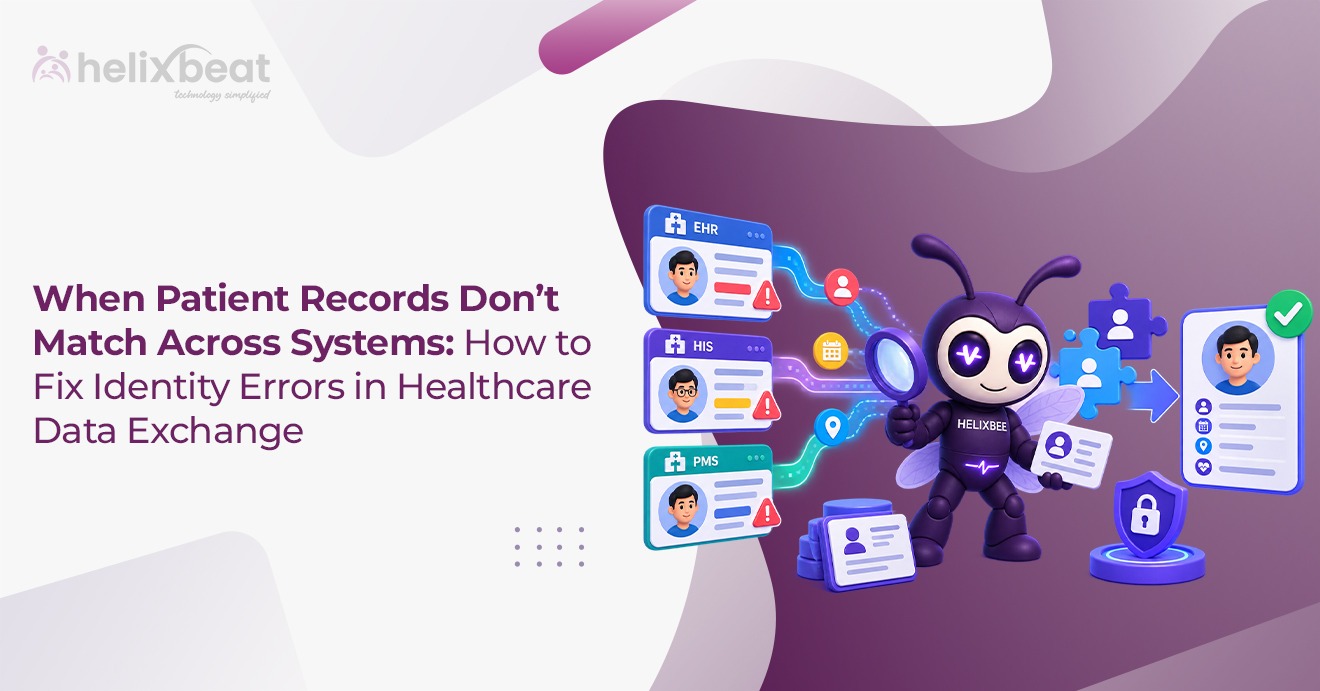
A patient walks into an emergency room in obvious pain. The intake nurse pulls up her chart. It shows no known allergies. It shows no history of the medication she’s currently taking.
Ten miles away, at the clinic that’s treated her for six years, a completely different chart tells a different story. Same person. Two records. Neither system knows the other one exists.
It’s one of the most common failures in healthcare data exchange, and it starts with something that sounds almost too simple: patient matching.
Table of Contents
Why Patient Matching in Healthcare Keeps Breaking?
Every time a patient registers at a new facility, someone at the front desk types in a name, a birth date, an address. That single moment of manual entry is where most identity problems begin.
A typo turns “Catherine” into “Katherine.” A recently married patient uses her maiden name at one location and her married name at another. An elderly parent and an adult child share a home address and a last name. None of these are unusual events. Legacy registration systems were never built to catch them consistently.
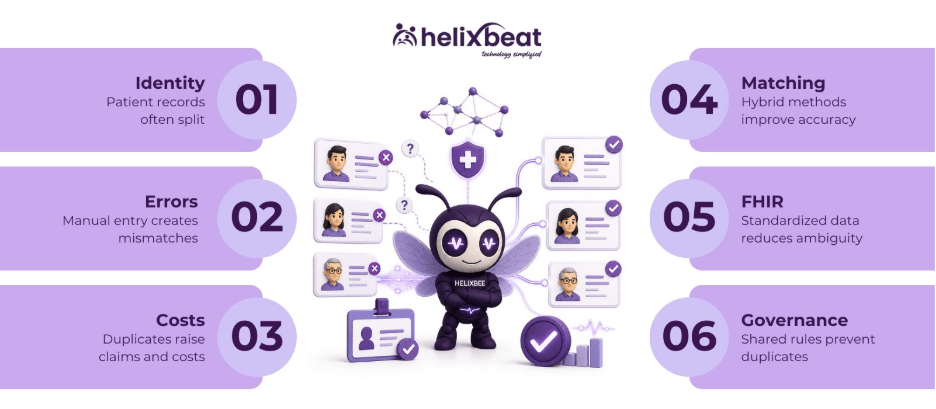
The United States also has no national patient identifier. Most developed countries assign one. Without it, hospitals rely on a patchwork of names, birth dates, and partial identifiers to guess whether two records belong to one person. Add hospital mergers, where decades of records built on different platforms suddenly need to be reconciled, and the problem multiplies quickly.
What Duplicate Patient Records Actually Cost?
The damage from duplicate patient records is well documented, and the numbers are hard to ignore.
Black Book Research found that inaccurate patient identification drives roughly 35% of all denied insurance claims. That costs the average hospital about $2.5 million a year. Across the US healthcare system, the total toll runs past $6.7 billion annually.
Untangling a single duplicate record adds close to $1,950 to the cost of an inpatient stay. It adds more than $1,700 to an emergency department visit. Both figures come from the same research.
Duplication rates across health systems commonly land between 10% and 20%. Some organizations report rates as high as 30%. AHIMA recommends a duplicate rate below 1% as the industry benchmark. However, a handful of top performers have achieved it.
These aren’t abstract figures. A missed allergy. A duplicate prescription. A repeated imaging test because the earlier result sits in a record nobody found. That’s the everyday cost of weak identity matching.
Deterministic vs. Probabilistic Matching: Neither Works Alone
Most legacy systems lean on deterministic matching. It looks for exact agreement across a fixed set of fields, such as name, birth date, and a Social Security number fragment. This method rarely produces a false positive. But it just as often misses a true match if even one field is slightly off. Some research suggests deterministic rules alone fail to connect matching records close to a third of the time.
Probabilistic patient identity matching takes a different approach. It scores each field by how reliable and unique it tends to be, then calculates the combined probability that two records belong to the same person. A government ID carries more weight than a phone number, since phone numbers change often and IDs rarely do.
The strongest identity resolution strategies combine both methods. Deterministic rules catch the obvious matches fast. Probabilistic and machine-learning models handle the harder cases. They recognize that “Bill” and “William” are often the same person, or that a transposed digit in a birth date is a typo, not a different patient.
Where FHIR Patient Matching Changes the Equation?
HL7 FHIR gives healthcare organizations a more structured foundation to build on. The standard defines a $match operation, along with consistent, machine-readable demographic fields. Therefore, systems no longer have to guess how a name or address was formatted upstream.
FHIR patient matching also benefits from the broader shift toward semantic interoperability, where data elements carry standardized codes instead of free-text descriptions. Helixbeat describes how semantic interoperability in healthcare covers consistent coding, through standards like LOINC and SNOMED CT, which reduces ambiguity.
However, none of this replaces good governance at registration. FHIR offers cleaner inputs to work with. The matching logic still needs to be tuned, tested, and watched over time.
Fixing EHR Data Matching: A Practical Path Forward
Organizations that meaningfully cut identity errors tend to follow a similar sequence.
They start by auditing their current duplicate rate honestly, using an enterprise master patient index or a dedicated matching engine. They tighten registration workflows, so staff verify identity against existing records when a search returns an imperfect match. Many are also adding biometric identifiers or photo capture at check-in as an extra layer of protection.
Also, having identical matching rules across all your connected EHRs matters just as much as building a smart algorithm. For instance, a hospital network running a dozen different interface engines, each with its own matching threshold, will keep generating duplicates no matter how sophisticated any single engine is. Therefore, centralizing that logic through a platform built for real-time exchange, like AERIS, gives every connected system one shared source of truth.
There’s also a legislative angle worth watching. The bipartisan MATCH IT Act, reintroduced in Congress in 2025, aims to create a standard definition for “patient match rate” and push for consistent demographic data standards across certified health IT. It hasn’t passed into law yet, but it signals where regulatory expectations are heading.
The Bottom Line
Patient matching in healthcare isn’t a back-office technicality. It decides whether a clinician sees a patient’s full history or just a fragment of it. Between growing pressure for standardized match-rate reporting and the maturing of FHIR-based tools, healthcare organizations have more resources than ever to close this gap. What’s often still missing is the discipline to pair better technology with better process, right at the point where a record is first created.
Ready to close the patient matching gap? Partner with Helixbeat to combine stronger technology with disciplined process!
FAQs
- What is patient matching in healthcare, exactly?
It’s the process of confirming that a patient record in one system, and a record in another system, both belong to the same real person. It happens every time data moves between a hospital, a clinic, a lab, or a health information exchange.
- Why do duplicate patient records happen in the first place?
Most start at registration. A misspelled name, a missing middle initial, a maiden name used at one visit and a married name at another. Research shows the large majority of duplicates originate at the initial data-entry step.
- How common are duplicate records in a typical hospital system?
Industry research points to duplication rates of roughly 10% to 20% at most organizations, with some running as high as 30%. AHIMA sets 1% as the target every organization should work toward.
- What’s the difference between patient identity matching and duplicate record cleanup?
Patient identity matching is the ongoing process of preventing new duplicates and correctly linking records as they’re created. Duplicate record cleanup is the retrospective work of finding and merging records that already exist as separate, mismatched entries.
- Does FHIR solve patient matching automatically?
No. FHIR patient matching gives organizations a standardized structure and a defined $match operation to work with. The underlying matching logic, the thresholds, and the data governance still need to be built and maintained by the organization.