

A decade ago, digital transformation meant moving files to the cloud and building a mobile app. That checklist is outdated now. Today, AI digital transformation is less about digitizing what already exists and more about rethinking how work gets done in the first place. If you’re leading a transformation initiative in 2026, artificial intelligence is the engine driving most of the progress.
Let’s get into what’s actually happening, where the real value shows up, and how to build a plan that doesn’t stall halfway through.
Table of Contents
Why AI Has Become the Core of Digital Transformation
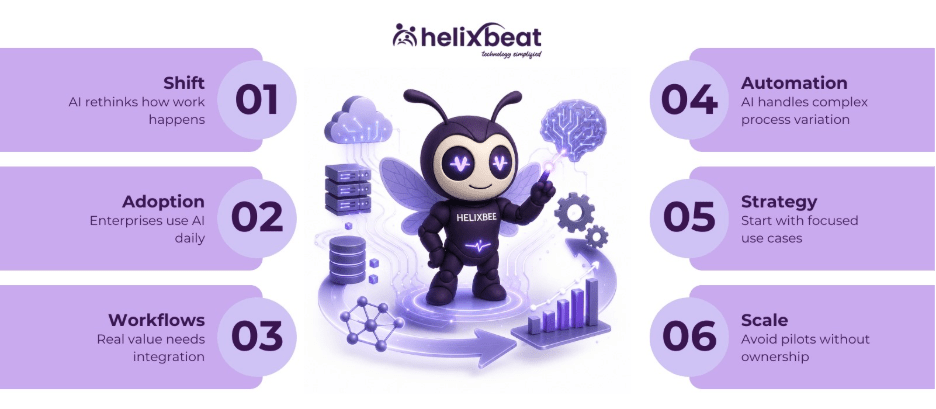
The numbers tell a clear story. McKinsey found that 88% of organizations regularly use AI in their day-to-day operations as of 2025. That’s a huge jump from 78% just a year prior. AI digital transformation has now moved from “something we’re piloting” to “something we depend on.”
But adoption and impact aren’t the same thing. The same research found that only around a third of companies have moved past isolated pilots to scale AI across the enterprise. The rest are still experimenting. That gap between using AI and actually transforming the business is where most of the missed opportunity sits.
This matters because artificial intelligence in business only pays off when it’s woven into workflows. A chatbot on a website is a feature. But AI that rewrites how claims get processed, how inventory gets forecast, or how contracts get reviewed — that’s transformation.
Where AI-Powered Business Transformation Actually Shows Up
Here’s where AI is changing day-to-day operations right now:
- Customer service: By taking over routine queries, auto-tagging tickets, and writing initial responses, AI keeps the easy tasks moving. This clears the time for support teams to solve customer problems.
- Supply chain and operations: Demand forecasting models now factor in weather, local events, and pricing shifts in ways spreadsheets never could.
- Finance and back office: Invoice matching, anomaly detection, and reconciliation that used to take days now run in the background continuously.
- Product and engineering: Code review, testing, and documentation are faster because AI handles the repetitive parts.
Each of these is a small AI-powered business transformation on its own. Stack enough of them together, and you get an organization that runs differently. Workflow automation services walk through this exact pattern in more depth.
What Separates Real Enterprise AI Adoption From a Science Project
Here’s the part most people skip: not every company that “uses AI” gets value from it. Gartner backs this up. Their data shows companies that take AI seriously keep their projects running past the three-year mark at twice the rate of those just dipping a toe in. Plus, early movers are already pointing to noticeable boosts in productivity and solid bottom-line savings.
What separates the two groups isn’t the technology. It’s three things:
- Data readiness. AI models are only as useful as the data feeding them. Siloed, inconsistent data is the single biggest reason pilots never scale.
- Workflow redesign. High performers don’t drop AI into an existing process. They rebuild the process around what AI makes possible. This is the difference between automating a bad process and fixing it.
- Leadership commitment. Successful enterprise AI adoption needs budget, executive sponsorship, and a willingness to change how teams work.
If your organization is still deciding where AI fits into your broader technology roadmap, it’s worth looking at how AI/ML integration connects with your existing systems.
AI Automation Solutions Beyond the Hype
“Automation” used to mean rigid, rules-based scripts that broke when a process changed. However, modern AI automation solutions are different because they can handle variation. It may include reading an unstructured invoice, interpreting an ambiguous customer request, or flagging an exception a static rule would’ve missed.
This matters for digital transformation because it removes a ceiling that used to exist. Traditional automation only worked on clean, predictable processes. AI-driven automation can now take on messier, judgment-heavy work — what actually slows businesses down. If paired with solid data analytics and insights, this kind of automation stops being a cost-cutting tool and starts becoming a genuine growth lever.
Building a Digital Innovation Strategy That Doesn’t Stall
A sound digital innovation strategy starts with picking a problem. Here’s a practical sequence that holds up across industries:
- Audit your data and processes first. You can’t automate or improve what you haven’t mapped out clearly.
- Pick one high-value, well-defined use case. Resist the urge to transform everything at once — narrow scope means faster proof of value.
- Pilot with a plan to scale, not just to test. Design the pilot assuming it will succeed, with the infrastructure to grow it.
- Set measurable business KPIs from day one — cost, cycle time, error rate — not just “did the AI work.”
- Build governance early. Data security, model oversight, and compliance can’t be an afterthought once you’re at enterprise scale.
Our digital transformation strategy consulting is built around this sequencing, largely because skipping steps is the most common reason transformation initiatives lose momentum.
Avoiding “Pilot Purgatory”
Industry researchers have a name for what happens when companies get stuck: pilot purgatory. It’s the state where AI projects run indefinitely as experiments, deliver small wins, and never graduate to production. It’s usually a planning failure. It happens when teams launch a pilot without a scaling plan, without clear ownership, and without a way to measure whether it’s actually working.
Therefore, treat every pilot as a future production system from day one, with the data pipeline, security review, and success metrics already built in.
The Bottom Line
AI digital transformation is already reshaping how competitive businesses operate. The organizations pulling ahead aren’t necessarily using more advanced models than everyone else. For them, it’s the core engine driving their day-to-day operations from the ground up. Whether you’re curious about artificial intelligence for your business or trying to scale past your first few pilots, the strategy matters more than the tool.
Tired of running small AI experiments and ready to make it a core part of your business? Get in touch with our team for a free consultation!
FAQs
1. What does “AI digital transformation” actually mean?
It refers to using artificial intelligence to fundamentally change how a business operates — rebuilding processes, decisions, and customer experiences around what AI makes possible.
2. Is AI digital transformation only relevant for large enterprises?
No. Small and mid-sized businesses often move faster because they have fewer legacy systems and less internal politics to navigate. The core principles — clean data, a well-scoped use case, and clear KPIs — apply regardless of company size.
3. How long does a typical AI transformation project take to show results?
A focused pilot on a single, well-defined process can show measurable results within 8 to 12 weeks. Enterprise-wide scaling typically takes 6 to 18 months, depending on data readiness and organizational complexity.
4. What’s the biggest reason AI pilots fail to scale?
Poor data quality and a lack of a scaling plan from the outset. Many organizations launch a pilot just to see if it works. But if you build a prototype without a blueprint for production, it’s going to get stuck in the lab.
5. Do we need a large data science team to get started?
Not necessarily. Many AI automation solutions today are built on pre-trained models and low-code platforms that don’t require an in-house data science team to implement. A knowledgeable technology partner can fill that gap.