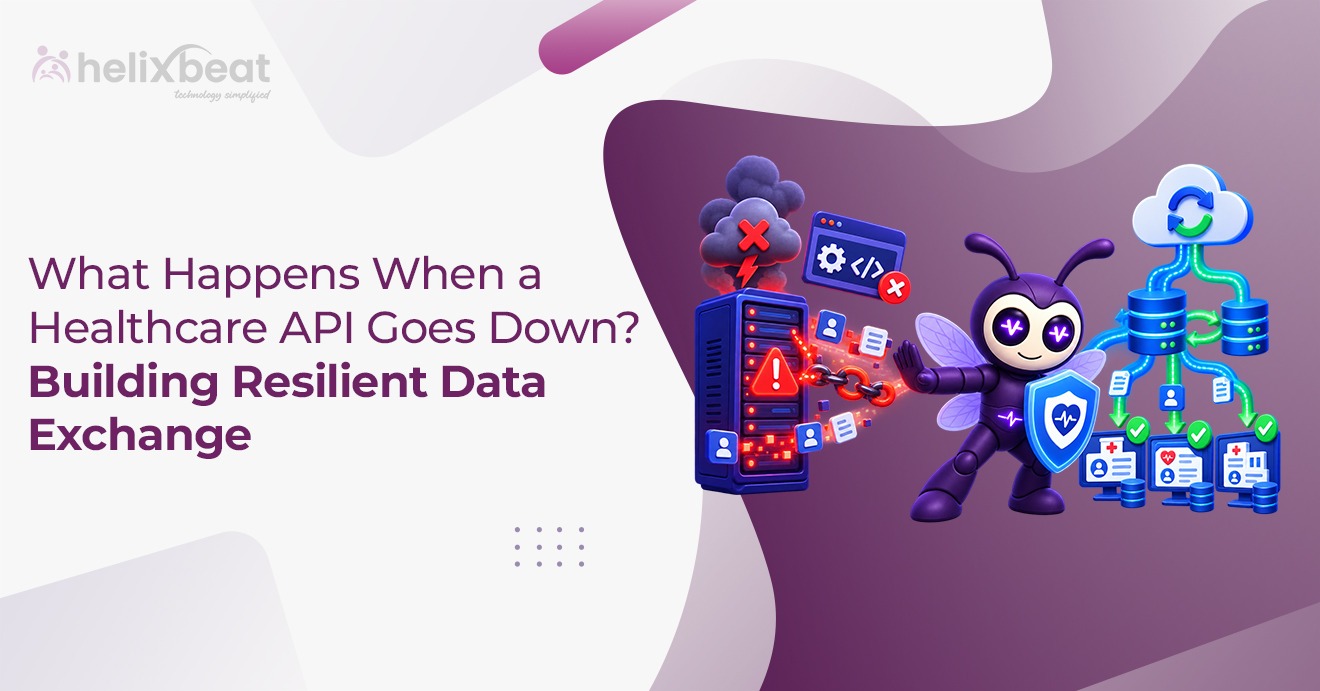


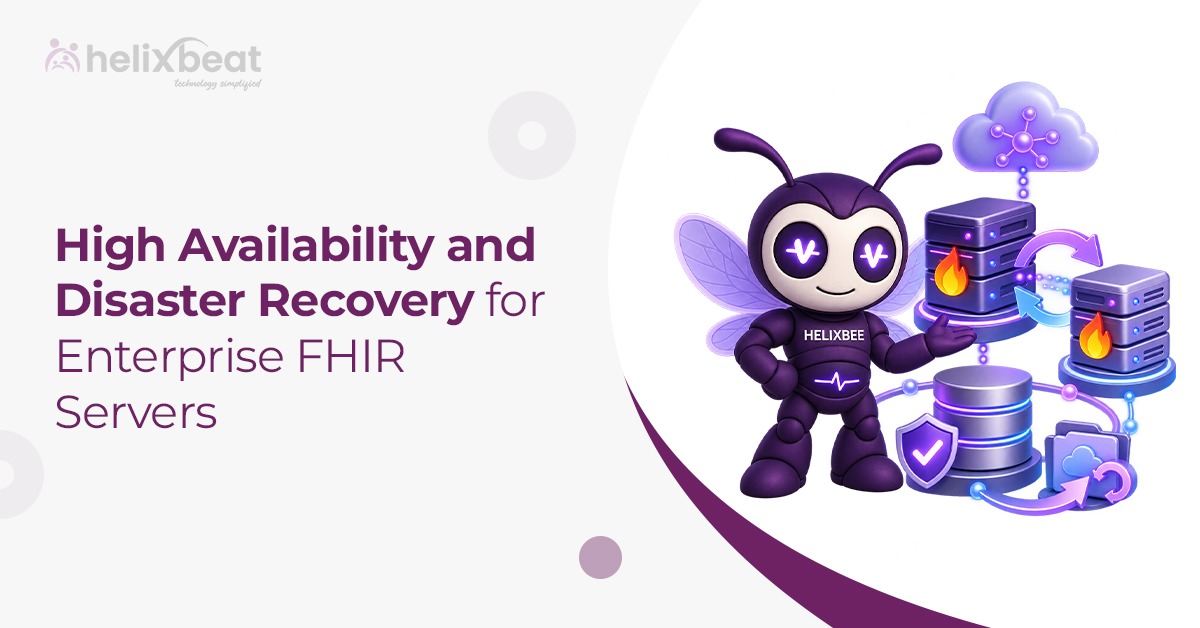
A FHIR server holds more than data. It holds the record a clinician pulls up mid-procedure, the lab result that changes a treatment plan, and the allergy flag that keeps a patient safe. When that system goes down, or worse, loses data, the cost isn’t measured in support tickets. It’s measured in delayed care. That’s why FHIR server disaster recovery deserves more attention than a line item in an IT audit.
Most enterprise IT teams already know the basics of high availability and backup. What changes with FHIR is the shape of the data and the regulatory weight behind it. In this blog, we walk you through what actually matters when building resilience around a FHIR server.
Table of Contents
Why FHIR Servers Need Their Own Conversation?
A FHIR server isn’t a single database. It’s usually the connective layer between EHRs, labs, imaging systems, patient portals, and third-party apps built on SMART on FHIR. If it goes offline, it doesn’t just stall one application. It can quietly break dozens of downstream integrations at once, some of which nobody remembers depend on it until they stop working.
The Regulatory Floor You Can’t Skip
Before getting into architecture, it’s worth being clear about what’s legally required. Under 45 CFR § 164.308(a)(7), the HIPAA Security Rule spells out five main requirements for your contingency plan. Covered entities and their business associates must maintain a data backup plan, a disaster recovery plan, and an emergency mode operation plan. They also need to map out their testing process and figure out which apps and data are too important to fail.
This isn’t optional guidance. It’s a compliance baseline. Any healthcare disaster recovery strategy for a FHIR server should start here, then build outward.
Building Real Redundancy, Not Failover Theater
A lot of “high availability” setups are really just a second server sitting idle, untested, and quietly out of sync with production. But real FHIR server redundancy means active-active or active-passive clusters across availability zones. It means database replication with a defined lag tolerance. It also means load balancing that can detect a degraded node and reroute traffic before users notice anything.
Testing failover on a schedule matters too. Both are prerequisites for redundancy that holds up under real load.
FHIR Data Backup: What’s Actually Different Here
Generic database backups aren’t quite enough for FHIR data, and here’s why. FHIR resources carry their own version history through the _history endpoint, which is useful for audit trails but isn’t a substitute for a real backup plan.
A proper FHIR data backup strategy needs a defined Recovery Point Objective: how much data loss is acceptable, measured in minutes. It needs backups stored offsite or in a separate cloud region from production. And it needs periodic restore testing, because a backup nobody has restored is a hypothesis, not a safeguard. Organizations weighing whether to build this in-house or move to a managed FHIR server should look closely at what downtime and data-loss risk actually cost.
From IT Recovery to Business Continuity
Recovering a server isn’t the same as keeping care running. Healthcare system business continuity planning has to account for what clinical staff does in the hours before systems come back online. That means downtime procedures, paper fallback workflows for critical orders, and clear communication about which data might be stale once systems return. A four-hour Recovery Time Objective means little if nobody on the clinical floor knows what to do during those four hours.
This piece is easy to skip when disaster recovery planning gets treated as a purely technical exercise. Yet it’s usually the piece that decides whether an outage becomes a non-event or a front-page problem.
A Short, Honest Checklist
Before calling a FHIR server disaster recovery plan complete, most teams still need to answer a few hard questions:
- Has failover actually been tested in the past twelve months, under realistic load?
- Is the Recovery Point Objective for FHIR data written down and agreed on by clinical leadership, not just IT?
- Are backups stored in a genuinely separate failure domain from production?
- Do frontline staff know the manual fallback process, and have they practiced it recently?
Is API access locked down well enough that a security incident doesn’t turn into the disaster being planned for?
Closing Thought
FHIR server disaster recovery isn’t a single project to finish and move past. Data volumes grow, integrations multiply, and regulatory expectations keep tightening. Therefore, building genuine redundancy takes ongoing work. So does a tested FHIR data backup process and a continuity plan that includes clinical staff.
Together, these are what separate organizations that recover in minutes from ones that spend days rebuilding trust. Platforms like FUSION are built with this kind of resilience in mind from the ground up.
Unlock Seamless Healthcare Interoperability with FUSION
Built by Helixbeat, FHIR server FUSION leverages RESTful APIs for seamless connectivity with legacy systems, modern EHRs, wearable devices, and telehealth platforms.
Certified Excellence
FUSION is officially certified by the Drummond Group for FHIR-based interoperability, validating its conformance with healthcare data exchange standards HL7, FHIR, and SMART on FHIR. This certification demonstrates that FUSION meets industry-recognized benchmarks for secure, standardized data exchange.
Ready to Build a More Resilient FHIR Infrastructure? Get in touch with us!
FAQs
- What’s the difference between high availability and disaster recovery for a FHIR server?
High availability keeps a FHIR server running through routine failures, like a single node going down, usually with little to no visible interruption. Disaster recovery covers larger-scale events, such as a full data center outage or data corruption, where systems need to be restored from backups or failed over to an entirely separate environment. Most enterprise setups need both working together.
- What Recovery Time Objective (RTO) should a FHIR server target?
It depends on how the server is used. A FHIR server supporting real-time clinical workflows, like order entry or medication administration, often needs an RTO measured in minutes. One supporting batch reporting or analytics can tolerate longer windows. The right number comes from a criticality analysis.
- How often should FHIR data backup restores be tested?
Quarterly is a reasonable minimum for most enterprise environments, with additional tests after any major schema, version, or infrastructure change. A backup that has never been restored in a test environment carries real, often hidden, risk.
- Does built-in resource versioning replace the need for backups?
No. Resource-level version history through the _history endpoint helps track changes to individual records, but it doesn’t protect against database-wide corruption, ransomware, accidental bulk deletion, or full infrastructure loss. A separate, independent backup process is still required.
- What does HIPAA actually require for disaster recovery?
The Contingency Plan standard (45 CFR § 164.308(a)(7)) requires a data backup plan, a disaster recovery plan, an emergency mode operation plan, testing and revision procedures, and an applications and data criticality analysis. It doesn’t prescribe specific technologies, only outcomes.