

Every hospital system wants an AI model that flags sepsis early, drafts clinical notes, or predicts which patients will miss a follow-up. But most of these projects stall before they reach a single patient. Here, the model usually isn’t the problem. The data underneath it is.
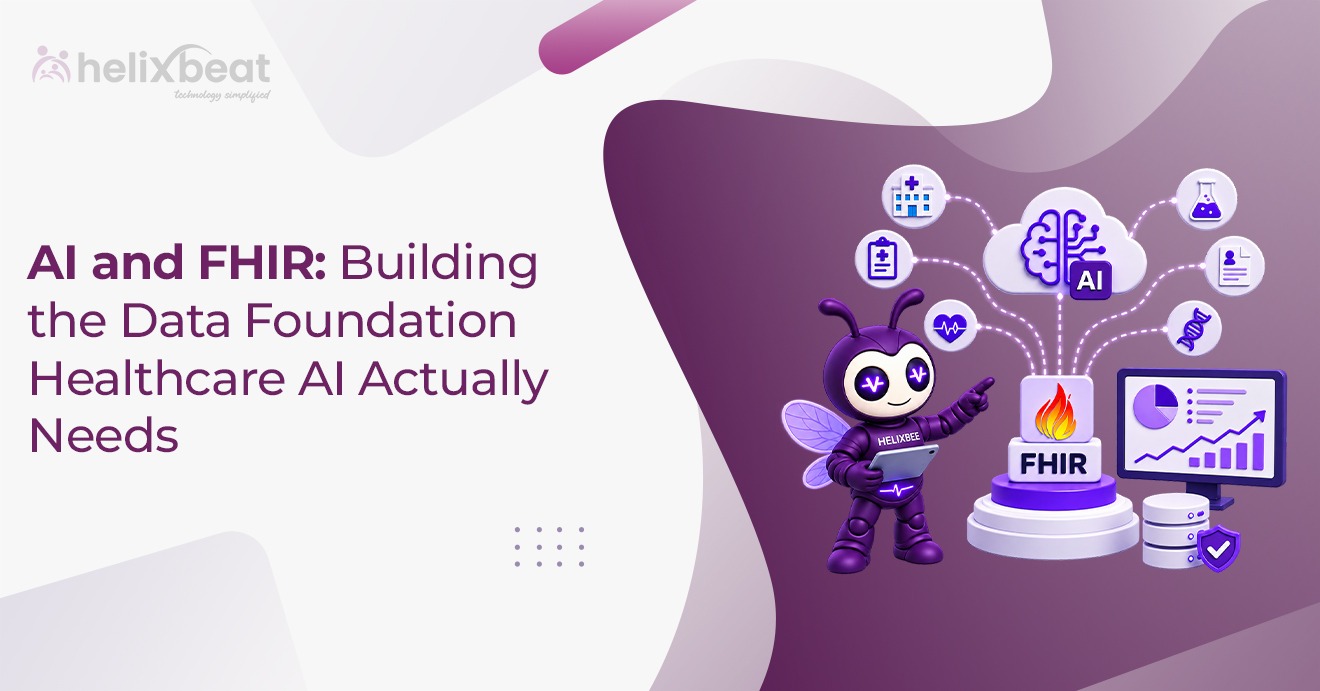
This is where AI and FHIR come together. FHIR gives healthcare systems a common language for exchanging patient data. Pair that common language with AI, and you get something healthcare has needed for years: a data foundation that machines can actually read, trust, and learn from.
In this blog, we walk through why that foundation matters, what FHIR brings that older formats didn’t, and how organizations are putting AI and FHIR to work today.
Table of Contents
Why Healthcare AI Keeps Hitting a Data Wall?
Ask any data scientist who has worked inside a hospital system, and they’ll tell you the same thing. The hardest part of a healthcare AI project isn’t training the model. It’s getting clean, structured, comparable data in the first place.
A single health system might run five different EHR platforms across its facilities. That’s why patient records end up scattered across HL7 v2 messages, PDF scans, free-text notes, and proprietary formats that don’t talk to each other. An AI model trained on data from one system often breaks the moment it sees data from another.
This is the core problem that clinical data interoperability tries to solve. Without it, every AI initiative starts by rebuilding the same data pipeline from scratch. That work eats up most of the project’s budget and time before a single prediction gets made.
What FHIR Actually Brings to the Table?
FHIR fixes this by breaking clinical information into discrete, well-defined pieces called resources. A Patient resource holds demographics. An Observation resource holds a lab result or vital sign. A MedicationRequest resource holds a prescription. Each resource follows the same structure everywhere it’s used. Each one can be requested through a standard REST API, returned as JSON or XML.
That consistency is what makes FHIR healthcare data usable for AI that older HL7 v2 messages couldn’t. Therefore, a model doesn’t need a custom parser for every hospital. It needs one that understands FHIR resources, and that same model can then run against any system that speaks FHIR.
How AI and FHIR Work Together in Practice?
The connection between AI and FHIR shows up in a few concrete ways.
SMART on FHIR makes it easy to snap custom apps straight into an EHR using OAuth2. Therefore, an AI-powered risk score or documentation assistant can run inside the clinician’s existing screen, instead of a separate app.
CDS Hooks, a related HL7 standard, lets an AI system trigger a recommendation at the exact moment a clinician is placing an order or reviewing a chart. That’s a very different experience from a report that arrives hours later and nobody reads.
For research and model training, Bulk FHIR, built around the $export operation, lets organizations pull population-level datasets in FHIR format instead of exporting one record at a time. That matters for teams building predictive models that need thousands of patient histories.
There’s also a newer pattern worth flagging: retrieval-augmented generation. When clinical LLMs draw directly from a patient’s FHIR record up front, you get summaries and answers you can actually rely on. That grounding keeps the model from hallucinating details outside the chart, which is huge in a clinical setting. This is one of the more promising directions for healthcare AI integration right now, and it depends entirely on having clean FHIR data.
The Regulatory Push Behind It All
The ONC’s 2020 Cures Act Final Rule requires certified health IT to support FHIR-based APIs, using HL7 FHIR Release 4 as the baseline. The CMS Interoperability and Patient Access Rule requires many payers to expose patient data through FHIR APIs as well. Together, these rules pushed FHIR from a nice-to-have standard into something close to a requirement across U.S. healthcare.
TEFCA, the Trusted Exchange Framework and Common Agreement, extends this further, aiming for nationwide data exchange between health information networks. None of these frameworks were written with AI specifically in mind. But each one pushes the industry toward structured, standardized records instead of siloed ones, which is exactly what AI healthcare data projects need to get off the ground.
Getting Started: A Practical Path
Organizations that get healthcare AI integration right tend to follow a similar sequence.
They start by auditing which FHIR resources their current systems actually expose, rather than assuming full coverage already exists. They pick one narrow, well-defined use case, such as readmission risk or documentation support, instead of trying to solve everything at once. They build in security from day one, including zero-trust access controls around FHIR APIs, since patient data now moves through more integration points than before. And they treat data governance as an ongoing job, not a one-time setup task.
Our AI/ML integration services and the AERIS data exchange platform both sit at this intersection, helping organizations move from scattered records to a FHIR-native foundation.
How AERIS Enhances Healthcare Data Interoperability with FHIR APIs?
Achieving true healthcare data interoperability demands real-time, standardized, and secure access to patient information. This is where AERIS by Helixbeat comes in, offering a powerful platform that combines event streaming with FHIR APIs.
AERIS enables healthcare providers, clinics, hospitals, pharmacies, and insurers to move beyond fragmented systems and adopt a connected, API-driven approach. Through FHIR APIs, the system supports real-time data exchange and provides instant access to critical patient information at the point of care.
As a result, AERIS creates a consistent, reliable data layer that simplifies integration, accelerates digital transformation, and drives meaningful improvements in healthcare data interoperability.
The Bottom Line
AI models are only as good as the data feeding them. In healthcare, that data has historically been locked in formats built for a different era. FHIR gives that data a common structure, and AI gives that structure a reason to exist beyond simple record-keeping. Get the foundation right first, and the AI applications might have a real shot at reaching patients instead of stalling in a pilot program.
Turn interoperability into an AI advantage with Helixbeat. Get in touch with us!
FAQs
- What does “AI and FHIR” actually mean together?
It refers to using FHIR-structured patient data as the input layer for AI models and applications, so the AI works with consistent, standardized clinical information instead of raw, mismatched formats.
- How is AI and FHIR integration different from traditional EHR integration?
Traditional EHR integration often relies on point-to-point interfaces built for one specific system pairing. FHIR integration uses a shared, standard API structure, so an AI tool built for one FHIR-compliant system can generally connect to another with far less custom work.
- Can AI models work with data thatisn’tin FHIR format?
Yes, but it usually takes more preprocessing. Many organizations convert HL7 v2 messages, CSV exports, or scanned documents into FHIR resources first, precisely so their AI tools only have to understand one format.
- Do smaller clinicsbenefitfrom AI and FHIR, or is this only for large hospital systems?
Smaller practices benefit too, especially since most modern EHR vendors now support FHIR APIs as part of Cures Act compliance. The barrier is usually less about clinic size and more about having the right integration partner.
- Is patient data safe when AI systems connect through FHIR APIs?
FHIR APIs support encryption, OAuth2-based authorization, and role-based access control. Safety in practice also depends on how an organization configures those controls andmonitorsaccess.