

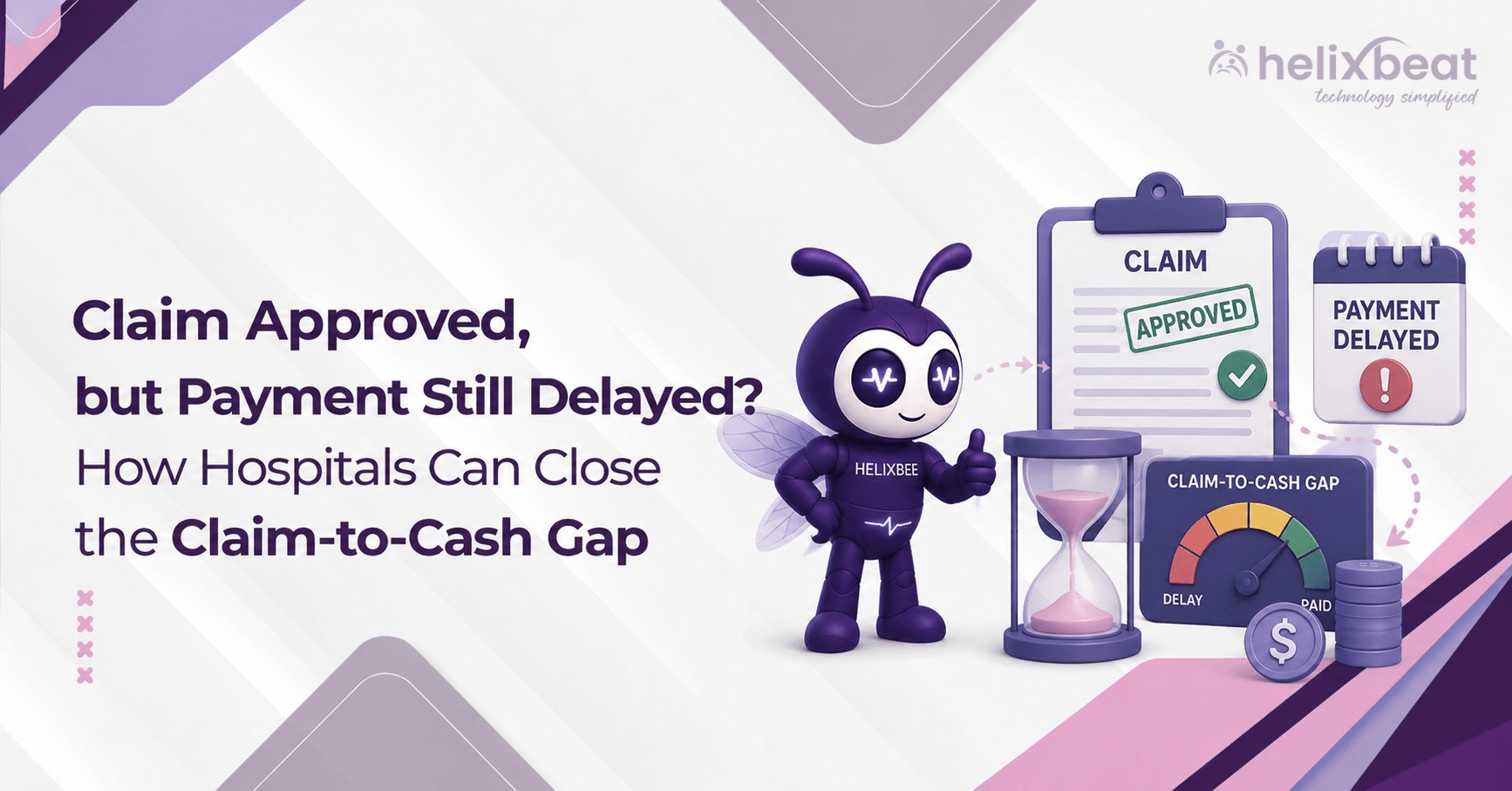
Claim Approved, but Payment Still Delayed? How Hospitals Can Close the Claim-to-Cash Gap
A claim marked “approved” can create a false sense of completion. For a hospital finance team, however, approval is only one milestone between care delivery and cash.
The payer may have adjudicated the claim, but the electronic funds transfer may still be pending, the remittance advice may not match the deposit, an adjustment may require review, or part of the balance may have shifted to the patient.
These gaps leave revenue sitting in accounts receivable even when clinical and claims teams believe their work is finished. For U.S. hospitals managing thin margins, labor pressure, and complex payer rules, that delay matters.
Automated insurance reimbursement gives revenue cycle teams a connected way to track approved claims, identify exceptions, reconcile payments, and route remaining balances. The goal is not simply faster approval. It is a controlled workflow that turns every approved claim into accurately posted revenue with fewer unnecessary manual follow-ups.
Approval Is Only One Claim-to-Cash Milestone
An approved claim still passes through several financial steps: calculation of the allowed amount, adjustments, ERA generation, EFT release, deposit, matching, posting, and collection of any patient balance.
That is why insurance claim payment delays can continue after adjudication. Automated insurance reimbursement must follow the transaction beyond the payer portal and confirm that expected revenue became posted cash.
The Centers for Medicare & Medicaid Services explains that an Electronic Funds Transfer, or EFT, transfers money, while an Electronic Remittance Advice, or ERA, explains how the claim was processed and adjusted. CMS also states that the EFT trace number should match the associated ERA trace number, helping providers connect a deposit with the correct remittance.
Why Approved Insurance Claims Are Not Paid Immediately
Understanding why approved insurance claims are not paid requires hospitals to separate payer delays from internal processing delays.
- Payers Release Funds on a Schedule
A payer may approve a claim but place it in a later payment batch. One EFT may cover many claims or facilities, leaving staff without a clear deposit date.
Automated insurance reimbursement should record approval, ERA, EFT, expected turnaround, and deposit dates to create a clear follow-up timeline.
- The ERA and EFT Arrive at Different Times
The remittance may arrive before the deposit, or the deposit before the remittance. Automated payment reconciliation can hold both records, match them when the second arrives, and flag only failed connections.
Without this connection, billing teams may spend hours searching payer portals, bank records, and remittance files for money that has already been approved.
- Payment Data Does Not Match Cleanly
Payer names may differ across systems, trace numbers may be incomplete, and deposits may combine hundreds of claims. Automated insurance reimbursement uses amounts, identifiers, claim references, and dates to connect the claim, ERA, EFT, deposit, and patient account.
This matching becomes particularly important for health systems with multiple hospitals, departments, provider groups, and bank accounts.
- The Approved Amount Is Lower Than Expected
Approval does not guarantee the contracted amount. Bundling, adjustments, recoupments, deductibles, or coinsurance may reduce payment. Automated payment reconciliation should compare billed, allowed, expected, and paid amounts, then route material differences for underpayment review.
Without an expected reimbursement value, a hospital may post an underpayment as complete and lose the opportunity to recover the difference.
- The Balance Shifts to the Patient
The insurer may complete its portion while assigning a deductible, copay, or coinsurance to the patient. Healthcare payment automation can immediately trigger a clear statement, secure payment options, reminders, recurring payments, or a payment plan.
This prevents the patient portion from sitting untouched after the insurance portion has been processed.
- Posting Is Delayed Inside the Hospital
Sometimes the money is already in the bank but remains unposted because staff are separating deposits, reviewing codes, or correcting account differences. Automated insurance reimbursement reduces this routine work and directs employees toward genuine exceptions.
Hospitals therefore need to distinguish between money that has not been released and money that has been received but not properly recorded.
The Financial Impact of Delayed Reimbursement
The claim-to-cash gap affects working capital, payroll planning, vendor payments, service-line decisions, and the hospital’s ability to invest in care.
The American Hospital Association reported that hospitals spent $43 billion in 2025 trying to collect insurer payments for care already delivered. The AHA linked this burden to claims denials, delays, repeated documentation requests, prior authorization, and changing billing rules. View the AHA statistics.
The 2025 DataSpring Index, powered by CAQH, identified a $21 billion industry savings opportunity from reducing administrative waste and closing automation gaps. View the 2025 Index findings.
These figures show why healthcare payment automation is an operational priority rather than a back-office convenience.
How to Reduce Insurance Reimbursement Delays
Hospitals asking how to reduce insurance reimbursement delays should organize the workflow around financial completion, not approval alone.
- Track the Full Reimbursement Sequence
Use a status model such as:
Approved → ERA received → EFT issued → Deposit received → Payment matched → Payment posted → Patient balance collected → Account closed
This creates reliable healthcare claims payment tracking and clarifies ownership. With automated insurance reimbursement, payer, treasury, posting, and patient financial teams can work the correct exceptions.
Each stage should have a responsible team, an expected completion time, and a defined escalation process.
- Build Payer-Specific Expectations
Hospitals should measure the normal days between approval, ERA receipt, EFT release, deposit, and posting for each payer. Automated insurance reimbursement can then prioritize exceptions by age, value, payer, and filing deadline.
A five-day delay may be unusual for one payer but normal for another. Payer-specific benchmarks prevent staff from wasting time on transactions that are still within the expected payment window.
- Automate ERA and EFT Matching
Automated payment reconciliation should use trace numbers, amounts, payer identifiers, claim references, dates, and facility data, including one-to-many payment relationships.
For additional guidance on connecting payment workflows with existing systems, read HelixBeat’s article on healthcare payment automation. It explains why EHR, RCM, and payment platforms need synchronized data instead of disconnected handoffs.
Automated matching should complete routine transactions without staff involvement while sending unmatched payments to a focused exception queue.
- Separate Payer Delays From Posting Delays
Healthcare claims payment tracking should classify each unresolved transaction precisely:
- Approved with no ERA or EFT
- ERA received with no deposit
- Deposit received with no ERA
- Payment matched but not posted
- Payment posted with an unresolved variance
- Insurance portion closed with a patient balance
This healthcare claims payment tracking prevents unnecessary payer calls and shows whether insurance claim payment delays originate outside or inside the hospital.
It also helps managers assign the issue to the correct team instead of moving it repeatedly between billing, treasury, and finance.
- Automate Adjustment and Underpayment Review
Claim Adjustment Reason Codes and Remittance Advice Remark Codes explain payer adjustments. Hospitals can route differences to contracting, coding, secondary billing, denial management, or patient collections.
Automated insurance reimbursement can rank underpayments by value, recovery probability, filing deadline, and payer behavior.
For example, a small contractual adjustment may require no action, while a significant variance on a high-value inpatient claim may need immediate contract review. Automation ensures both transactions receive the appropriate response.
- Trigger Patient Collection After Adjudication
Waiting to bill the patient extends the revenue cycle. Once the ERA confirms responsibility, healthcare payment automation can send an itemized statement, payment link, reminders, recurring billing, or a flexible plan, while showing what insurance paid and what remains due.
Clear communication is especially important when patients believe insurance should have covered the entire amount. Hospitals should explain the insurer payment, contractual adjustment, and patient responsibility in plain language.
- Use One Financial Dashboard
Claim status alone is insufficient. Leaders need a combined view of approved claims, pending EFTs, unmatched deposits, posting backlogs, underpayments, patient balances, and aging. Automated insurance reimbursement for hospitals should let every financial team work from the same record.
A centralized dashboard can also reveal recurring patterns, such as one payer consistently releasing late payments or one facility generating a high volume of unmatched deposits.
- Measure What Happens After Approval
Hospitals should monitor:
- Days from approval to EFT
- Days from deposit to posting
- Automatic payment match rate
- Total value of unmatched cash
- Approved claims beyond the expected payment time
- Underpayment value by payer
- Patient balance collection rate
- Manual touches per payment
- Cost to collect
These measures show whether automated insurance reimbursement is reducing insurance claim payment delays and improving cash flow.
What a Mature Automated Workflow Looks Like
A mature workflow does not remove staff from reimbursement. It removes avoidable searching, downloading, copying, and spreadsheet matching. Routine transactions move through automated insurance reimbursement without intervention, while exceptions are assigned with the evidence needed for action.
For example, an unmatched EFT should arrive in a treasury queue with the payer name, amount, trace number, deposit date, and possible ERA matches. An underpayment should reach the contract team with the expected amount, adjustment codes, filing deadline, and relevant payer rule. A confirmed patient balance should move directly to the appropriate billing and collection sequence.
Hospitals should also establish controls for access, audit trails, data retention, exception aging, and escalation. Automation becomes sustainable when every alert has an owner, every owner has a deadline, and leadership can see whether exceptions are being resolved or merely moved between teams.
Where PayNova Fits
PayNova supports the financial side of revenue cycle management. It should not be positioned as controlling payer adjudication or forcing an insurer to release an approved payment.
Within the hospital’s payment environment, PayNova can support connected billing information, digital patient collection, payment plans, recurring payments, multi-channel payments, dashboards, and reconciliation. This improves visibility after the payer determines insurance and patient portions.
Hospitals evaluating automated insurance reimbursement can use connected payment workflows to identify unmatched transactions, reduce posting work, accelerate patient billing, and shorten the distance between approved revenue and usable cash.
Implementation can begin with one high-volume payer, standardized identifiers, matching rules, and assigned exception queues. Once stable, the hospital can expand automated insurance reimbursement across more payers and facilities.
Conclusion
An approved claim is not revenue until payment is received, matched, posted, and fully resolved. Hospitals can close this gap by tracking every financial milestone, connecting ERA and EFT data, automating reconciliation, prioritizing underpayments, and moving patient balances into collection without delay.
Automated insurance reimbursement gives revenue cycle teams the visibility and control needed to replace fragmented follow-up with measurable workflows.
With PayNova supporting payment collection, reconciliation, dashboards, reminders, and flexible patient payment options, hospitals can reduce administrative work and improve cash flow without overstating what payment technology can control inside a payer’s complex adjudication and fund-release process reliably today.
Frequently Asked Questions
- Why are approved insurance claims not paid immediately?
An approved claim may still be waiting for an Electronic Remittance Advice, Electronic Funds Transfer, payment batch release, adjustment review, or internal payment posting. Approval confirms that the payer has processed the claim, but it does not necessarily mean the hospital has received and reconciled the payment.
- What is automated insurance reimbursement?
Automated insurance reimbursement is the use of connected technology to track approved claims, match remittance information with deposits, identify payment exceptions, support payment posting, and monitor outstanding reimbursement. It helps hospitals reduce manual follow-ups and improve visibility across the claim-to-cash process.
- How can hospitals reduce insurance claim payment delays?
Hospitals can reduce insurance claim payment delays by tracking every stage after approval, establishing payer-specific payment timelines, automating ERA and EFT matching, reviewing underpayments, monitoring unmatched deposits, and assigning unresolved transactions to dedicated exception queues.
- How does automated payment reconciliation help hospitals?
Automated payment reconciliation compares claims, remittance files, electronic deposits, adjustment codes, and expected reimbursement amounts. It automatically matches routine payments and flags missing, partial, delayed, or underpaid transactions for staff review.
- Can PayNova control when an insurance payer releases payment?
No. PayNova does not control payer adjudication or insurer fund-release schedules. It supports the financial side of revenue cycle management through payment visibility, reconciliation, digital billing, patient payment collection, recurring payments, payment plans, reminders, and financial dashboards.