

Delayed Patient Payments: Why They Happen—and the One Solution That Can Fix Them
A patient receives treatment, the insurer processes the claim, and the remaining balance becomes the patient’s responsibility. Yet the payment still does not arrive. For hospitals and medical practices, this creates longer accounts receivable cycles, repeated follow-up work, and unpredictable cash flow.
Understanding how to reduce patient payment delays requires looking beyond the final unpaid bill. Delays often begin earlier, with confusing insurance adjustments, late statements, high deductibles, limited payment methods, and disconnected billing systems.
The central solution is healthcare payment automation. By connecting billing, patient communication, digital collection, payment plans, transaction visibility, and reconciliation, automation removes avoidable friction. It cannot make an insurer or patient pay on command, but it can help providers send accurate bills sooner, make payment easier, and recognize received funds faster.
This article explains why delays occur, how insurance processing affects collections, and how PayNova supports a more efficient payment workflow.
Why Delayed Patient Payments Are a Growing Problem
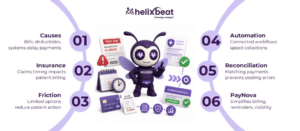
Patient responsibility now represents a meaningful part of provider revenue. Deductibles, copays, coinsurance, and non-covered services can leave patients with balances they did not expect or cannot pay immediately. KFF reports that about 41% of U.S. adults have some form of health care debt caused by medical or dental bills. KFF’s review of health care cost challenges shows why affordability must be part of any collection strategy.
For providers, staff must resend statements, answer questions, make reminder calls, and investigate exceptions. A sound strategy for how to reduce patient payment delays must improve both the patient experience and the internal workflow.
The Payment Journey Does Not End with Claim Approval
The payment journey typically moves through care delivery, claim submission, insurer adjudication, insurer payment, calculation of patient responsibility, patient billing, payment collection, posting, and reconciliation.
This sequence explains why insurance claim payment delays can create patient payment delays. Until the insurer completes adjudication and sends usable remittance information, the provider may not know the correct patient balance. Billing too early can create errors; billing too late increases the distance between care and collection.
Providers also ask why approved insurance claims are not paid immediately. Approval, payment release, remittance delivery, posting, and reconciliation are separate events, so an approved claim may still be in transit or unmatched.
The Most Common Reasons Patient Payments Are Delayed
Confusing Medical Bills
Patients may not understand what insurance paid or why a balance remains. Clear, itemized bills are essential to how to reduce patient payment delays because patients act faster when the amount is understandable and trusted.
High Out-of-Pocket Costs
Even a correct bill can remain unpaid when the balance is unaffordable as a lump sum. Flexible plans and recurring installments can turn a large one-time charge into a manageable schedule.
Late Statements
Manual workflows may require staff to wait for remittance, calculate the balance, and mail a statement. Faster digital delivery supports how to reduce patient payment delays by reaching patients sooner.
Inconvenient Payment Options
Requiring patients to call during office hours, mail a check, or visit the billing desk creates unnecessary friction. Mobile-friendly links, cards, bank transfers, and digital wallets let patients pay when they are ready.
Inconsistent Follow-Up
Manual reminders depend on staff capacity. Automated email or text messages create a reliable follow-up process without requiring a call for every account.
Disconnected Systems
Disconnected EHR, payment, and accounting systems force staff to re-enter data, slowing posting and leaving payments unmatched.
How Insurance Delays Affect Patient Collections
Insurance claim payment delays can postpone the point when patient responsibility becomes final. Missing remittance details, coordination-of-benefits issues, secondary insurance, partial payments, and payer adjustments may all delay the statement.
Providers considering how to reduce insurance reimbursement delays should improve claim visibility, data accuracy, electronic transactions, and exception management. A payment platform does not control the insurer’s timeline, but it can reduce internal delays after claim or payment information becomes available.
CAQH explains that standardized electronic rules can simplify claims and payment processes and reduce errors. Its payment and claims processing update supports more consistent electronic workflows.
This is where healthcare claims payment tracking matters. It helps teams distinguish claims awaiting adjudication, approved claims awaiting funds, missing remittance information, secondary payer balances, and amounts ready to bill to patients.
Why Traditional Billing Methods Are No Longer Enough
Consider a patient who receives a $1,200 statement six weeks after treatment. It does not clearly show what insurance covered, offers no plan, and requires a phone call. The patient sets it aside, forcing staff to follow up manually.
This example shows how to reduce patient payment delays: shorten the gap between balance determination and billing, explain the amount clearly, offer convenient payment options, and automate follow-up. Paper statements can still be offered, but they should not be the foundation of modern patient collections.
The One Solution: Healthcare Payment Automation
Healthcare payment automation connects repetitive financial tasks so information moves with less manual intervention. It can support digital statements, payment links, automated reminders, flexible plans, recurring transactions, centralized records, and financial dashboards.
Patients gain simplicity, while providers gain consistency: statements go out sooner, reminders follow a schedule, and teams focus on exceptions.
A practical guide on how to reduce patient payment delays should focus on removing friction. Patients respond better when payment is clear and manageable.
How to Reduce Patient Payment Delays with Automation
Send Accurate Statements Sooner
Automation can trigger billing after insurance responsibility is finalized. This directly supports how to reduce patient payment delays by removing unnecessary gaps between adjudication and patient outreach.
Make Balances Understandable
Digital statements can separate original charges, insurer payments, adjustments, and patient responsibility. Transparency reduces disputes and builds confidence.
Offer Payment Choice and Flexibility
Patients should be able to use convenient digital methods. Recurring plans allow larger balances to be divided into predictable installments, reducing missed due dates.
Automate Respectful Reminders
Messages can be scheduled around due dates and link directly to payment.
Give Teams Real-Time Visibility
Dashboards can show paid, overdue, partially paid, disputed, and plan-enrolled accounts. This visibility improves how to reduce patient payment delays because staff can prioritize high-risk exceptions.
The Role of Automated Payment Reconciliation
Receiving money is not the same as recognizing it correctly. Automated payment reconciliation matches a transaction with the appropriate patient account, statement, encounter, department, or payment plan.
For example, a patient may pay through a digital link, but incomplete reference details can leave the payment unidentified. With automated payment reconciliation, available transaction data can be used to match the payment or flag it for focused review.
This reduces unidentified cash, posting errors, and outdated balances. Automated payment reconciliation also limits reminders for bills already paid.
Why Healthcare Claims Payment Tracking Still Matters
A patient should not be billed before the payer portion is settled accurately. Healthcare claims payment tracking shows whether an account is awaiting payer action, approved but unpaid, missing remittance information, partially paid, assigned to secondary insurance, or ready for patient billing.
Combined with this visibility, automated insurance reimbursement for hospitals can improve workflow efficiency. It should not be presented as a guarantee that a payer will release funds sooner.
Better healthcare claims payment tracking also limits premature, incorrect, or duplicate statements. That accuracy is a key part of how to reduce patient payment delays, because patients are less likely to pay balances they do not trust.
How PayNova Helps Providers Collect Patient Payments Faster
PayNova is a healthcare-focused payment and billing automation solution supporting the financial side of revenue cycle management. It helps reduce friction between sending a bill and receiving, tracking, posting, and reconciling payment.
Relevant capabilities include automated patient billing and reminders, digital and multi-channel collection, recurring payments, flexible plans, telehealth payments, centralized transaction visibility, financial dashboards, secure processing, and simplified reconciliation.
Through healthcare payment automation, PayNova can help providers make bills clearer, payments more convenient, reminders more consistent, and workflows easier to monitor.
PayNova does not force payment, control payer timelines, correct coding, appeal denials, or replace a complete RCM platform. Its value lies in reducing avoidable friction and administrative work.
Practical Steps for Healthcare Providers
Organizations deciding how to reduce patient payment delays can use the following checklist. It turns the question of how to reduce patient payment delays into practical action:
- Map the process from adjudication to final payment.
- Identify statements waiting for manual action.
- Make bills clear, itemized, and mobile-friendly.
- Offer multiple digital methods and flexible plans.
- Automate respectful reminders.
- Use healthcare claims payment tracking to confirm patient responsibility.
- Apply automated payment reconciliation to received transactions.
- Measure payment cycle time, digital adoption, and plan completion.
Automation should remove routine work while staff handle disputes, hardship cases, and complex questions.
Conclusion
Delayed patient payments are usually caused by connected problems: confusing bills, high out-of-pocket costs, insurance claim payment delays, limited options, manual follow-up, and fragmented systems. The most sustainable answer to how to reduce patient payment delays is a connected, patient-friendly workflow.
PayNova supports that goal through digital billing, flexible payments, recurring plans, automated reminders, transaction visibility, and reconciliation.
By modernizing these processes, hospitals and medical practices can reduce avoidable administrative delays, improve cash-flow predictability, and give patients a clearer way to meet their financial responsibility.
Frequently Asked Questions
- Why are patient payments often delayed?
Patient payments are commonly delayed because of confusing bills, high deductibles, insurance processing issues, limited payment options, and manual follow-up processes.
- How can hospitals reduce patient payment delays?
Hospitals can reduce delays by sending bills faster, offering digital payment options, providing flexible payment plans, automating reminders, and improving payment visibility.
- What is healthcare payment automation?
Healthcare payment automation uses digital workflows to streamline billing, reminders, payment collection, recurring payments, transaction tracking, and reconciliation.
- How does PayNova help improve patient collections?
PayNova helps providers simplify patient billing, offer convenient payment methods, automate reminders, support payment plans, and reduce manual reconciliation work.