

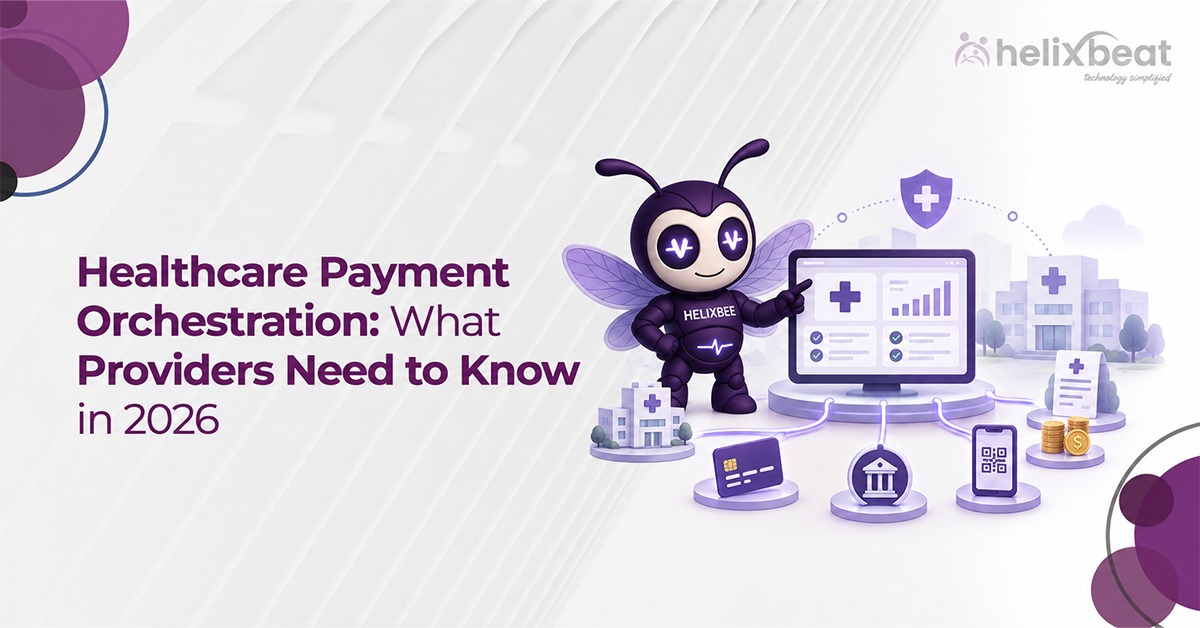
Healthcare payments are no longer a simple “send a bill, take a card, post the payment” process. Providers collect from patients and payers across cards, ACH, digital channels, payment plans, and multiple locations while keeping financial data connected to EHR, practice management, and revenue cycle workflows.
That complexity is why healthcare payment orchestration is becoming an important topic for finance, revenue cycle, and technology leaders in 2026. Instead of relying on one processor or a collection of disconnected payment tools, orchestration creates a coordinated layer that can decide how a transaction should move, which provider should handle it, what happens if the first route fails, and how the result is reconciled back into healthcare systems.
In simple terms, payment orchestration healthcare strategies aim to make payment operations more connected, resilient, and manageable. For providers, the goal is not merely faster transactions. It is a better financial workflow for patients, staff, and the organization.
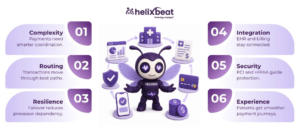
Table of Contents
What Is Healthcare Payment Orchestration?
Healthcare payment orchestration is the coordinated management of payment methods, processors, gateways, routing rules, security controls, transaction data, and downstream reconciliation through one operating layer.
A traditional payment gateway generally focuses on accepting and authorizing a transaction. A payment orchestration platform goes further by connecting multiple payment services and applying rules to determine how each transaction should be processed.
For example, an orchestration layer can route ACH and card transactions to different providers, retry eligible failed transactions through an alternate route, select processors by location or performance, tokenize credentials for recurring plans, send payment status back to billing systems, and centralize reporting across channels.
In healthcare, these capabilities matter because payment data cannot sit separately from patient responsibility, billing status, encounter information, refunds, and reconciliation.
Why Is Healthcare Payment Orchestration More Important in 2026?
The payment environment is becoming more distributed. Providers now support portals, mobile payments, card-present transactions, recurring payments, ACH, and remote care, while patients expect consumer-style convenience from a much more complex billing system.
The broader payments industry is also emphasizing redundancy. A June 2026 PYMNTS Intelligence and Spreedly study found that nearly nine in ten surveyed companies had failover or backup routing in place. Although the research was not healthcare-specific, it shows that routing resilience has become a mainstream payments priority.
For providers, healthcare payment orchestration can create a layer of resilience between the patient experience and an individual processor. If one route becomes unavailable or performs poorly, another may be selected according to predefined rules rather than forcing staff to resolve every problem manually.
How Does Payment Routing Work in Healthcare?
Healthcare payment routing is the logic used to decide where and how a transaction should be processed. A rule may be simple, such as directing ACH transactions to a particular provider, or dynamic, such as choosing a route based on authorization performance, transaction type, fees, payment channel, location, or system availability.
A well-designed healthcare payment routing model should not focus only on cost. Providers should also consider reliability, settlement speed, security, refunds, recurring billing, reporting, and how cleanly payments post back to the source system.
An approved transaction can still create administrative work if staff cannot match it to the correct patient account or encounter.
What Problems Can Orchestration Solve for Healthcare Providers?
Payment Failures and Processor Dependency
A single payment connection creates a single point of operational dependency. Healthcare payment orchestration can support controlled failover so eligible transactions have another path when a processor or connection becomes unavailable.
Fragmented Patient Payment Channels
A patient might pay at the front desk, through a portal, using a mobile payment link, through a payment plan, or after a telehealth visit. Payment orchestration healthcare architecture can help unify these channels rather than forcing every payment method into a separate reporting process.
Manual Reconciliation
Disconnected processors often create separate settlement files, dashboards, refund processes, and reporting formats. Orchestration can normalize transaction data and provide financial teams with a more consistent view of payments.
Complex Routing Decisions
Healthcare payment routing can automate decisions that would otherwise sit inside processor configurations or depend on manual intervention. Rules can be designed around transaction type, location, payment method, processor health, or organizational priorities.
Limited Flexibility as Providers Grow
As practices expand into new locations, specialties, or digital care models, the payment environment often becomes more complex. A payment orchestration platform can create a common layer for adding processors and payment methods without rebuilding every patient-facing workflow.
Healthcare Payment Orchestration vs. a Payment Gateway
The terms are related, but they are not identical.
A payment gateway securely transmits payment information for authorization and processing. Healthcare payment orchestration, on the other hand, coordinates multiple components across gateways, processors, payment methods, tokenization, routing rules, and reporting.
Think of a gateway as one road. Orchestration is the traffic-control system deciding which road a transaction should take, what should happen when a route is unavailable, and where the transaction data must go afterward.
For organizations connecting EHR, RCM, and payment systems, integration is foundational. Learn more about healthcare payment orchestration in connected financial workflows through PayNova’s payment integration resource.
PayNova’s existing payment model also emphasizes centralized processing and integration with EHR and Practice Management Systems, helping connect billing and payment information instead of managing them as isolated workflows.
What Should Providers Look for in an Orchestration Platform?
Providers should evaluate more than the number of processors a solution supports. The architecture must work within real healthcare operations.
Key questions include:
- Integration: Can it connect with EHR, PMS, RCM, patient portal, and billing systems?
- Routing: Can rules change according to payment method, location, channel, processor performance, or operational conditions?
- Failover: Can backup processing occur automatically under clearly defined conditions?
- Tokenization: Can payment credentials be securely tokenized for recurring payments and payment plans?
- Reconciliation: Can payments, settlements, refunds, and adjustments be connected back to the appropriate patient account?
- Reporting: Can finance teams analyze transaction performance across channels, processors, locations, and payment methods?
- Security: Does the payment orchestration platform support relevant PCI DSS obligations and appropriate healthcare privacy and security controls?
PCI DSS v4.0.1 remains central to payment-security planning in 2026. The PCI Security Standards Council published updated v4.0.1 assessment materials, while requirements originally designated as future-dated under v4.0 became effective on March 31, 2025. Security therefore needs to be treated as an active operational responsibility rather than a future technology project.
How Does HIPAA Affect Payment Orchestration?
HIPAA does not prevent protected health information from being used for legitimate healthcare payment activities. HHS guidance explains that covered entities may use and disclose PHI for treatment, payment, and healthcare operations, subject to applicable Privacy Rule limits and protections.
The important issue is architecture.
If a payment workflow includes PHI, providers need to understand which vendors receive it, why they receive it, how it is protected, and whether business associate obligations apply.
A healthcare-focused implementation should minimize unnecessary exposure of patient information, use appropriate access controls, maintain auditability, and carefully manage how financial and healthcare data interact.
For a deeper security discussion, review PayNova’s guide to HIPAA-compliant card processing when assessing a payment orchestration platform.
What Does Good Payment Routing Look Like?
Good healthcare payment routing should be predictable for administrators while remaining almost invisible to patients.
A patient should simply experience a reliable payment process while the technology applies the appropriate routing rules in the background. Rules might consider payment method, provider location, processor availability, authorization performance, transaction amount, recurring versus one-time payments, or card-present versus digital transactions.
The important point is governance. A mature payment orchestration healthcare strategy documents, tests, monitors, and reviews routing rules.
If routing becomes unnecessarily complicated, an organization can create new reconciliation and support problems instead of solving existing ones.
How Can Orchestration Improve the Patient Financial Experience?
Patients care less about the processor behind a screen than whether payment works, the amount is clear, their preferred method is supported, and confirmation is accurate.
Healthcare payment orchestration supports this experience by reducing operational fragmentation behind the scenes. When payments, balances, payment plans, refunds, and transaction statuses remain synchronized, patients are less likely to encounter duplicate payment requests, unclear balances, or delayed posting.
It also gives healthcare organizations more freedom to expand payment options without creating a completely separate financial workflow for every new channel.
Where Does PayNova Fit?
PayNova is designed around healthcare payment workflows in the United States, where providers must coordinate patient payments, multiple payment methods, billing processes, security requirements, and healthcare system integrations.
PayNova’s model includes centralized payment processing, credit and debit cards, bank transfers, digital wallets, recurring payments, payment plans, EHR and PMS integration, financial reporting, automation, and secure transaction handling.
Its underlying approach also addresses common provider challenges such as delayed collections, administrative workload, payment disputes, refunds, fragmented revenue streams, and financial reporting.
These capabilities align closely with the operational goals of healthcare payment orchestration: fewer disconnected systems, more consistent payment data, stronger visibility, and less manual work for administrative teams.
The practical question is not, “How many processors can we connect?” It is, “Can we build a reliable payment model across patients, staff, systems, and locations?”
Final Thoughts
In 2026, healthcare payment orchestration is becoming less about adding another payment tool and more about creating the coordination layer that fragmented healthcare finance has been missing.
The strongest strategy combines intelligent routing, backup processing, integrated payment data, reconciliation, patient-friendly payment choices, security, and clear operational governance. Payment orchestration healthcare programs should ultimately reduce complexity rather than move that complexity into another dashboard.
Before selecting technology, providers should map current payment flows, identify failure points, review processor dependencies, understand where PHI and financial data travel, and determine what needs to synchronize with their EHR, PMS, billing, or RCM environment.
When those foundations are clear, healthcare payment orchestration can help providers create a more resilient payment ecosystem—one that supports smoother collections, cleaner financial operations, and a better patient experience as payment expectations continue to evolve.
FAQs
- What is healthcare payment orchestration?
It connects and manages multiple payment systems in one workflow.
- How does healthcare payment routing help providers?
It directs payments through the best available processing route.
- Why use a payment orchestration platform?
It improves reliability, reconciliation, flexibility, and payment visibility.
- Is payment orchestration healthcare secure?
Yes, with proper PCI DSS, tokenization, and data security controls.