

Running ads is easy. Knowing whether those ads are actually helping your business grow is much harder.
You may see clicks rising, leads coming in, and revenue increasing. But none of these numbers tells the full story on its own. A campaign can generate strong revenue and still be unprofitable. Another can produce cheap leads that never become paying customers.
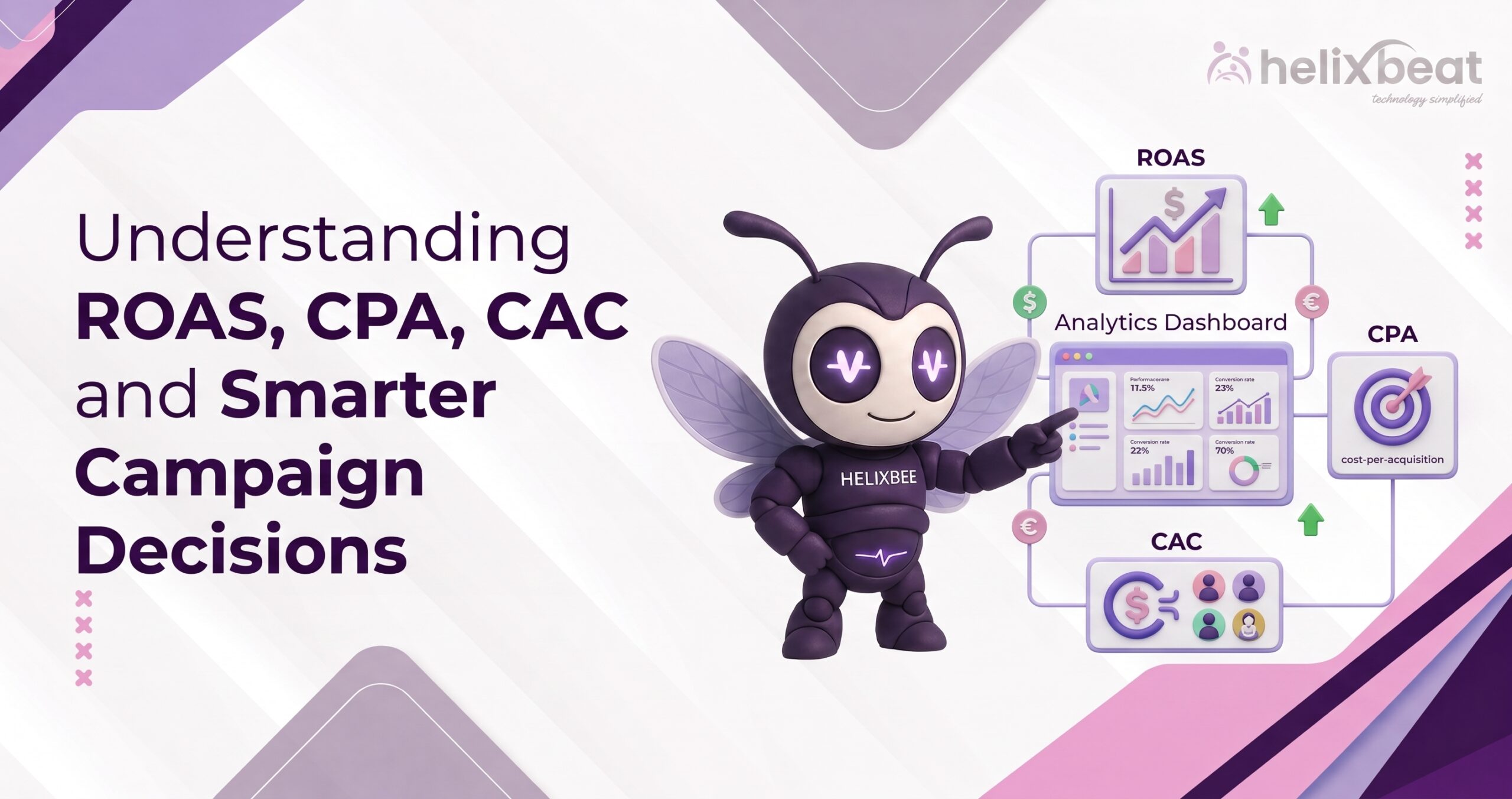
That is why marketers need to understand ROAS vs CPA vs CAC. These three numbers answer different questions about efficiency, conversion, and growth. Read together, they give you a clearer view of where your budget is working and where it is leaking.
These marketing performance metrics help turn campaign reporting into smarter budget decisions.
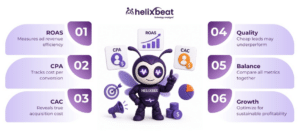
Table of Contents
ROAS vs CPA vs CAC: The Simple Difference
The easiest way to understand ROAS vs CPA vs CAC is this:
- ROAS asks: How much revenue did my ads generate?
- CPA asks: How much did I spend to get one conversion?
- CAC asks: How much did it cost the business to win one new customer?
Return on ad spend focuses on advertising revenue efficiency. Cost per acquisition focuses on the cost of a defined conversion. Customer acquisition cost looks wider and includes the broader cost of acquiring a paying customer.
A campaign can look excellent in an ad platform but appear much weaker once broader acquisition costs are included.
What Is ROAS?
ROAS stands for return on ad spend. It shows how much revenue your advertising generates compared with what you spent.
ROAS = Revenue from Ads ÷ Advertising Spend
If you spend ₹1,00,000 on ads and generate ₹4,00,000 in attributed revenue, your ROAS is 4.0, or 400%.
Google describes target ROAS as the conversion value you want to generate for each unit of ad spend. For example, $5 in sales for every $1 spent equals a 500% target ROAS.
This makes ROAS one of the most useful campaign ROI metrics when revenue can be tied directly to advertising. But high ROAS does not automatically mean high profit. A 5x ROAS product with weak margins can be less attractive than a 3x ROAS product with stronger margins and repeat purchases.
That is the first reason the ROAS vs CPA vs CAC comparison matters.
What Is CPA?
CPA means cost per acquisition or, on some platforms, cost per action. It measures how much you spend to generate a defined conversion.
CPA = Campaign Cost ÷ Number of Conversions
If you spend ₹50,000 and generate 100 qualified leads, your CPA is ₹500 per lead.
Google defines average CPA as total conversion cost divided by the number of conversions.
CPA is useful when your goal is a lead, demo, install, trial, or booking rather than immediate revenue. That makes it an important digital marketing KPI for lead-generation campaigns.
But cheap conversions are not always good conversions. WordStream’s 2025 Google Ads benchmark study analyzed more than 16,000 US campaigns and found an average cost per lead of $70.11, up from $66.69 in 2024. The number is a useful reminder that acquisition costs change over time and vary by industry, intent, and offer quality.
This is another reason ROAS vs CPA vs CAC should be reviewed together.
What Is CAC?
CAC means customer acquisition cost. It answers a broader question: how much does it really cost to acquire one new paying customer?
CAC = Total Sales and Marketing Acquisition Costs ÷ New Customers Acquired
If your total sales and marketing acquisition spend is ₹3,50,000 and it brings in 100 new customers, your CAC is ₹3,500.
This is where CAC becomes more useful than ad-platform CPA for business planning. A low CPA can look impressive, but if very few leads become paying customers, the final CAC can still be too high.
That is the third key lesson in ROAS vs CPA vs CAC.
ROAS vs CPA vs CAC: Quick Comparison
| Metric | What It Measures | Formula | Best For |
| ROAS | Ad revenue efficiency | Ad revenue ÷ ad spend | Ecommerce and revenue campaigns |
| CPA | Cost of a conversion | Campaign cost ÷ conversions | Leads, trials, installs, bookings |
| CAC | Cost to acquire a customer | Sales + marketing cost ÷ new customers | Growth and profitability |
The mistake is choosing one number as the “winner.” Strong decisions come from connecting all three marketing performance metrics to your business model.
Why ROAS Alone Can Mislead You
ROAS is useful, but it can hide important costs.
It usually focuses on attributed revenue, not complete profitability. Margins, refunds, discounts, delivery costs, or commissions may sit outside the number. Attribution can also distort your campaign ROI metrics when multiple channels influence one purchase.
There is also a time problem. Research highlighted by Think with Google found that advertisers in the analyzed studies averaged £1.87 in short-term profit ROI for every £1 invested, but the figure increased to £4.11 when sustained effects were included.
So when reviewing ROAS vs CPA vs CAC, do not assume a short-term dashboard captures the full value of marketing.
When CPA Is More Useful
CPA is often the better digital marketing KPI when the campaign goal is an action rather than immediate revenue.
Imagine two B2B campaigns:
- Campaign A: CPA ₹1,000, lead-to-customer rate 5%
- Campaign B: CPA ₹1,500, lead-to-customer rate 15%
Campaign A looks cheaper. But Campaign B produces much stronger leads. Once sales outcomes are included, its final customer acquisition cost may actually be lower.
That is why optimizing only for the lowest cost per acquisition can push you in the wrong direction.
Instead, connect ad data with CRM data. Track qualified leads, opportunities, closed customers, revenue, and repeat business. This turns ROAS vs CPA vs CAC into a decision framework instead of three disconnected formulas.
When CAC Matters Most
CAC matters most when leadership wants to know whether growth can scale.
A marketing team may celebrate strong return on ad spend, while finance still worries that the overall acquisition model is too expensive.
For example, if a new customer contributes ₹10,000 in gross profit and CAC is ₹8,500, there is little room for error. If CAC falls to ₹4,000 while customer value remains stable, the business has far more room to reinvest.
CAC should also be read alongside lifetime value, gross margin, retention, and payback period to judge whether growth is sustainable.
How to Use ROAS, CPA, and CAC Together
The smartest way to use ROAS vs CPA vs CAC is to create a simple measurement flow.
First, use ROAS and CPA to check revenue and conversion efficiency. These are your first-level campaign ROI metrics.
Second, check conversion quality. Track which leads become opportunities or customers. This makes CPA a more useful digital marketing KPI.
Third, calculate full CAC by including paid media, team, agency, creative, tools, and relevant sales costs.
Fourth, compare CAC with customer value. A ₹5,000 CAC can be excellent for one company and unsustainable for another.
Finally, move budget based on business outcomes: scale valuable-customer campaigns, fix low-quality conversion sources, and cut spend where dashboard performance does not translate into profit.
That is the real value of ROAS vs CPA vs CAC.
Common Mistakes to Avoid
Do not compare every channel using the same benchmark; search, social, display, and retargeting play different funnel roles. Do not treat every conversion as equal either.
Teams also confuse CPA with CAC. CPA measures a defined action; CAC measures the broader cost of acquiring a paying customer. And chasing one metric too aggressively can hurt another: very low CPA may reduce lead quality, while an overly high ROAS target may limit prospecting.
A balanced ROAS vs CPA vs CAC view helps prevent these mistakes.
How HelixBeat Supports Smarter Campaign Decisions
Good measurement requires accurate tracking, useful conversion events, clear reporting, and continuous optimization.
HelixBeat positions its digital marketing services around data-backed strategy, SEO and SEM, paid campaigns, analytics, conversion tracking, and ongoing performance refinement. This makes the approach relevant for businesses that want to move beyond vanity metrics and connect marketing activity with measurable outcomes.
For deeper reading, explore HelixBeat’s guide to performance marketing strategies and its article on how data analytics shapes performance marketing. Both support a stronger understanding of marketing performance metrics and optimization.
You can also explore HelixBeat’s digital marketing services to see how strategy, execution, analytics, and performance optimization can work together instead of operating in separate silos.
Final Thoughts
The biggest lesson from ROAS vs CPA vs CAC is simple: no single metric can tell you whether a campaign is truly successful.
ROAS tells you how efficiently ads generate revenue. CPA tells you how efficiently campaigns generate a chosen action. CAC tells you what it really costs to acquire a customer.
Use return on ad spend to evaluate advertising revenue, cost per acquisition to manage conversion efficiency, and customer acquisition cost to understand the economics of growth.
When these numbers are connected, reporting becomes more useful, budget decisions become smarter, and marketing gets closer to what matters most: profitable, sustainable growth.
FAQs
- What is the difference between ROAS, CPA, and CAC?
ROAS measures revenue from ad spend, CPA measures the cost of a conversion, and CAC measures the total cost of acquiring a new customer.
- Which is more important: ROAS or CAC?
Both matter. ROAS shows advertising efficiency, while CAC helps determine whether customer acquisition is profitable and sustainable.
- How do you calculate CPA?
CPA is calculated by dividing total campaign spend by the number of conversions generated.
- Why should marketers track ROAS vs CPA vs CAC together?
Tracking ROAS vs CPA vs CAC together gives a clearer picture of campaign efficiency, lead quality, customer acquisition costs, and overall profitability.