

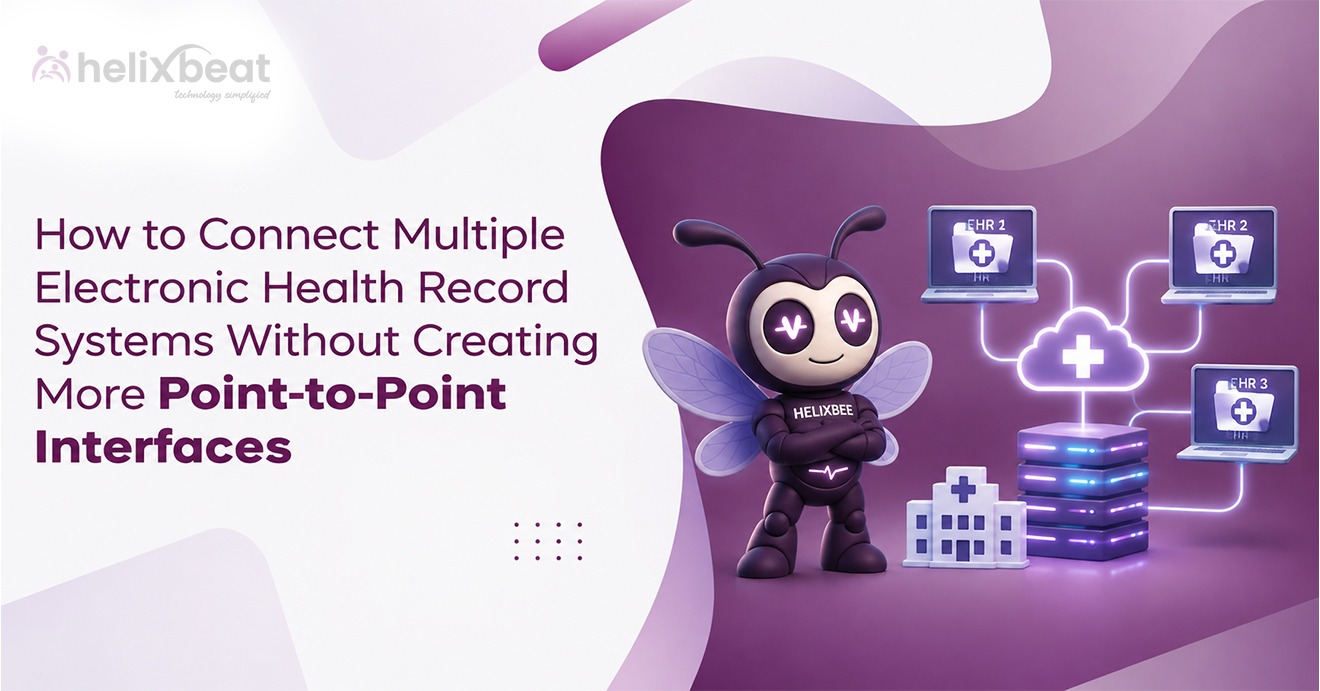
Every time there’s a merger, clinic buy, or vendor switch, you’re back to square one, building another interface. Each request looks reasonable on its own. Together, they create a web that no one fully understands. If your organization runs several electronic health record systems, you have probably felt this already.
In this guide, we show how to connect them through a shared integration layer instead of adding more one-off links. It covers the architecture, the order of work, and the mistakes that quietly derail these projects.
Table of Contents
Why point-to-point interfaces stop scaling?
With electronic health record systems, direct connections multiply faster than the systems themselves. Linking every system to every other one takes n(n−1)/2 interfaces. As a result, five systems need 10, but ten systems need 45.
Each link carries its own field mappings, error handling, and owner. When one vendor upgrades, every connected interface needs retesting. Likewise, when the analyst who built a feed leaves, the logic leaves too.
The deeper problem is meaning. One system stores encounter status as a code, another as free text, a third not at all. As a result, copying data between them without agreeing on meaning only moves confusion around. That is why EHR data integration efforts built one interface at a time often stall after the first few connections. We have a useful breakdown of why EHR data integration projects fail.
The alternative: connect once, translate in the middle
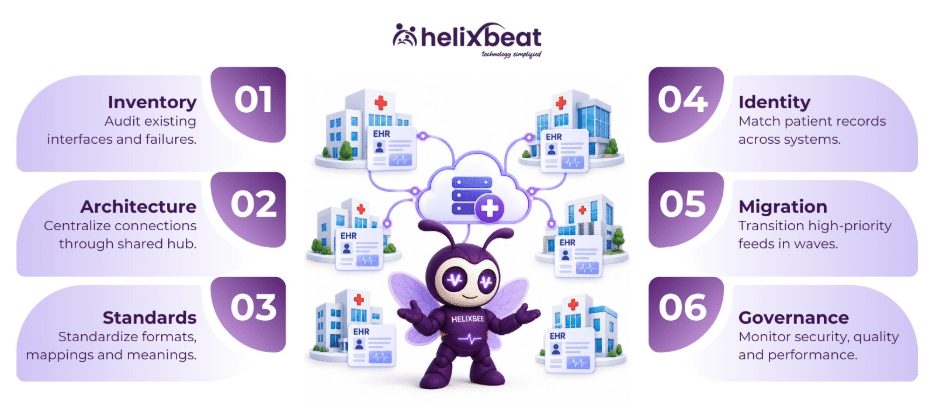
A hub-and-spoke model gives each of your electronic health record systems a single connection to a shared integration layer. The layer receives data, translates it into a common format, and routes it to whoever needs it. Therefore, adding a sixth system means one new connection, not five.
This is the core idea behind modern electronic health record integration. The hub also gives you one place to apply security rules, log access, and watch message flow.
A practical sequence for connecting electronic health record systems
- Inventory what exists. Pull interface lists from each of your electronic health record systems and from engine logs. Record the source, destination, standard (HL7 v2, C-CDA, FHIR, or flat file), volume, owner, and recent failures. Most teams find duplicates and feeds nobody uses. Retire those first.
- Pick a shared data model. Use FHIR R4 resources with US Core profiles for new work, since US certification rules point there. Many electronic health record systems still rely on HL7 v2 at the edges, so keep v2 where it works. Rewriting a stable ADT feed for tidiness adds risk and no value.
- Place an integration layer in the middle. This can be an interface engine, a data exchange platform, like AERIS. AERIS supports real-time data exchange across existing healthcare systems through event streaming and FHIR APIs. This helps organizations exchange information across disparate systems without necessarily replacing their existing infrastructure.
- Solve patient identity early. If one patient appears in three systems under slightly different names, a hub simply delivers three records faster. Therefore, set up an enterprise master patient index with documented matching rules, and decide who resolves uncertain matches.
- Map once, then govern the mapping. Agree on standard vocabularies: LOINC for lab tests, SNOMED CT for clinical findings, and RxNorm for medications. Store each mapping in one place with a named owner. Weak mappings are a common reason APIs return partial records.
- Migrate in waves. Start with high-volume, high-pain flows such as ADT and lab results. Run the old and new paths in parallel. Compare message counts and sample records field by field. Then switch off a legacy interface only after clinical and IT owners sign off.
- Monitor like production software. Track latency, queue depth, and rejected messages. Alert a person when a feed goes quiet, because silent failure is the riskiest kind in healthcare data integration.
Mistakes that bring teams back to square one
- Turning the hub into a bottleneck. If every mapping change needs a ticket to one central team, people will quietly build side interfaces again. Therefore, give system owners self-service tools within clear governance.
- Assuming FHIR behaves the same everywhere. Vendors expose different resources, search parameters, and rate limits. That’s why you should always test with real data from each of your electronic health record systems before promising timelines.
- Skipping privacy controls. Privacy rules do not vanish because data moves internally. Build role-based access and audit trails into the hub from the start. Some records, like substance use disorder treatment records covered by 42 CFR Part 2, carry added restrictions.
- Ignoring data quality. A hub amplifies whatever it carries. Duplicate and stale records need active cleanup, which we address in our guide to preventing duplicate and stale EHR data.
Where to start this quarter?
You do not need a full rebuild. Pick the two systems that generate the most interface requests and route them through a shared layer. Then measure three things: how many custom interfaces you avoided, how long the next system takes to onboard, and how many reconciliation errors remain.
The goal is not to retire your electronic health record systems. It is to stop each one from needing a custom handshake with every other. Connect with us to discuss your integration requirements.
FAQs
- What is the difference between point-to-point and hub-and-spoke integration?
Point-to-point links two systems directly, so every pair needs its own interface. Hub-and-spoke connects each system once to a central layer that translates and routes data. The number of connections then grows in step with the number of systems.
- How many interfaces does it take to connect ten systems directly?
Up to 45, using the formula n(n−1)/2. Through a hub, the same ten systems need ten connections.
- Do I need FHIR to connect electronic health record systems?
No. HL7 v2 and C-CDA still carry a large share of real-world traffic. FHIR is a sensible target for new work, and an integration layer can translate between all three.
- Should I replace my existing HL7 v2 interfaces?
Not by default. Replace them when they fail often, lack documentation, or block a new use case. Stable feeds can stay in place behind the hub.
- Is an interface engine enough on its own?
It handles routing and transformation well. But you still need patient matching, terminology governance, access controls, and monitoring around it