

Table of Contents
Why Contractors Need More Than a Standard Visitor Pass
Walk into most corporate lobbies and you’ll see the same routine. A guest signs a logbook, gets a sticker badge, and heads in. That process works fine for a client meeting or a job interview. It falls apart the moment a contractor walks through the door.
A contractor isn’t just visiting. They’re carrying tools into a server room, climbing onto a rooftop HVAC unit, or working alone near a live electrical panel for six hours. Treating that person like a walk-in guest with a paper badge isn’t just outdated — it’s a liability waiting to happen. This is exactly why contractor visitor management has become its own category, separate from general front-desk check-in, and why more facility and security teams are rethinking how they handle it from the ground up — with purpose-built platforms like VISTA leading that shift.
The Problem With Treating Contractors Like Regular Visitors
A standard visitor pass answers one question: who’s in the building? That’s not enough for contractors, because a plumber, an electrician, and an IT vendor each need different levels of access, different safety briefings, and different documentation before they’re cleared to work.
Think about what a basic paper badge doesn’t tell you:
- Whether the contractor’s certifications and insurance are current
- Which specific zones they’re cleared to enter
- Whether they’ve completed the site’s safety orientation
- Who is accountable if something goes wrong while they’re on-site
Without contractor visitor management built specifically for this group, organizations end up relying on a security guard’s memory or a spreadsheet nobody updates. That’s how contractors end up in areas they were never supposed to reach, and it’s how audits turn into finger-pointing exercises.
What Contractor Visitor Management Actually Covers
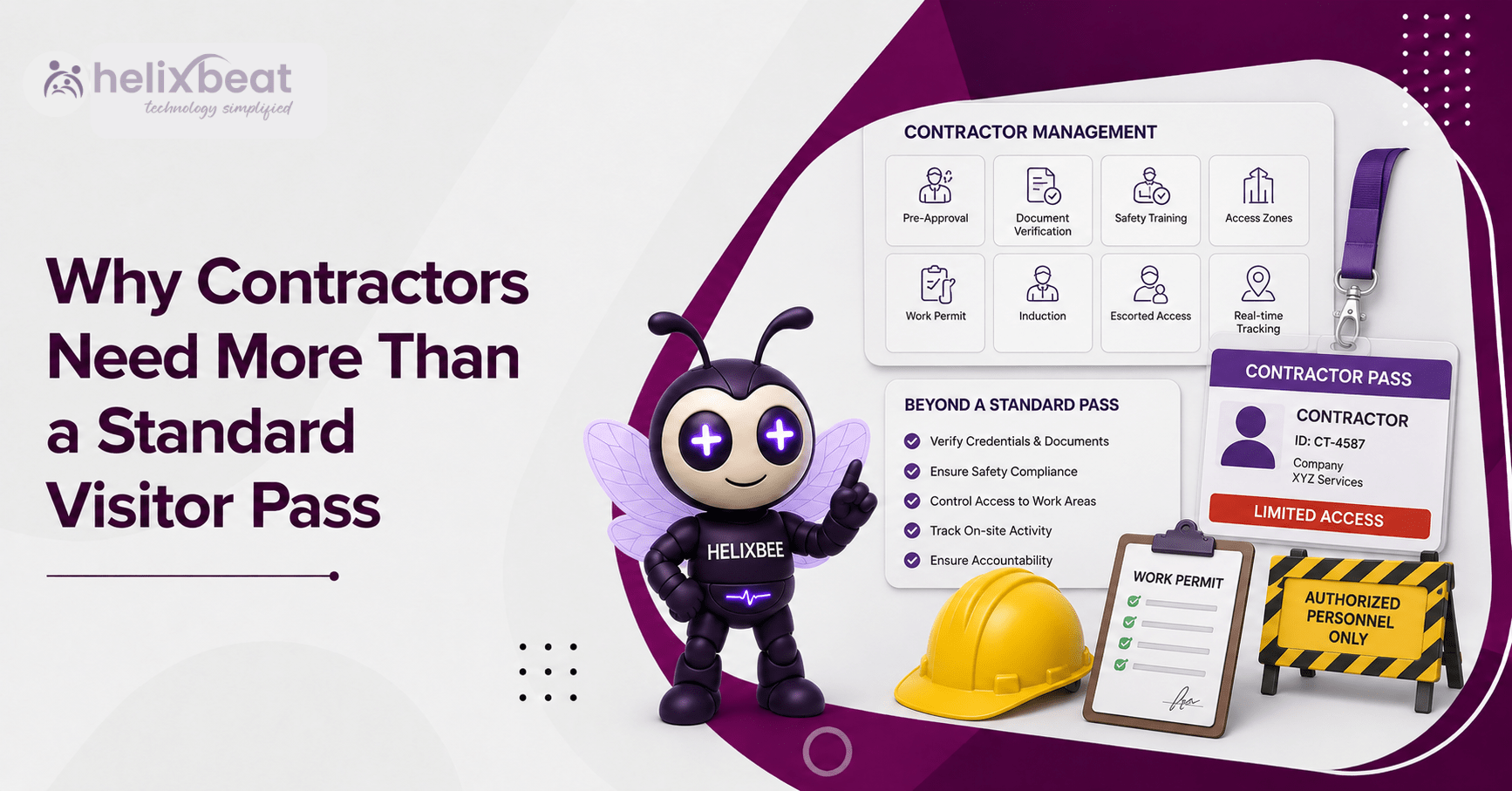
A proper contractor management system does more than log a name and a company. It treats every contractor visit as a mini-project with its own requirements, checkpoints, and accountability trail, which is the standard any serious contractor management system should be held to. Contractor visitor management typically covers:
Pre-registration with document verification. Before a contractor arrives, their host or facilities manager can upload the visit details, expected duration, and the areas they’ll need to access. Contractor visitor management software can flag missing documents automatically — an expired certification or a lapsed insurance policy stops the process before the contractor ever reaches the gate.
Contractor check-in tied to identity and purpose. Instead of a generic sign-in sheet, contractor check-in captures who the person is, which company they represent, what work order they’re fulfilling, and who approved their visit. This turns contractor check-in into a record you can actually defend during an audit, not just a formality at the front desk.
Contractor access control by zone and time. This is where contractor visitor management earns its keep. Contractor access control means a visitor’s credential only works where and when it’s supposed to — the mechanical room during their shift window, not the executive floor at midnight. If the work order ends, access ends with it.
Contractor safety compliance tracking. Before certain contractors are cleared to work, they may need to complete a safety briefing or acknowledge site-specific hazards. Contractor safety compliance built into the check-in flow means nobody bypasses this step because the front desk was busy, and it gives facility managers a running record of contractor safety compliance they can point to whenever it’s questioned.
Visitor badge management with real accountability. A digital badge isn’t just a printed name tag. Visitor badge management ties the badge to a time-bound, zone-specific credential that can be revoked instantly if something changes — a canceled contract, an incident report, or simply the end of the workday. Good visitor badge management also makes it obvious, at a glance, whether a badge is still active or should have already expired.
The Approval-to-Access Journey
Here’s where contractor visitor management moves from a checklist to an actual workflow. Say a contractor arrives to service a rooftop unit. Their host — a facilities manager or the assigned security lead — receives the visit request through VISTA and reviews it before approving. The moment approval happens, VISTA issues a gate pass valid for the length of that specific visit.
That pass isn’t a static sticker. It’s an access credential the contractor can use to move through every checkpoint relevant to their job, right up until the visit window closes. Pair that with device-level access integration — door controllers, turnstiles, elevator banks — and the same credential that got the contractor through the front gate also determines which floors their elevator will stop on and which doors will actually unlock for them.
This is a meaningfully different experience from a paper badge that technically lets someone wander anywhere the guard isn’t watching. Contractor access control in workplaces built this way removes the guesswork: access is granted by design, not by assumption.
Why Contractors Also Need Vehicle and Equipment Tracking
Contractors rarely show up empty-handed. They bring vans, trucks, and equipment that also needs to be accounted for. A visitor management system for contractors that includes parking and vehicle management — like VISTA’s built-in vehicle module — captures the vehicle’s details at entry — plate, driver, purpose — and issues a matching gate pass for the vehicle itself.
This matters more than it sounds like it should. If a facility experiences an incident involving unauthorized parking near a loading dock, or needs to confirm which vendor’s truck was on-site during a specific window, having that record already tied to the same contractor visitor management platform saves hours of manual cross-referencing.
The Queue Problem Nobody Talks About
Large facilities — hospitals, manufacturing plants, data centers — often have multiple contractor teams arriving at once, especially during scheduled maintenance windows. Without structure, this turns into a crowd at the security desk. Token-based queue management, generated as part of the same contractor visitor management process, gives each team a sequential number so security staff can call and process visitors in order rather than managing chaos at the door.
Departments, Roles, and Who Gets to Approve What
Contractor visitor management only works if the right people can approve the right requests. A facilities coordinator shouldn’t need to escalate every routine maintenance visit to a senior admin, but that same coordinator shouldn’t be able to grant access to restricted server rooms either.
This is where role-based permissions and department-level controls matter. Structuring contractor visitor management around departments means the IT team manages IT vendor access, facilities manages maintenance contractors, and admins retain oversight without becoming a bottleneck for every single request. A well-configured contractor management system routes each request to the right approver automatically, and pairs that approval with contractor access control that’s already scoped to what that department is allowed to grant — so nobody accidentally hands out access above their authority.
Contractor Check-In and Compliance Tracking, Together
One of the most common gaps in older systems is that check-in and compliance live in separate places — a sign-in sheet here, a folder of insurance certificates there. Contractor check-in and compliance tracking should happen in the same flow, so that the moment a contractor checks in, the system already knows whether their documentation is current and their safety briefing is complete.
This isn’t just about convenience. During an OSHA inspection or an internal audit, being able to pull a complete, time-stamped record of every contractor’s access — badge issued, zones entered, compliance status — is the difference between a quick resolution and a drawn-out investigation. OSHA’s own guidance on host-contractor coordination points to exactly this gap: facilities and outside crews are expected to align on training and safety policy before work even starts, which is difficult to prove without a digital trail for contractor safety compliance. Digital contractor visitor management makes that coordination verifiable rather than assumed, and it’s the kind of record a manual contractor management system simply can’t produce on demand.
What This Looks Like in Practice
A manufacturing facility bringing in an HVAC contractor for a scheduled repair might run the process like this using VISTA: the facilities manager pre-registers the visit and uploads the contractor’s certification. The contractor arrives, checks in with a QR code, and the host approves the request from their phone. A gate pass is issued, valid only for the mechanical room and only for the scheduled window. The contractor’s van is logged at the gate with a matching vehicle pass. When the job wraps up, the badge and vehicle pass both expire automatically, no manual revocation required.
That’s contractor visitor management doing what a paper badge never could — combining identity, access, safety compliance, visitor badge management, and equipment tracking into one accountable process.
Getting Contractor Access Control Right From the Start
Retrofitting compliance after an incident is always more expensive than building it in from day one. Most jobsites involve more than one employer at once — the host facility, the general contractor, and often a subcontractor layer beneath that — and OSHA’s compliance guidance for construction sites flags this multi-employer structure as a reason access and contractor safety compliance obligations need to be spelled out before anyone steps on-site, not after. Any contractor management system worth adopting should make those obligations visible at check-in, not buried in a filing cabinet. A visitor management system for contractors isn’t just about looking modern at the front desk — it’s about closing a real security and compliance gap that generic visitor tools were never built to handle.
If your organization still relies on a shared logbook or a basic printed badge for contractors, it’s worth asking what would actually happen during an audit, an OSHA review, or a security incident. Would you be able to prove who was where, doing what, and for how long? Contractor visitor management software exists precisely to make that question easy to answer — and it’s a gap why every organization needs a smart visitor management system makes clear, using a real breach that started with an unverified contractor.
Final Thought
Contractors aren’t guests, and a visitor badge built for guests will always fall short of what a jobsite actually requires. Purpose-built contractor visitor management — combining check-in, access control, safety compliance, and visitor badge management into one workflow — protects your facility, your people, and your compliance record all at once. VISTA was built to handle exactly this, and if your current setup is due for an upgrade, this checklist for upgrading your visitor management platform is a good place to see where the gaps are.
FAQs
What does this actually involve for contractors?
It covers registering, verifying, approving, and tracking contractors as they enter and move through a facility — separate from how a business handles regular guests. This typically includes document verification, zone-specific access, a safety briefing step, and time-bound badge issuance in one connected workflow.
How is this different from a regular visitor badge for access control?
A regular visitor badge just confirms someone checked in. This ties the same credential to specific zones and specific time windows, so a contractor can only reach the areas relevant to their work order, and only while that work order is active.
Do contractors need to complete safety training before check-in?
In many facilities, yes. That requirement is often tracked as part of the check-in flow itself, so a contractor can’t be issued a gate pass until required briefings or hazard acknowledgments are complete.
Can this kind of platform track contractor vehicles too?
Yes. Platforms like VISTA can capture vehicle details at entry and issue a matching gate pass for the vehicle, alongside the contractor’s own badge, so both the person and their vehicle are accounted for during the visit.
What happens to a contractor’s access once their visit ends?
Because the credential is time-bound from the start, access expires automatically once the visit window closes or the work order is marked complete — no manual revocation required.