

Table of Contents
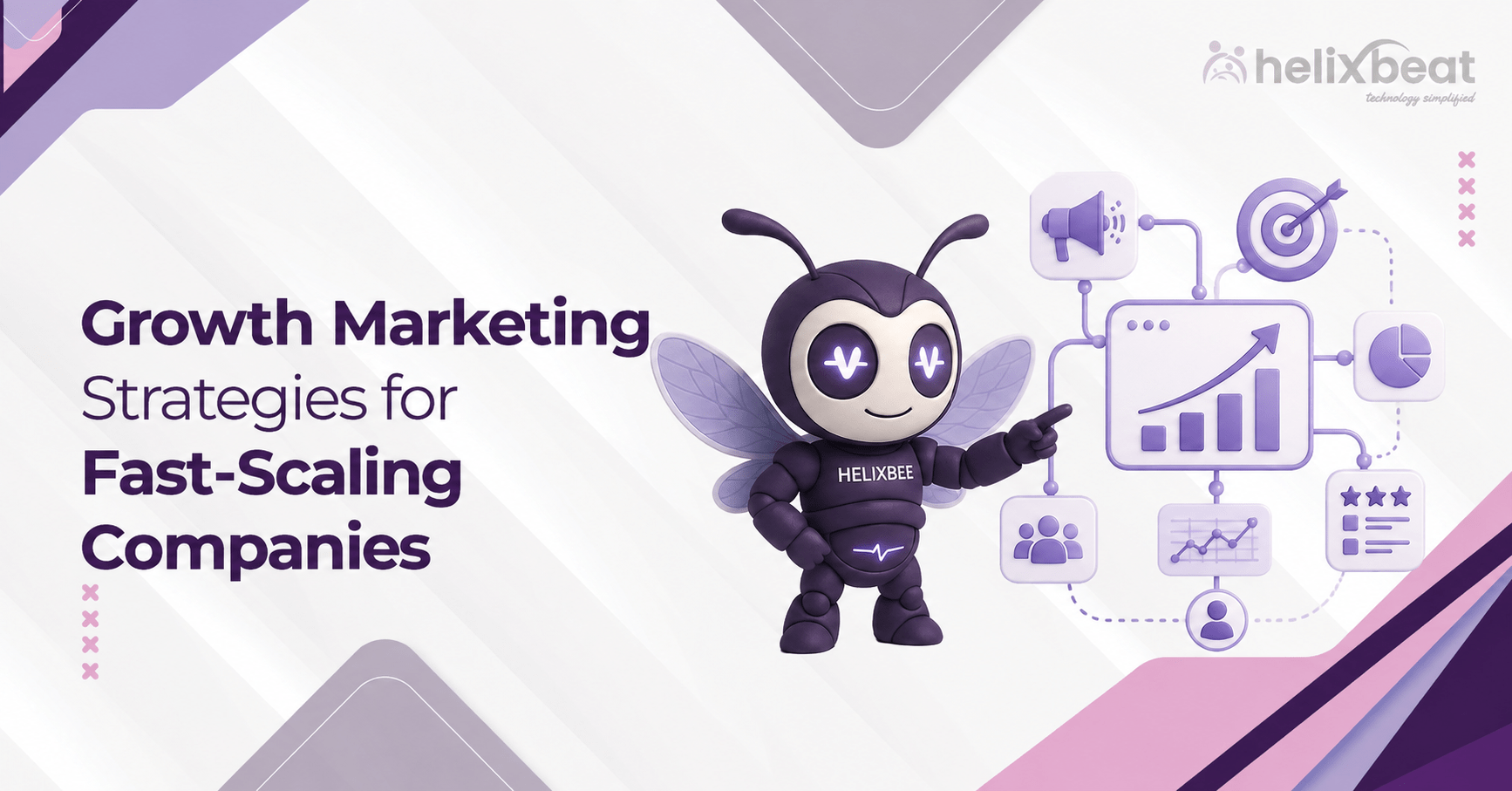
Growth Marketing Strategies for Fast-Scaling Companies
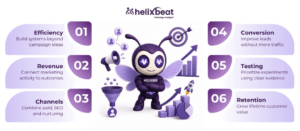
Fast-scaling companies rarely run out of marketing ideas. What they run out of is marketing efficiency.
A paid campaign that works at a small budget may become expensive when spend triples. Lead volume grows, but quality can fall.
That is why fast-growing businesses need Growth Marketing Strategies built around systems, not isolated campaigns.
The goal is a repeatable engine that attracts the right audience, improves conversion, increases retention, and shows the team what to scale next.
Why Fast Growth Requires a Different Marketing Model
Traditional marketing often starts with campaigns. Growth marketing starts with constraints.
Where is growth stuck: traffic, conversion, sales, retention, or acquisition cost?
The best Growth Marketing Strategies identify that constraint first and then use marketing resources to remove it.
This is especially important in growth marketing for startups. Limited runway means startups cannot afford disconnected channel plans. They need one system linking marketing activity to revenue.
HelixBeat’s digital marketing model supports this integrated approach through SEO and SEM, social media, content, performance marketing, email, WhatsApp marketing, analytics, testing, and continuous optimization.
- Build a Growth Marketing Framework Around Revenue
Before scaling spend, define the economics of growth.
A practical growth marketing framework should cover acquisition, activation, conversion, retention, and expansion. Track meaningful metrics such as qualified lead cost, conversion rate, customer acquisition cost, retention, and customer lifetime value.
This turns business growth marketing into an operating discipline rather than a reporting exercise.
A campaign producing thousands of clicks is not successful if it generates poor-quality leads and little revenue. That is the foundation of performance-driven marketing: connecting activity to commercial outcomes.
- Stack Channels Instead of Depending on One
One-channel growth is fragile.
Paid media creates demand. SEO and content compound over time. Social builds trust, while email, WhatsApp, and retargeting nurture known audiences.
Scalable marketing strategies combine these channels instead of asking one platform to carry the growth target.
A search-led article can attract a high-intent prospect who later sees retargeting ads, receives email nurturing, watches a product video, and returns when ready to buy.
Growth Marketing Strategies work best when each channel has a specific role and shares learning with the others.
- Treat Conversion Rate as a Growth Lever
More traffic is not always the fastest way to create more revenue.
Suppose a website receives 40,000 qualified visits per month and converts 2% into leads. That produces 800 leads. Increase conversion to 2.5%, and the same traffic produces 1,000 leads.
That is 200 extra leads without buying more traffic.
Strong Growth Marketing Strategies therefore include landing-page optimization, offer testing, form improvements, calls to action, customer proof, and message-to-intent alignment.
Useful growth marketing tactics include reducing unnecessary form fields, testing stronger value propositions, matching landing pages to ad intent, and placing proof near high-friction decisions.
- Create a Repeatable Experiment Engine
Fast-growing companies need speed, but speed without structure creates noise.
A useful growth marketing framework gives every experiment a clear problem, hypothesis, audience, success metric, test period, and next decision.
A simple prioritization method is:
Impact × Confidence ÷ Effort
This helps teams focus on experiments that could materially affect growth. Improving lead qualification may matter far more than testing a minor creative detail.
These growth marketing tactics create a learning loop: test, measure, keep what works, and stop what does not.
Example: Scaling a B2B SaaS Company From 150 to 1,000 Leads
Imagine a B2B SaaS company generating 150 monthly leads, mostly through paid search.
The company triples its ad budget. Lead volume rises, but acquisition cost increases and lead quality drops.
Instead of increasing spend again, the team applies Growth Marketing Strategies across the funnel.
High-intent keywords are separated from research-stage searches. The team creates comparison pages, customer stories, short videos, and page-based retargeting.
Next, industry-specific email journeys and sales feedback help marketing identify which sources generate customers, not just forms.
That is business growth marketing in practice: improving the whole revenue system instead of forcing one channel to work harder.
It is also why growth marketing for startups should combine rapid experimentation with CAC, LTV, conversion, and revenue measurement. HelixBeat’s startup offering emphasizes ROI-focused campaigns, agile execution, real-time reporting, CAC and LTV analysis, and revenue attribution.
- Build First-Party Data Before Scaling Personalization
Fast growth creates more customer data, but more data does not automatically create more insight.
Salesforce reports that 84% of marketers use first-party data, while only 31% are fully satisfied with their ability to unify data. Marketers also use an average of 10 customer engagement channels.
Scalable marketing strategies need a connected view of website behavior, ads, CRM stages, email activity, retention, and revenue.
Once that foundation exists, personalization becomes more useful. Someone repeatedly visiting pricing and integration pages should not receive the same message as someone reading introductory content.
This is where performance-driven marketing becomes more precise: audiences, offers, and spend can respond to real intent.
- Personalize Around Intent, Not Just Personas
Personas tell you who someone might be. Behavior tells you what they may want now.
HubSpot’s 2026 State of Marketing research found that 48.57% of marketers identified AI-powered personalized content as a leading trend, while 93.2% said personalized or segmented experiences had led to more leads and purchases.
For growth marketing for startups, relevance helps smaller budgets work harder.
Use signals such as pages viewed, product interest, content consumed, lifecycle stage, purchase history, or sales objections. Then adapt the message, proof, and offer.
This makes business growth marketing more customer-centered and improves acquisition efficiency.
- Build Content for Search, AI Discovery, and Distribution
Search behavior is changing.
HubSpot’s 2026 research says 40.6% of marketers are updating SEO for search changes, while 35.08% are repurposing content across channels. It also reports that websites, blogs, and SEO remain important, especially for B2B marketers.
Growth Marketing Strategies should therefore treat content as a reusable growth asset.
One valuable article can become a search page, LinkedIn posts, short videos, an email sequence, sales material, webinar content, and retargeting creative.
That is one of the most practical scalable marketing strategies because the team is not starting from zero for every platform.
- Add Trust and Video to Performance Marketing
Performance and brand should not compete.
LinkedIn’s 2025 B2B Marketing Benchmark found that 94% of surveyed B2B marketers agreed trust is key to success. It also reported that 78% use video and more than half planned to increase investment.
Video can support business growth marketing across the funnel: founder insights create awareness, explainers educate, demos reduce uncertainty, and customer stories build proof.
Performance-driven marketing should therefore measure more than the click. Ask whether the campaign helped the buyer understand the offer, trust the company, and move closer to a decision.
- Make Retention Part of the Growth Plan
Acquisition cannot compensate forever for weak retention.
If customers leave quickly, increasing ad spend simply sends more money into a leaking funnel.
A mature growth marketing framework includes onboarding, customer education, reactivation, upselling, cross-selling, referrals, and retention.
Useful growth marketing tactics can include behavior-based onboarding emails, WhatsApp reminders, usage-triggered communication, loyalty offers, and win-back campaigns.
Retention should also improve acquisition decisions. A campaign with a higher acquisition cost may still be better if those customers stay longer and spend more.
That is how Growth Marketing Strategies move from lead generation toward lifetime customer value.
- Scale Winners and Stop Waste
Review major marketing initiatives regularly and classify them as:
Scale: Strong economics and repeatable performance.
Improve: Promising results with a clear bottleneck.
Test: A credible opportunity needing evidence.
Stop: Weak performance without a strategic reason to continue.
This keeps Growth Marketing Strategies from becoming a long list of tools and channels.
It also makes performance-driven marketing actionable because budget and capacity move toward proven opportunities.
How HelixBeat Supports Fast-Scaling Companies
Fast-scaling businesses need coordination between visibility, acquisition, conversion, nurturing, retention, and measurement.
HelixBeat brings together SEO and SEM, social media, content marketing, performance campaigns, email, WhatsApp, analytics, A/B testing, and ongoing optimization.
For businesses developing Growth Marketing Strategies, the value of this integrated approach is that strategy, execution, and measurement can work as one system.
The objective is a system where every channel has a purpose, every test creates learning, and decisions connect to business performance.
Final Takeaway
Fast growth exposes weak marketing systems.
More traffic will not solve poor conversion. More advertising will not solve weak retention. More content will not solve unclear positioning. More analytics tools will not solve fragmented data.
The strongest Growth Marketing Strategies connect acquisition, conversion, retention, experimentation, content, data, and measurement.
Start with a clear growth marketing framework. Use scalable marketing strategies instead of relying on one source. Build growth marketing for startups around capital efficiency. Apply growth marketing tactics to the biggest funnel constraints. Tie business growth marketing to revenue and lifetime value. Keep performance-driven marketing accountable to commercial outcomes.
When those pieces work together, marketing becomes a repeatable growth engine that can scale with the company.
FAQs
- What are Growth Marketing Strategies?
Growth Marketing Strategies use data, experimentation, and multiple marketing channels to improve acquisition, conversion, retention, and revenue.
- Why are Growth Marketing Strategies important for scaling companies?
They help companies grow efficiently by identifying high-performing channels, improving conversions, and reducing wasted marketing spend.
- What is a growth marketing framework?
A growth marketing framework connects acquisition, activation, conversion, retention, and expansion to measurable business goals.
- Which growth marketing tactics work best for startups?
Effective tactics include SEO, paid advertising, content marketing, conversion optimization, email automation, retargeting, and continuous A/B testing.
- How is growth marketing different from traditional marketing?
Traditional marketing often focuses on awareness and acquisition, while growth marketing optimizes the entire customer journey from discovery through retention.