

Healthcare payments become difficult when clinical records, billing systems, and payment processors operate separately. A patient may check in through an EHR, receive an estimate from a billing system, pay through a terminal or portal, and still leave staff manually matching that transaction to the correct account.
A healthcare payment API is designed to remove those gaps. It lets payment software exchange information with EHR, practice management, revenue cycle, and patient-facing systems so payment events can move through the workflow automatically.
In a well-designed setup, the process can happen in seconds: the EHR identifies the patient and encounter, the payment system receives the amount due, the patient pays, and the transaction status is sent back to the appropriate financial record. That reduces duplicate entry, delayed posting, and reconciliation work.
For providers evaluating real-time integration, it is important to understand what the API actually does, where FHIR fits, and how payment data must be secured.
Table of Contents
What Is a Healthcare Payment API?
A healthcare payment API is a software interface that enables healthcare applications and payment services to exchange payment-related information programmatically.
Instead of a staff member copying a patient balance from an EHR into a separate terminal, an integration can pass approved transaction details to the payment platform automatically. After processing, the API can return an authorization, decline, refund, or settlement status to the connected system.
A modern implementation may support:
- Patient and encounter matching
- Credit and debit card payments
- ACH payments
- Tokenized payment methods
- Recurring payments and payment plans
- Refunds and voids
- Transaction status updates
- Payment reconciliation
- Digital receipts and reporting
This is where an EHR payment API becomes valuable: it connects the financial event to the healthcare workflow rather than treating payment as a separate front-desk activity.
How Does Real-Time EHR Payment Integration Work?
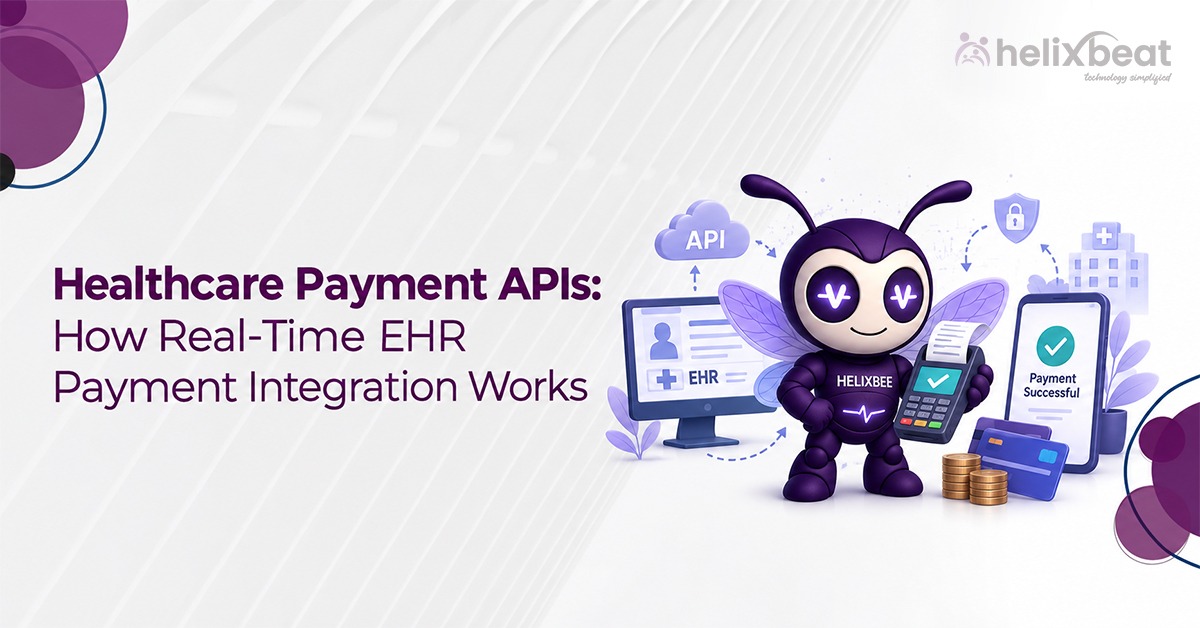
At a high level, healthcare payment API integration usually involves the EHR or practice management system, an integration layer, a payment platform, and the payment processor or banking network.
- The EHR Creates the Payment Context
The workflow begins with information already available in the EHR or PMS.
Depending on the use case, this may include:
- Patient ID
- Encounter ID
- Location
- Copay
- Outstanding balance
- Invoice number
- Amount due
Only the information required to complete the financial workflow should move into the payment environment.
- The API Creates a Payment Request
The healthcare payment API receives the approved payment context and creates a transaction request.
The patient may then pay using a front-desk terminal, patient portal, mobile payment link, kiosk, or another connected channel.
The payment platform sends the transaction to the appropriate processor while sensitive card information can be protected through controls such as tokenization.
- The Payment Processor Returns a Result
The processor returns information such as:
- Approved or declined status
- Transaction ID
- Authorized amount
- Payment method
- Response status
This may happen within seconds.
However, it is important to understand that “real time” does not mean every financial process is complete immediately. Authorization can happen quickly while card settlement, ACH processing, or banking movement may occur later.
Real-time EHR integration primarily means that transaction information can be communicated and reflected in connected workflows without waiting for staff to manually transfer it.
- The Payment Status Is Written Back
Once the transaction status is available, the payment platform can notify the connected EHR, PMS, or RCM system through an API response, webhook, callback, or event message.
The healthcare system may then:
- Update the patient’s balance
- Mark an invoice as paid
- Associate payment with an encounter
- Create a receipt
- Update a payment plan
- Trigger reconciliation workflows
This write-back is what makes the connection operationally useful. Without it, staff may still have to reconcile payment records manually.
Where Does FHIR Fit Into Healthcare Payments?
FHIR is increasingly important to healthcare interoperability, but FHIR itself should not be confused with a credit card or ACH payment processor.
FHIR standardizes how healthcare information can be represented and exchanged through APIs. In the U.S., ONC-certified health IT includes standardized API requirements, with FHIR and SMART App Launch playing a central role in modern healthcare interoperability.
FHIR also includes financial resources.
For example, PaymentNotice can indicate that a payment has occurred, is expected, or has been cancelled. PaymentReconciliation can connect payment amounts with claims, invoices, and other financial transactions, helping healthcare organizations reconcile receivables.
That makes FHIR valuable for sharing healthcare and financial context.
However, the actual movement of funds is usually handled through specialized payment processors and transaction APIs.
A practical payment API healthcare architecture may therefore combine:
EHR/FHIR data → Payment platform → Processor → Payment response → EHR/RCM update
FHIR helps systems understand the healthcare context. The payment infrastructure handles authorization, tokenization, settlement, and transaction processing.
What Data Moves Between an EHR and Payment Platform?
A payment integration should exchange only the information needed to support the transaction and financial workflow.
Common data elements may include:
- Patient or account identifier
- Encounter or appointment ID
- Invoice or statement ID
- Amount due
- Transaction status
- Tokenized payment-method reference
- Payment reference number
- Refund status
- Payment date and time
- Location or department
The goal is not to send an entire medical record to a payment processor.
Good architecture separates clinical information from cardholder information and limits unnecessary exposure of protected health information.
For providers planning this integration, data mapping is particularly important. The identifiers used by the EHR, PMS, RCM, and payment system must match consistently so each transaction is posted to the correct patient and account.
Why Is Real-Time Integration Better Than Manual Payment Posting?
Disconnected payments create hidden administrative work.
A front-desk employee may collect a payment in one system and then open another application to record it. Later, the billing team may compare processor reports against patient accounts.
One small data-entry mistake can cause:
- Incorrect balances
- Unapplied payments
- Duplicate payment requests
- Reconciliation delays
- Refund problems
- Patient billing confusion
With API connectivity, much of that information can flow automatically.
The potential benefits include faster payment posting, fewer manual-entry errors, better reconciliation, more accurate patient balances, improved reporting, and a smoother checkout experience.
Providers looking to understand how EHR, RCM, and payment systems connect can explore PayNova’s healthcare payment API resource on healthcare payment processing integration.
PayNova’s healthcare payment model includes centralized payment processing and EHR/PMS integration, which can help connect billing and payment information rather than keeping them in separate workflows.
How Do Webhooks Make Payments Real Time?
APIs allow one application to request information or an action from another system.
Webhooks work differently.
They allow the payment platform to notify another application automatically when an event happens.
For example, an API request may create a transaction. A webhook can later inform the EHR that the payment:
- Succeeded
- Failed
- Was refunded
- Was voided
- Changed status
This matters because some events occur after the original request.
ACH payments, refunds, chargebacks, and settlement events may take time to reach their final status.
A reliable healthcare payment API implementation should also account for duplicate webhook notifications. Unique transaction IDs, event IDs, and idempotency controls help prevent the same payment from being recorded twice.
How Should Healthcare Payment APIs Handle Security?
Payment integration involves two important security areas: healthcare data and financial data.
HIPAA permits protected health information to be used or disclosed for legitimate payment activities such as billing and collections, but appropriate privacy and security requirements still apply. Organizations acting on behalf of covered entities and handling PHI may also have business associate obligations.
Payment card information also brings PCI DSS responsibilities. PCI DSS v4.0.1 remains the published version of the standard in 2026.
A secure API architecture should therefore include:
- Encryption in transit
- Strong API authentication
- Tokenization
- Role-based access
- API credential management
- Audit logging
- Minimum-necessary data exchange
- Webhook signature verification
- Transaction monitoring
- Controlled data retention
For more security context, PayNova’s EHR payment API planning should also consider the controls discussed in its HIPAA-compliant credit card processing guide.
What Should Providers Ask Before Integrating a Payment API?
Not every payment API healthcare solution is designed around real healthcare workflows.
Before implementation, providers should ask whether the system supports their EHR or PMS and whether it can handle patient matching, payment plans, refunds, multiple locations, reporting, and reconciliation.
Technical teams should also ask:
- Does the API support both immediate responses and asynchronous webhooks?
- How does the platform prevent duplicate transactions?
- Are stored payment methods tokenized?
- How are refunds and adjustments written back?
- Can transaction IDs be traced across all connected systems?
- What happens when the EHR or payment service is unavailable?
- Which system remains the source of truth for the patient balance?
- How are API upgrades and version changes managed?
These questions help distinguish a true integration from a simple payment button connected to an EHR.
How Does PayNova Support Connected Healthcare Payments?
PayNova is designed around healthcare-specific financial workflows rather than treating healthcare providers like generic merchants.
Its payment model supports centralized processing, multiple payment methods, recurring billing, payment plans, EHR integration, PMS integration, reporting, and payment automation.
It also addresses challenges such as manual billing work, delayed payments, fragmented revenue streams, refunds, disputes, and reconciliation.
With the right healthcare payment API architecture, providers can reduce repeated data entry, synchronize payment status, improve reconciliation, and create more consistent experiences across front-desk, portal, mobile, and remote-care payment channels.
The key is not simply connecting an API.
A successful system needs clear rules for patient identifiers, transaction states, balances, refunds, settlement information, retries, failures, and system ownership.
Final Thoughts
A healthcare payment API can turn payment collection from a disconnected financial task into an integrated part of the patient and revenue-cycle workflow.
Real-time EHR integration typically works by sending approved financial context from the EHR or PMS to a payment platform, securely processing the transaction, and returning the transaction status through APIs or event-driven webhooks.
FHIR can support standardized healthcare and financial information exchange, while specialized payment infrastructure handles the actual movement of money.
Successful healthcare payment API integration depends on more than basic connectivity. It requires accurate data mapping, tokenization, reliable write-back, authentication, webhook controls, reconciliation logic, and appropriate HIPAA and PCI safeguards.
As patient payments become increasingly digital, a well-designed healthcare payment API gives providers a practical way to connect payment speed with healthcare context—reducing manual work while creating a simpler and more consistent patient payment experience.
FAQs
- What is a healthcare payment API?
It connects healthcare systems with payment services to automate transactions, updates, and reconciliation.
- Can an EHR payment API update patient balances automatically?
Yes. Supported integrations can write payment status back to the patient’s financial record.
- Is FHIR a payment processing API?
No. FHIR exchanges healthcare data, while payment processors handle card or ACH transactions.
- Is healthcare payment API integration HIPAA compliant?
It can be when PHI and payment data are protected with appropriate HIPAA and PCI safeguards.