

If you think SEO takes 6–12 months to show results, you’re not wrong—but you’re not entirely right either.
I’ve seen websites increase website traffic in just 30 days—not by hacking the system, but by aligning with how search works in 2026: intent, experience, and authority.
At Helixbeat, we call this Marketing as a Service—a systemized, repeatable way to drive traffic to your website without guesswork.
Let’s break it down.
Table of Contents
Why Most Websites Fail to Increase Traffic
Before we jump into the plan, here’s the truth:
Most people try random tactics—posting blogs, sharing links, maybe running ads—and hope it leads to more traffic to website.
But traffic growth isn’t random. It’s engineered.
If you want to increase website traffic, you need:
- Clear keyword intent
- Technical SEO foundation
- Consistent content velocity
- Distribution strategy
Without these, you’ll struggle to boost website traffic no matter how much content you create.
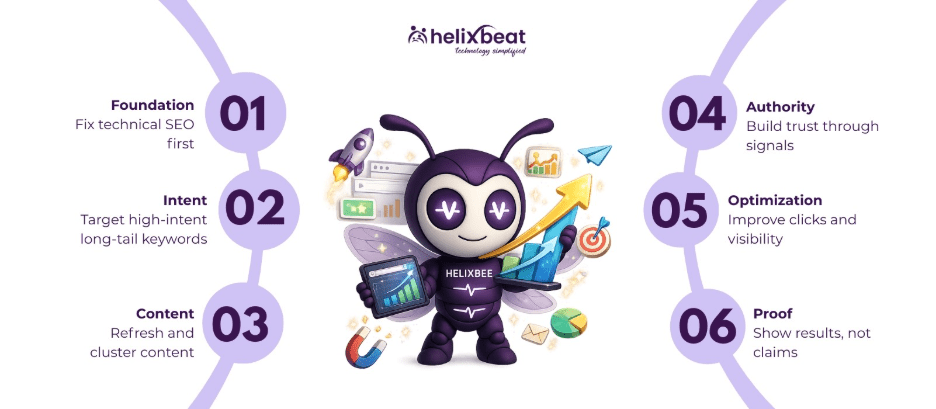
The 30-Day SEO Action Plan for 2026
This is not theory. This is execution.
Follow this exactly, and you’ll start to increase organic traffic to website within weeks.
Week 1: Foundations & Technical Hygiene
This is where most people fail. Skip this, and nothing else works.
Days 1–2: Audit & Analytics
Start with clarity.
- Use Google Search Console to identify errors
- Check indexing issues
- Analyze existing keywords
Focus on:
- Pages already getting impressions
- Pages ranking on page 2 or 3
These are your quick wins to increase website traffic fast.
Also:
- Website speed → under 2 seconds
- Mobile responsiveness → non-negotiable
If your site is slow, you’ll never achieve high website traffic.
Days 3–4: Intent Mapping
Stop targeting generic keywords.
Instead of:
- “digital marketing”
Go for:
- “how to get traffic to your website in 2026”
Long-tail keywords bring:
- Higher conversions
- Faster rankings
This is one of the most underrated ways to increase site traffic.
Days 5–6: Fix Technical SEO
Clean your backend.
- Remove unnecessary plugins
- Fix broken links (404s)
- Install SSL certificate
- Create XML sitemap
These steps directly help improve website traffic by making your site easier for search engines to crawl.
Week 2: Content Strategy & Authority Building
Now we build momentum.
Days 7–8: Content Refresh
Don’t just create—optimize.
Update:
- Old blog posts
- Outdated statistics
- Titles and meta descriptions
Refreshing content is one of the fastest ways to generate traffic to your website.
Why?
Because Google already trusts those pages.
Days 9–10: Topic Clusters & Content Boost
Here’s where real growth happens.
Instead of random blogs, create:
1 Pillar Page + 5 Supporting Articles
Example:
- Pillar: “Complete Guide to SEO in 2026”
- Supporting:
- how to get traffic to your website
- ways to increase site traffic
- improve website traffic techniques
Publishing multiple related articles quickly creates authority.
This is how you increase website traffic aggressively.
Days 11–12: Implement Video SEO
Google loves video.
Embed:
- YouTube videos
- Short explainers
This helps:
- Reduce bounce rate
- Increase dwell time
And yes—it helps boost website traffic significantly.
Days 13–14: Internal Linking
This is your hidden weapon.
- Link old pages → new content
- Use keyword-rich anchor text
Example:
- “Learn more ways to increase site traffic here”
Internal linking distributes authority and helps drive traffic to your website without extra effort.
Week 3: Off-Page SEO & User Experience
Now we scale.
Days 15–17: Backlink Acquisition
Backlinks still matter—but smarter.
Focus on:
- Guest posting
- Industry collaborations
- Niche directories
Quality > Quantity.
Even 5 strong backlinks can increase website traffic faster than 100 weak ones.
Days 18–20: Social Signals
SEO doesn’t live in isolation.
Promote content on:
- YouTube
- Instagram / TikTok
This generates:
- Immediate clicks
- Engagement signals
Which helps you boost website traffic instantly.
Days 21–23: Schema Markup
Want rich results?
Add structured data:
- FAQs
- Reviews
- Articles
This increases:
- Click-through rate
- Visibility
And ultimately helps you increase organic traffic to website.
Week 4: Optimization & Monitoring
This is where growth compounds.
Days 24–25: Optimize Meta Tags & CTR
Your rankings don’t matter if nobody clicks.
Improve:
- Titles → curiosity-driven
- Descriptions → benefit-focused
Example:
Instead of:
“SEO Tips Guide”
Use:
“10 Proven Ways to Increase Website Traffic in 30 Days”
Higher CTR = more traffic.
Days 26–27: Geographic Content
Target location-based searches.
Example:
- “SEO services in Bangalore”
- “how to get traffic to your website in India”
Local SEO is one of the easiest ways to increase site traffic.
Days 28–30: Analyze & Plan
Use Google Analytics 4.
Track:
- Traffic growth
- Top-performing pages
- Bounce rate
Double down on what works.
This is how you sustain high website traffic beyond 30 days.
2026 SEO Trends You Can’t Ignore
If you want long-term growth, adapt.
1. AI-Enhanced Content
Use AI for:
- Research
- Structuring
But always add:
- Human insights
- Real experience
This builds trust and helps increase website traffic sustainably.
2. Community-Driven SEO
Forums, comments, discussions.
User-generated content:
- Expands keyword reach
- Builds authority
It’s one of the smartest ways to generate traffic to your website today.
3. Founder-Led Authority
People trust people, not brands.
Share:
- Personal insights
- Case studies
- Real results
This dramatically helps improve website traffic and conversions.
Case Study: From Stuck to Scaling in 30 Days
One of our clients came to us frustrated.
They had content. They had a website. But they couldn’t get traffic to their website consistently.
In fact, their monthly traffic was stuck under 2,000 visitors.
We didn’t redesign everything.
We didn’t run ads.
We simply applied the 30-day SEO framework you saw above.
First, we fixed technical issues that were silently killing their ability to increase website traffic. Then we reworked their content around search intent—focusing on queries people were actually typing.
Instead of publishing more blogs, we refreshed their top-performing pages.
Within 30 days, something interesting happened.
Traffic didn’t just grow—it accelerated.
They crossed 6,500 monthly visitors. That’s more than 3x growth.
This is how you create high website traffic—not by doing more, but by doing what works.
Before vs After: What Changed?
Before:
- Random blog topics
- No keyword intent
- Weak internal linking
After:
- Structured topic clusters
- Intent-driven content
- Strong internal linking strategy
That’s it.
No magic. No shortcuts.
Just execution that actually helps improve website traffic.
Why Problem-Solving Content Wins Every Time
Here’s the shift you need to make:
Instead of writing:
“Top SEO Services We Offer”
Write:
“Why Your Website Isn’t Getting Traffic (And How to Fix It in 30 Days)”
See the difference?
One sells.
The other solves.
And solving problems is the fastest way to:
- increase website traffic
- get more traffic to website
- Build authority
When your content answers real questions, Google rewards you.
The Power of Showing, Not Telling
Anyone can claim they know ways to increase site traffic.
Very few can show real results.
That’s your unfair advantage.
Add:
- Screenshots from Google Search Console
- Traffic growth graphs
- Keyword ranking improvements
This builds trust instantly.
And trust is what helps you generate traffic to your website consistently.
What Most Businesses Still Get Wrong
They focus on volume instead of value.
They chase trends instead of intent.
They publish content but never promote it.
And then they wonder why they can’t increase website traffic.
Here’s the truth:
You don’t need 100 blogs.
You need 10 that actually work.
The Helixbeat Approach
At Helixbeat, we don’t just create content.
We build systems that:
- increase website traffic
- boost website traffic
- Sustain long-term growth
Every strategy is backed by:
- Real data
- Real testing
- Real results
Because in 2026, SEO isn’t about guessing.
It’s about proving.
Final Takeaway
If you want to win in SEO today, remember this:
Don’t say you can drive traffic to your website.
Show that you already did.
Don’t claim you know ways to generate traffic to your website.
Prove it with results.
Because the moment your content shifts from claims to proof—
That’s when you don’t just increase website traffic…
You dominate it.
The Helixbeat Advantage: Marketing as a Service
Most businesses struggle because they:
- Don’t have time
- Lack expertise
- Execute inconsistently
Helixbeat solves this with:
- Done-for-you SEO strategy
- Continuous optimization
- Data-driven execution
Instead of guessing, you get a system designed to:
- increase website traffic
- drive traffic to your website
- Deliver consistent growth
Final Thoughts
If you follow this plan, you won’t just see random spikes—you’ll build a system.
Remember:
Traffic doesn’t come from luck.
It comes from execution.
If your goal is to:
- increase website traffic
- boost website traffic
- Build high website traffic consistently
Then this 30-day plan is your starting point.
But the real growth?
That comes from repeating what works.
Start your 30 days plan with Helixbeat.
FAQs
1. How can I increase website traffic in 30 days?
You can increase website traffic in 30 days by fixing technical SEO issues, targeting long-tail keywords, refreshing existing content, and building strong internal links.
2. What are the fastest ways to get traffic to your website?
The fastest ways to get traffic to your website include optimizing existing pages, leveraging social media promotion, and publishing intent-driven content.
3. How do I increase organic traffic to website without ads?
To increase organic traffic to website, focus on SEO strategies like keyword optimization, content clusters, backlink building, and improving user experience.
4. Why is my website not getting more traffic?
Your website may not get more traffic due to poor keyword targeting, slow loading speed, weak content strategy, or lack of backlinks.
5. What are the best ways to boost website traffic in 2026?
The best ways to boost website traffic in 2026 include AI-assisted content, video SEO, schema markup, and building authority through real case studies.