

Most IT departments aren’t short on effort. They’re short on direction. Servers get upgraded, software gets patched, new tools get rolled out, and six months later, nobody can say how any of it moved the business forward. That gap between technical work and business outcomes is what IT business alignment is meant to close, and a well-built technology roadmap is the tool that closes it.
This isn’t a theoretical exercise. Companies that treat their roadmap as a living planning document tend to spend less on redundant tools, hit fewer surprise outages, and get IT leaders a seat at the table during real business decisions. In practice, IT business alignment shows up more as a habit, and the roadmap becomes the document everyone checks before making a call.
Table of Contents
What a Technology Roadmap Actually Does
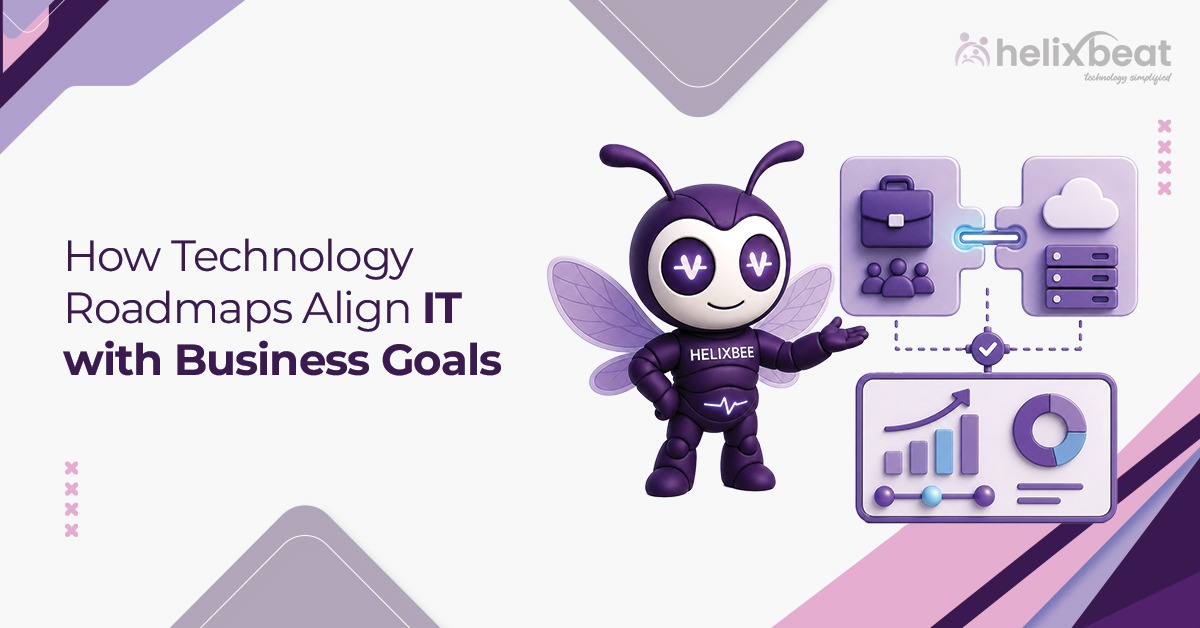
A technology roadmap is a visual, time-phased plan that lays out which technology initiatives happen, in what order, and why. It isn’t a project plan. It shows leadership how infrastructure upgrades, software rollouts, security work, and platform migrations connect to revenue targets, customer experience goals, or cost-reduction mandates.
Done right, a technology roadmap strategy answers three questions any executive actually cares about: what are we building, why does it matter to the business, and when will we see the payoff? Miss any one of those, and the roadmap turns into an IT wish list.
Our technology roadmap planning work starts from this exact premise. It has to trace back to a business goal, not just a technical preference.
Why IT Business Alignment Breaks Down Without One
Without a shared roadmap, IT and business leadership end up planning in parallel universes. The CFO is thinking about quarterly margins. The COO is thinking about supply chain reliability. IT is thinking about which legacy system to retire next. None of these conversations touch, because there’s no shared document forcing them to.
This is where IT business alignment tends to fail in practice. It’s not from a lack of talent or budget, but from a lack of a common reference point. Therefore, a roadmap must give every department the same picture of what’s coming and why, which cuts down on surprise requests, last-minute vetoes, and the “why didn’t anyone tell us” meetings.
The Building Blocks of an Aligned Roadmap
Strong strategic IT planning usually rests on four pillars, and each one feeds directly into IT business alignment.
- Current-state assessment. Before anyone maps the future, someone has to document the present — what systems exist, what they cost, where they’re brittle. Skipping this step is the single most common reason roadmaps fall apart.
- Business goal mapping. Every initiative on the roadmap should trace to a stated business objective — entering a new market, cutting operating costs, or improving customer retention. If an initiative can’t be tied to a goal, it doesn’t belong on the roadmap yet.
- Prioritization and sequencing. Deciding what to build now and what to put on the back burner is where the real brainwork happens in strategic IT planning. At the end of the day, no team has infinite budget or endless hands on deck.
- Milestones with owners. A roadmap without accountable owners for each phase is just a diagram. Assigning ownership is what turns the plan into something that actually gets executed.
Put these four pieces together, and you have the practical mechanics behind IT business alignment.
Where an IT Governance Framework Fits In
A roadmap sets direction. However, an IT governance framework is what keeps decisions consistent. Frameworks like COBIT, ITIL, and TOGAF exist precisely because organizations kept discovering that good plans fall apart without clear rules for who approves spending, who owns risk decisions, and how exceptions get handled. Without that structure, IT business alignment tends to hold for a quarter or two and then quietly unravel.
Connecting Enterprise IT Planning to Digital Business Strategy
A technology roadmap only earns its keep when it’s read alongside the company’s broader digital business strategy. It’s the plan for how the business competes and serves customers using digital channels, data, and automation. Enterprise IT planning that’s disconnected from that broader strategy tends to produce technically sound systems that solve the wrong problem.
Imagine you’re running a store where same-day shipping is your biggest competitive edge. Upgrading your customer service software might sound nice on paper, but it won’t help you get packages out the door any faster. But live inventory updates and smart shipping integrations will. At Helixbeat, our digital transformation strategy helps companies sequence their tech investments the exact same way, not a generic best-practice list.
Practical Steps to Build One That Sticks
A few habits separate roadmaps that get used from ones that get shelved:
- Revisit the roadmap quarterly, not annually. Markets and budgets move faster than a once-a-year review can keep up with.
- Keep the roadmap visual and short enough that a non-technical executive can read it in ten minutes.
- Tie every major line item to a cost or ROI figure. Vague benefits get cut first when budgets tighten. A proper IT infrastructure assessment up front makes this a lot easier.
- Involve finance and operations leaders in the drafting stage, not just the review stage.
- Review IT spend against the roadmap at least twice a year.
None of these steps are complicated on their own. What’s hard is doing them consistently, quarter after quarter. That consistency is what IT business alignment actually rewards over time — not a clever framework, just the discipline to keep checking the plan against reality.
The Bottom Line
A technology roadmap isn’t a technical artifact. It’s a negotiation device between IT and the rest of the business, written down so nobody has to relitigate priorities every quarter. Get the fundamentals right, and IT business alignment stops being an aspiration and becomes how the organization actually runs.
Contact us to learn how Helixbeat can help you turn strategy into execution.
FAQs
1. What is IT business alignment?
It’s the degree to which an organization’s technology decisions and investments directly support its stated business goals, rather than running on a separate track decided purely by the IT department.
2. How is a technology roadmap different from a project plan?
A project plan tracks tasks, deadlines, and resources for one initiative. A roadmap sits above that — it shows the sequence and rationale of multiple initiatives over a longer time horizon, tied to business goals rather than day-to-day tasks.
3. How often should a technology roadmap be updated?
Most organizations review the roadmap at least quarterly and do a fuller revision annually, since market conditions, budgets, and business priorities shift faster than an annual-only cycle can capture.
4. What role does an IT governance framework play in a roadmap?
It supplies the decision-making rules — who approves spending, who owns risk calls, how exceptions get handled — that keep the roadmap consistent even as staff, priorities, or budgets change.
5. Who should be involved in building the roadmap?
IT leadership, finance, operations, and the business unit leaders whose goals the roadmap is meant to support. Building it in an IT silo is one of the most common reasons roadmaps get ignored later.