

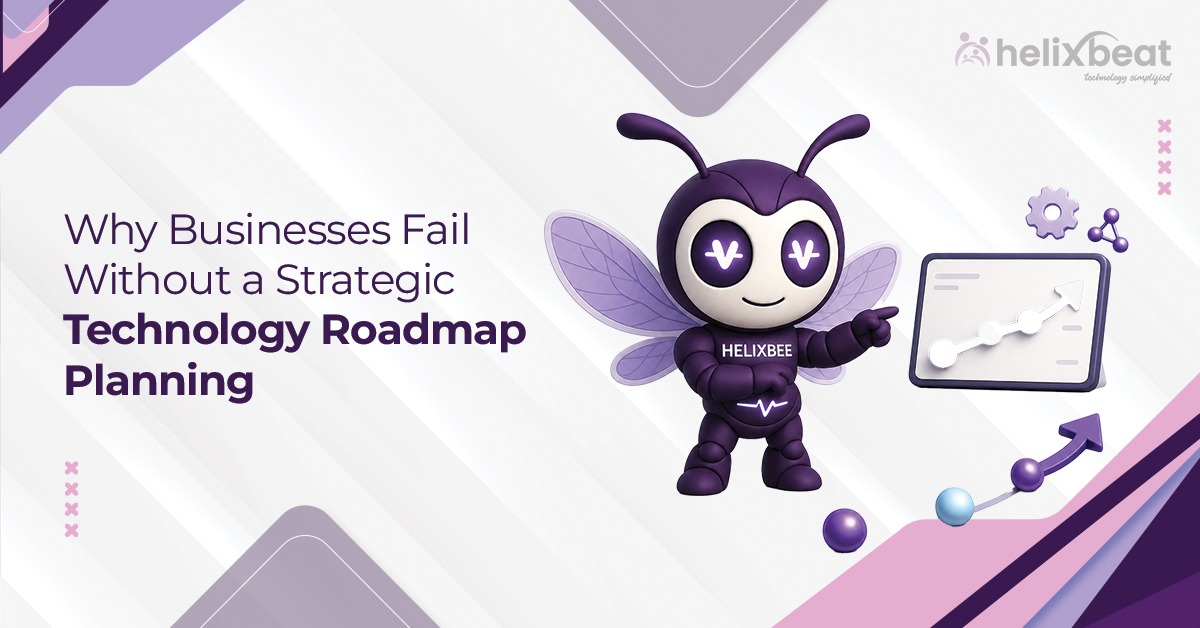
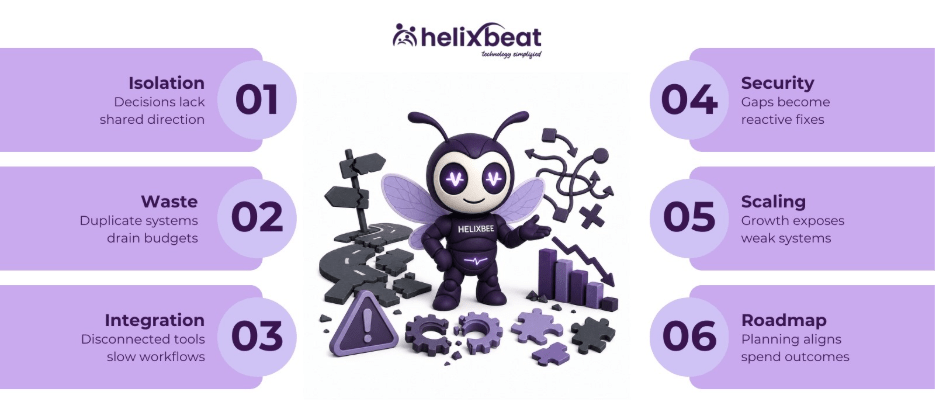
Most companies don’t fail because of bad technology. They fail because every technology decision gets made in isolation. Each choice makes sense on its own. However, none of them add up to anything because nothing connects them. That is what happens without a technology roadmap. As a result, a business ends up with a pile of disconnected tools instead of a system built to grow.
A roadmap isn’t a slide deck for the board. It’s the working document that ties every IT investment back to a business outcome.
Table of Contents
The Hidden Cost of Operating Without a Plan
Companies without a roadmap don’t usually notice the cost until it’s large. Spending on software and infrastructure trickles out department by department. Marketing buys one automation platform, sales buys another, and finance keeps running processes in spreadsheets because nobody owned the decision to modernize it.
A few years in, the bill comes due: duplicate licenses nobody remembers approving, systems that can’t talk to each other, and a technical debt load so heavy that every new project takes twice as long as it should. It happened because nobody was making decisions against a shared plan.
Five Ways the Absence of a Roadmap Shows Up
Technology decisions follow the loudest request, not the biggest opportunity. Without a documented plan, the IT budget tends to go to whichever department complains the most. As a result:
- Integration becomes an afterthought. Systems get purchased individually and connected later. Usually, the result is manual data re-entry, mismatched reporting, and staff quietly building spreadsheets to bridge gaps nobody planned for.
- Security gets treated as a project instead of a standard. A breach or audit finding triggers a scramble to patch one system, while the rest of the environment stays exactly as exposed as it was before.
- Scaling exposes the cracks. A platform chosen for a 50-person company starts buckling at 300 employees, and by then, replacing it means migrating years of data under time pressure instead of on a planned schedule.
- Leadership loses the ability to forecast IT spend. Without a roadmap, technology budgeting becomes a yearly guessing game rather than a multi-year plan tied to growth targets.
What Real Technology Roadmap Planning Actually Involves
Good technology roadmap planning starts with an honest look at what already exists. It includes the systems in use, where they overlap, where they’re aging out, and where they’re quietly costing more. That assessment matters more than the roadmap document itself, because a plan built on an inaccurate picture of the current environment will misdirect spending from day one.
From there, the roadmap maps specific technology initiatives to specific business goals on a realistic timeline. It also builds in review points, because a roadmap set once and never revisited becomes outdated the moment market conditions or business priorities shift. Therefore, businesses that get the most value out of it treat the roadmap as a living document.
IT Roadmap Planning vs. a Full Digital Transformation Roadmap
These terms get used interchangeably, but they aren’t quite the same thing. IT roadmap planning typically covers infrastructure, security, and system upgrades. A digital transformation roadmap goes further, addressing how technology reshapes the way the business actually works. It involves automating manual processes, changing how customers interact with the company, or restructuring how data flows between departments.
A business can have solid IT roadmap planning in place and still stall out on transformation, because upgrading infrastructure doesn’t automatically change how work gets done. The two need to be built together.
Building the Roadmap: A Practical Starting Point
A roadmap doesn’t need to start big. It needs to start accurately. The starting point is a proper IT infrastructure assessment — an inventory of every system, its age, its cost, and how well it’s actually serving the people. From there, priorities get ranked against business impact, and a phased timeline gets built with clear owners for each phase.
The plan should also account for the cost from the start. A roadmap that ignores budget realities tends to get shelved the first time a finance review happens, which is why strategic technology planning usually runs alongside a cost review. It helps identify where existing spend can be redirected before asking for a new budget.
When to Bring in Technology Roadmap Consulting
Internal teams often know their own systems well but lack the outside view needed to spot where a plan is missing something. This means a compliance requirement nobody flagged, a vendor lock-in risk, or a scaling limit that won’t show up until it becomes a crisis. This is usually where technology roadmap consulting earns its cost. It helps bring a structured framework and pattern recognition from the outside experts.
The businesses that get real value from consulting treat it as a second opinion, not an outsourcing of the decision itself. However, the roadmap still has to reflect the specific business it’s built for, and internal stakeholders still have to own the outcome.
The Bottom Line
Skipping technology roadmap planning doesn’t guarantee a business will fail, but it removes the one thing that catches expensive mistakes before they happen: a shared plan everyone is working against. What good planning does is turn technology spending from a series of disconnected reactions into a strategy that leadership can defend, adjust, and hold people accountable to.
Businesses that skip this step don’t usually fail all at once. They fail slowly, one disconnected decision at a time, until the cost of catching up becomes larger than the cost of planning.
FAQs
1. What is technology roadmap planning?
Technology roadmap planning is the process of documenting a business’s current technology environment, mapping planned initiatives to specific business goals, and sequencing them on a realistic timeline so every IT decision supports a larger objective.
2. How is IT roadmap planning different from a digital transformation roadmap?
IT roadmap planning generally focuses on infrastructure, security, and system upgrades. A digital transformation roadmap covers a broader set of changes, including how processes, customer experience, and data flow across the business get reshaped by technology.
3. How often should a technology roadmap be updated?
Most businesses review the roadmap on a quarterly or biannual basis, with a fuller reassessment once a year. However, rapid change in the industry or a major shift in business strategy is also a reasonable trigger for an off-cycle review.
4. How far out should a technology roadmap plan?
A common range is 12 to 36 months, broken into phases. Anything longer tends to lose accuracy as market conditions and business priorities shift.
5. Who should be involved in building the roadmap?
IT leadership sets the technical direction, but finance, operations, and department heads who depend on the systems should have input. A roadmap built without their involvement tends to miss real operational constraints.