

US enterprises lose nearly $15 million annually due to poor data quality, delayed reporting, and disconnected analytics systems. Traditional platforms are no longer designed to support real-time decision-making or modern compliance requirements. This is why companies are upgrading to next-generation data warehouse solutions powered by Helixbeat. These platforms provide centralized data visibility, improve reporting accuracy, and support scalable cloud-based environments for enterprise analytics.
By modernizing their infrastructure with Helixbeat DaaS, organizations can eliminate manual reporting delays, enhance governance, and accelerate insights—making advanced data warehouse solutions a strategic investment rather than just an IT upgrade.
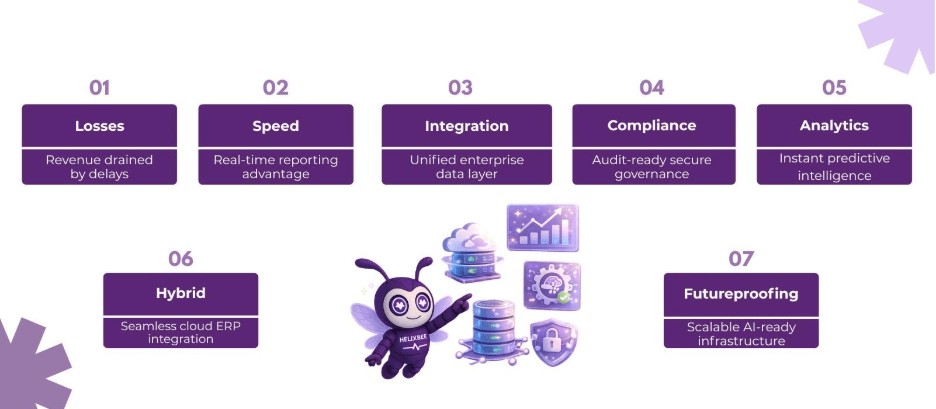
Table of Contents
Reporting Delays Are Costing US Businesses 8–10% of Revenue Annually
Outdated reporting tools still slow many US companies, taking 6–12 hours to generate critical operational insights. In fast-moving sectors like retail, logistics, and fintech, these delays directly affect revenue decisions.
Modern data warehouse solutions help organizations:
- Enable real-time dashboards for instant insights
- Reduce reporting turnaround time by up to 40%
- Support faster financial forecasting
- Improve operational responsiveness
Investing in a cloud data warehouse platform is now essential for companies aiming to stay competitive and agile.
Disconnected Business Data Is Becoming a Strategic Risk
US enterprises use an average of 110 SaaS applications across departments, yet most legacy systems fail to integrate them efficiently. As a result:
- Finance teams rely on outdated numbers
- Sales forecasts lack accuracy
- Supply chain insights are incomplete
- Customer behavior analytics remain fragmented
The best data warehouse software consolidates enterprise-wide data into a single analytics layer, enabling accurate, timely decisions across all departments.
52% of US Organizations Are Upgrading Due to Compliance Pressure
Rising regulatory requirements make it essential for businesses to ensure:
- Audit-ready reporting
- Data lineage tracking
- Access governance
- Encrypted storage
Legacy systems lack built-in compliance frameworks, increasing audit risks. Cloud data warehouse platforms and solutions like SAP Data Warehouse Cloud automate compliance, reduce manual intervention, and improve governance across all enterprise datasets.
Real-Time Analytics Is Now a Competitive Necessity
Companies leveraging real-time analytics are more likely to outperform competitors in profitability. Modern data warehouse solutions allow organizations to:
- Track live customer engagement
- Monitor inventory demand instantly
- Optimize pricing dynamically
- Predict churn behavior
This shift toward instant intelligence is a key driver for adopting best data warehouse software and cloud data warehouse solutions.
Hybrid Analytics Needs Are Driving Adoption of SAP Data Warehouse Cloud
US organizations increasingly rely on hybrid environments combining:
- On-premises ERP systems
- Cloud-based CRM platforms
- Third-party SaaS tools
SAP Data Warehouse Cloud enables businesses to:
- Virtualize distributed data efficiently
- Integrate cross-platform analytics seamlessly
- Maintain centralized governance
- Scale compute resources dynamically
This flexibility ensures enterprises can handle modern analytics demands while maintaining performance and compliance.
Helixbeat DaaS Is Helping US Enterprises Future-Proof Their Data Warehouse Solutions
Helixbeat DaaS tackles the critical challenges driving modernization by offering:
- Automated data consolidation for accurate insights
- AI-ready analytics infrastructure for predictive decisions
- Scalable cloud data warehouse deployment to support growth
- Secure enterprise-grade governance
- Reduced reporting latency for faster operational decisions
By enabling these capabilities, Helixbeat empowers businesses to move from reactive reporting to predictive decision-making, making it one of the best data warehouse solutions for modern US enterprises.
What Happens When Companies Don’t Upgrade Their Data Warehouse Infrastructure?
Delaying modernization can lead to operational inefficiencies and poor forecasting accuracy. The difference between legacy and next-generation platforms is evident:
| Business Impact | Legacy Warehouse | Next-Gen Data Warehouse Solutions |
| Reporting Speed | 6–12 Hours | Real-Time |
| Data Accuracy | Low | High |
| Compliance Risk | High | Reduced |
| AI Readiness | Limited | Enabled |
| Integration Capability | Fragmented | Unified |
| Decision Speed | Delayed | Instant |
Modern data warehouse solutions like Helixbeat DaaS unify enterprise data, enhance decision-making speed, and reduce compliance risks across global operations.
Wrapping Up
US enterprises are upgrading to next-gen data warehouse solutions to overcome reporting delays, fragmented analytics, and compliance challenges. Helixbeat DaaS delivers scalable cloud data warehouse platforms that improve data visibility, decision speed, and governance—helping businesses remain competitive in today’s real-time, data-driven economy.
FAQs
1. Why are legacy data warehouse systems no longer effective?
They cannot support real-time analytics, multi-source integration, or automated compliance required for modern enterprise operations.
2. How do next-gen data warehouse solutions improve decision-making?
They provide real-time insights by consolidating enterprise data into a unified analytics platform.
3. Why is compliance a reason for upgrading data warehouse infrastructure?
Modern platforms offer built-in governance frameworks that reduce audit risks and manual reporting errors.
4. How does Helixbeat DaaS support cloud data warehouse deployment?
It automates integration, improves governance, and enables scalable analytics environments.
5. What role does SAP Data Warehouse Cloud play in hybrid analytics?
It integrates on-premises and cloud data systems into one centralized platform.
6. Can data warehouse upgrades improve operational forecasting?
Yes, faster reporting improves financial planning and supply chain optimization.
7. What happens if companies delay upgrading their data warehouse solutions?
They may face inaccurate analytics, compliance risks, and slower decision-making processes.