

In the age of big data, businesses generate massive volumes of information every day, making it essential to manage, analyze, and act on this data effectively. Data Warehouse SaaS solutions provide a cloud-based, scalable, and cost-efficient approach to storing and analyzing complex datasets.
Platforms like Helixbeat offer advanced tools that transform raw data into actionable insights, reduce operational costs, and improve decision-making. Modern data warehouse systems seamlessly integrate with existing databases and applications, allowing businesses to focus on growth rather than infrastructure management.
This blog highlights the key benefits of adopting Data Warehouse SaaS and explains why it is crucial for achieving sustainable business success.
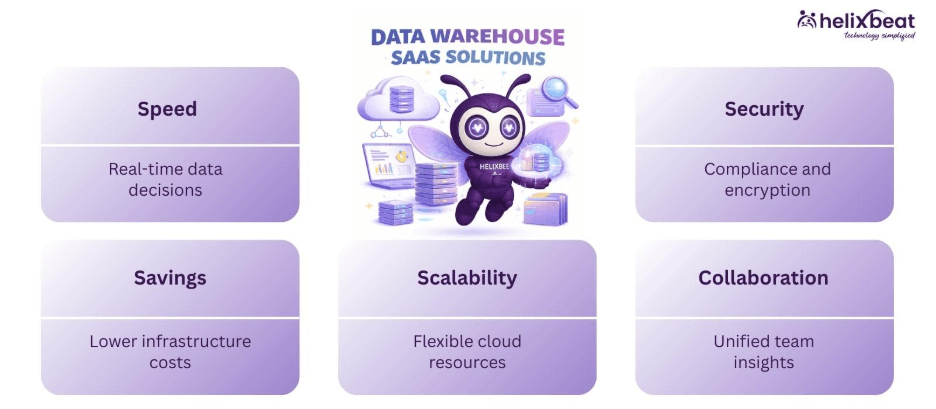
Table of Contents
1. Accelerating Business Decisions with Data Warehouse SaaS
In today’s competitive market, the speed of decision-making can define business success. Data Warehouse SaaS enables organizations to access and analyze data quickly, ensuring timely and informed actions.
Real-Time Data Access
Cloud-based database and data warehouse solutions provide instant access to large datasets. Instead of waiting for manual aggregation, teams can pull real-time insights and make decisions faster. For example, sales teams can adjust strategies immediately based on current customer behavior, improving responsiveness, and performance.
Enhanced Reporting and Analytics
Modern data warehouse management systems offer automated dashboards, reporting, and visual analytics. Business leaders no longer rely on static reports; interactive dashboards present trends, anomalies, and forecasts in real time, supporting faster strategic decisions.
Example: A retail company using a SaaS-based warehouse reduced reporting time significantly, enabling faster product launches and more agile operations.
2. Cost Efficiency and Reduced IT Overhead
Traditional on-premises warehouses require large investments in servers, storage, and maintenance. Data Warehouse SaaS significantly reduces these costs.
Pay-as-You-Go Model
SaaS solutions allow businesses to pay only for the storage and computing resources they use. This eliminates the need for large upfront infrastructure investments while keeping costs predictable.
Reduced IT Maintenance
With SaaS, the provider manages updates, patches, and backups. Internal IT teams can focus on high-value tasks instead of routine maintenance, saving time, and reducing operational risks.
Mini Case: A mid-sized company reduced IT expenditure by shifting to a cloud-based warehouse and redeploying IT staff to analytics and innovation projects.
3. Scalability to Match Business Growth
As organizations grow, data requirements increase exponentially. Data Warehouse SaaS platforms scale storage and computing resources automatically to meet evolving needs.
Elastic Storage and Compute
Unlike traditional warehouses, SaaS-based data warehouse management systems can expand resources instantly. This ensures performance remains consistent even during periods of high demand.
Supporting Peak Loads
E-commerce businesses often face seasonal traffic surges. With SaaS, types of data warehouse applications handle spikes without downtime or manual intervention, ensuring smooth operations.
Example: A cloud platform serving millions of users scaled its data warehouse seamlessly during peak sales periods, avoiding slow queries or service interruptions.
4. Stronger Data Security and Compliance
Securing data is critical in the modern business environment. Data Warehouse SaaS platforms are built with robust security measures to protect sensitive information.
Encryption and Access Controls
Advanced encryption, multi-factor authentication, and role-based access ensure data protection. Businesses can control who accesses information without compromising security.
Regulatory Compliance
SaaS data warehouse management systems adhere to global compliance standards such as GDPR, HIPAA, and SOC 2. Compliance is automated and continuously updated, helping organizations in regulated sectors like healthcare and finance minimize risk.
5. Enhanced Collaboration Across Teams
Effective collaboration provides a competitive advantage. Centralized database and data warehouse access ensures that all teams work with the same information, improving alignment and decision-making.
Centralized Data Access
SaaS data warehouse systems act as a single source of truth. Sales, marketing, operations, and finance teams can access unified data, reducing conflicts and duplication, which allows faster and more accurate decision-making.
Shared Dashboards and Analytics
Interactive dashboards and reporting tools allow teams to co-analyze data. Collaborative insights foster faster problem-solving and enable better strategy execution.
Example: A multinational company implemented SaaS warehouses to unify team access, enhancing cross-departmental project execution and communication.
Understanding Helixbeat’s Competitive Edge
Helixbeat delivers unique value in Data Warehouse SaaS by combining advanced analytics, seamless integration, and automation, helping organizations make data-driven decisions confidently.
AI-Powered Insights
Helixbeat leverages AI and machine learning to identify trends, detect anomalies, and predict future scenarios, empowering organizations with predictive business strategies.
Seamless Integration
Helixbeat integrates easily with existing data warehouse applications and corporate databases, ensuring smooth migration with minimal downtime and zero data loss.
Key Features of Helixbeat
| Feature | Benefit |
| AI Analytics | Identify trends and predict outcomes |
| Cloud Integration | Connects seamlessly with databases |
| Automated Reporting | Saves time with instant reports |
| Security & Compliance | Protects data and ensures regulatory adherence |
| Scalability | Handles growing data and user demands |
Types of Data Warehouse Applications for Competitive Advantage
Selecting the right data warehouse applications ensures businesses leverage the most effective system for their needs.
Enterprise Data Warehouses (EDW)
Centralized systems consolidate organizational data, providing a comprehensive view for strategic decisions.
Operational Data Stores (ODS)
Designed for real-time operational reporting, these warehouses deliver daily tactical insights.
Data Marts
Department-focused warehouses offer faster, targeted insights for finance, sales, or marketing teams.
Comparison of Data Warehouse Types
| Type | Use Case | Advantages |
| EDW | Enterprise-wide analytics | Integrated view, long-term strategy |
| ODS | Daily operations | Fast, operational reporting |
| Data Mart | Department-level insights | Lightweight, rapid deployment |
Faster Deployment and Easy Maintenance
Time-to-value is critical for technology investments. SaaS data warehouse systems drastically reduce setup and ongoing maintenance efforts.
Quick Setup
SaaS warehouses can be deployed in days instead of months. Pre-configured solutions and templates allow immediate data ingestion and reporting.
Automated Updates
Providers continuously update the warehouse with new features and security patches, ensuring analytics remain current and organizations avoid downtime.
Data-Driven Insights Improve Market Competitiveness
Turning data into actionable insights is essential for staying ahead in competitive markets.
Predictive Analysis
SaaS data warehouse systems provide predictive models that help businesses anticipate customer behavior, optimize inventory, and improve marketing ROI.
Strategic Advantage
Organizations leveraging data warehouse applications outperform competitors in decision-making speed, operational efficiency, and customer satisfaction.
Mini Case: A retail chain used predictive analytics in Helixbeat to optimize inventory and improve availability, ensuring higher customer satisfaction during peak periods.
Wrapping Up
Adopting Data Warehouse SaaS with Helixbeat empowers businesses with cost efficiency, scalability, security, and actionable insights. Leveraging advanced data warehouse applications and modern database and data warehouse systems, companies can make faster decisions, foster collaboration, and maintain a competitive edge in an increasingly data-driven world.
FAQs
1. What is a Data Warehouse SaaS?
A cloud-based platform for storing, managing, and analyzing large volumes of business data.
2. How does Helixbeat enhance data warehouse efficiency?
Helixbeat integrates AI analytics, automation, and seamless database connections to deliver actionable insights quickly.
3. Are SaaS data warehouses secure?
Yes, they provide encryption, access controls, and regulatory compliance features.
4. What are the types of data warehouse applications?
EDWs, ODS, and Data Marts, each designed for specific analytics and business needs.
5. Can data warehouse SaaS reduce IT costs?
Yes, it minimizes hardware investment, maintenance, and resource management costs.
6. Is scaling easy with Data Warehouse SaaS?
Absolutely. SaaS solutions allow elastic storage and computing to match business growth.
7. How quickly can I deploy a SaaS data warehouse?
Deployment is much faster, typically within days, thanks to pre-built cloud infrastructure.
8. Why is real-time analytics important in SaaS data warehouses?
It enables faster decisions, improves responsiveness to market changes, and drives revenue growth.