

Technology has changed how businesses operate, compete, and deliver value. Yet many companies continue to rely on outdated systems, which slow growth. The challenge is that these problems often develop gradually, which makes them difficult to spot until they start affecting revenue, customer satisfaction, and employee productivity.
This is where a well-planned digital transformation strategy becomes important. Companies that adopt digital transformation can streamline operations, improve decision-making, and adapt faster to changing market demands.
If your organization is facing any of the following challenges, it may be time to rethink how you operate.
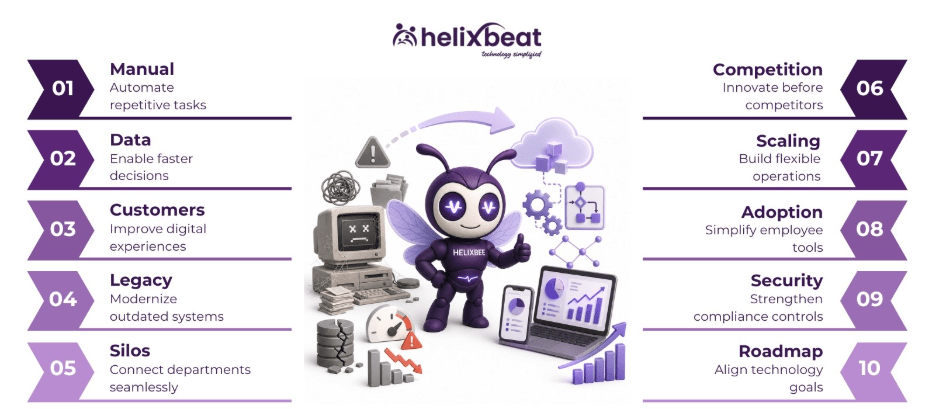
Table of Contents
1. Your Teams Spend Too Much Time on Manual Tasks
If employees are repeatedly entering data or generating reports manually, productivity suffers.
For example:
- Sales teams manually update CRM records.
- Finance teams spend days reconciling spreadsheets.
- HR departments process employee requests through email chains.
Manual processes increase errors and consume valuable hours that could be spent on strategic initiatives.
However, implementing workflow automation and system integrations can dramatically reduce repetitive work and improve operational efficiency.
2. Decision-Making Takes Too Long
Businesses generate enormous amounts of data, but data alone does not create value. If leadership teams wait days or weeks for reports before making decisions, they are operating at a disadvantage.
Signs include:
- Reports coming from multiple spreadsheets
- Inconsistent metrics across departments
- Lack of real-time visibility
Modern organizations rely on analytics platforms that transform raw data into actionable insights. Real-time dashboards and predictive analytics help leaders identify opportunities and risks faster.
A robust digital transformation strategy places data at the center of decision-making.
3. Customers Are Complaining About Slow or Inconsistent Experiences
Today, customers expect fast, personalized, and seamless interactions. Poor customer experiences often stem from outdated technology and fragmented systems. Warning signs include:
- Slow response times
- Repeated support tickets
- Disconnected communication channels
- High customer churn rates
A strong business transformation strategy integrates customer data, automates workflows, and delivers personalized experiences across touchpoints. Companies that fail to modernize risk losing customers to digitally mature competitors.
4. Your Legacy Systems Are Becoming Expensive to Maintain
Older systems may still function, but maintaining them can become increasingly costly.
Common issues include:
- Frequent downtime
- Limited scalability
- Security vulnerabilities
- Lack of integration capabilities
Plus, legacy platforms were not designed for cloud computing, AI applications, or real-time analytics. Instead of continually patching outdated infrastructure, organizations should evaluate modernization initiatives through a comprehensive digital transformation strategy.
5. Departments Operate in Silos
When teams work in isolation, information gets trapped.
Typical symptoms include:
- Duplicate work
- Miscommunication
- Conflicting reports
- Delayed project execution
Disconnected systems create organizational friction.
However, modern integration solutions enable departments to share information seamlessly. Therefore, enterprise integration has become a fundamental element of successful digital transformation initiatives.
6. Your Competitors Are Innovating Faster Than You
If competitors are launching new services, introducing AI-powered experiences, or expanding digitally while your organization struggles to keep pace, it is a warning sign.
Meanwhile, digital-first businesses can:
- Adapt quickly to market changes
- Launch products faster
- Experiment with new business models
- Respond to customer needs in real time
Without a proactive digital transformation strategy, businesses often become reactive rather than innovative.
7. Scaling Operations Feels Difficult
Growth should not create chaos. However, many businesses experience:
- Operational bottlenecks
- Resource constraints
- Inability to manage increasing demand
- Technology limitations
Therefore, scalability requires systems that can grow without major restructuring. Cloud technologies, modular architectures, and automated workflows help organizations scale efficiently.
This is one of the primary goals of enterprise digital transformation initiatives.
8. Employees Resist Existing Tools
Technology should simplify work. However, if employees avoid using company systems or develop workarounds, the problem often lies in the technology itself.
Indicators include:
- Low software adoption rates
- Heavy reliance on spreadsheets
- Duplicate data entry
- Frequent complaints about usability
Modern digital solutions prioritize user experience and intuitive design. Therefore, successful digital transformation consulting initiatives focus equally on technology and employee adoption.
9. Security and Compliance Risks Are Increasing
Cybersecurity threats are becoming more sophisticated, and regulatory requirements continue to evolve.
Businesses relying on outdated infrastructure often face:
- Weak access controls
- Unpatched vulnerabilities
- Inconsistent data management
- Compliance challenges
Security should not be an afterthought. A modern digital transformation strategy incorporates cybersecurity, governance, and compliance into every phase of implementation.
10. You Lack a Clear Roadmap for Future Growth
Many businesses invest in technology without a long-term vision. These signs include:
- Random software purchases
- Disconnected transformation initiatives
- No measurable digital goals
- Technology investments with unclear ROI
Transformation works best when it aligns technology initiatives with business objectives.
This is where digital transformation services and expert consulting become valuable. They help organizations assess current capabilities, prioritize investments, and build measurable roadmaps for growth.
Why Businesses Need Expert Guidance
Digital transformation is not a single project. It is an ongoing process involving technology, people, processes, and culture. Organizations increasingly pursue digital transformation because consultants bring:
- Structured transformation frameworks
- Technology expertise
- Change management capabilities
- Cross-industry experience
- Faster implementation methodologies
Expert-led transformation initiatives can remarkably improve operational efficiency and create scalable business models.
Final Thoughts
A successful digital transformation strategy is not defined by how much technology a company adopts. It is defined by how effectively technology solves business challenges, improves customer experiences, empowers employees, and supports sustainable growth.
Helixbeat helps organizations modernize operations through customized digital strategies, advanced technology integration, analytics, workflow automation, and continuous support. Our approach focuses on aligning digital initiatives with business goals while creating scalable, future-ready systems. Get in touch with us!
FAQs
1. What is a digital transformation strategy?
A digital transformation strategy is a structured plan that uses technology to improve business processes, customer experiences, and operational efficiency.
2. Why is a digital transformation strategy important?
It helps businesses become more agile, data-driven, and competitive in rapidly changing markets.
3. What industries benefit from digital transformation services?
Healthcare, retail, manufacturing, finance, education, logistics, and e-commerce can all benefit from digital transformation services.
4. What does digital transformation consulting involve?
It includes assessing existing systems, creating digital roadmaps, selecting technologies, managing implementation, and driving organizational change.
5. How long does enterprise digital transformation take?
The timeline varies depending on the scope, complexity, and organizational readiness. Projects can range from several months to multiple years.