


Table of Contents
How to Build Topical Authority in Healthcare SEO
Healthcare search is no longer a one-query journey. A patient may start with “persistent knee pain,” then search for causes, treatment options, surgery risks, recovery time, specialists, and local providers.
That changes the SEO game.
Ranking one page for one keyword is not enough. The bigger opportunity is becoming the website Google and patients consistently associate with a medical subject. That is where Healthcare SEO Services can create long-term growth.
Google says its systems give stronger weight to E-E-A-T signals for topics that can significantly affect health or safety—often called Your Money or Your Life, or YMYL, topics. That raises the bar for accuracy, expertise, sourcing, and trust in healthcare content.
Build topical authority by creating deep, connected, medically credible content around subjects your organization genuinely knows.
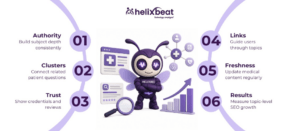
What Topical Authority Means in Healthcare
Topical authority is the degree to which search engines and users see your site as a reliable source on a specific subject.
Imagine two dermatology websites.
Site A has one acne-treatment page.
Site B has resources on adult acne, hormonal acne, cystic acne, scars, medications, skincare, triggers, and treatment timelines.
Site B clearly demonstrates more depth.
That is why modern Healthcare SEO Services should focus on topic ecosystems instead of isolated keywords. A medical SEO agency should map what patients need to know before, during, and after choosing care. Good SEO for healthcare providers becomes a combination of visibility, education, and trust.
A healthcare digital marketing agency can extend those topics across search, social, video, and email, while a medical practice SEO company connects content to appointments.
-
Choose the Topics You Want to Own
Do not begin with search volume.
Begin with clinical relevance.
List your priority specialties, treatments, and locations. Then map the symptoms, questions, and comparisons that influence patient decisions.
This is the foundation of effective Healthcare SEO Services.
A healthcare SEO consultant can turn those questions into a topic map. A medical SEO agency can then separate informational, commercial, local, and transactional intent.
For example, a cardiology clinic should go deep into hypertension, arrhythmia, heart screening, cholesterol, or cardiac rehabilitation instead of chasing unrelated wellness traffic.
Focus first. Expand later.
-
Create a Pillar Page for Each Core Topic
A pillar page is the central resource for a broad subject.
Suppose an orthopedic practice wants to build authority around knee replacement.
Its pillar page could cover:
- Who may need knee replacement
- Diagnosis and evaluation
- Partial vs. total knee replacement
- Preparing for surgery
- Benefits and risks
- Recovery
- Rehabilitation
The pillar answers the main questions and points readers toward deeper supporting articles.
This gives Healthcare SEO Services a clear hub-and-spoke structure.
For SEO for healthcare providers, that structure also matches patient behavior. Someone may enter through a symptom article, move to a treatment comparison, visit a surgeon profile, and finally book an appointment.
-
Build Clusters Around Patient Intent
Now expand your pillar.
A knee replacement cluster could include:
- Signs you may need surgery
- Knee injections vs. surgery
- Partial vs. total replacement
- How to prepare for surgery
- Recovery timeline
- Physiotherapy after surgery
- Common complications
- Returning to work
Every page has a different job.
That is what separates strategic Healthcare SEO Services from content production for its own sake.
A medical practice SEO company can use Search Console, competitor gaps, patient FAQs, and physician interviews to identify missing subtopics.
Strong healthcare marketing services turn those insights into content that supports both patient education and conversion.
A healthcare digital marketing agency can also repurpose physician answers into videos, FAQs, social posts, and emails while keeping the underlying medical message consistent.
-
Make E-E-A-T Visible
Healthcare content should never make readers guess who created or reviewed it.
Google recommends making authorship clear and describes trust as the most important element of E-E-A-T. It also places greater emphasis on E-E-A-T signals for YMYL topics such as healthcare.
Your Healthcare SEO Services process should therefore include:
- Named authors or medical reviewers
- Relevant professional credentials
- Review and update dates
- Credible medical references
- Balanced treatment claims
- Accurate doctor information
- Transparent editorial information
A healthcare SEO consultant should build these checks into the workflow.
A medical SEO agency should also challenge exaggerated claims such as “guaranteed cure” or “100% successful treatment.”
Here is a simple rule:
If a page could influence a health decision, it deserves stronger review than an ordinary marketing article.
-
Use Internal Links to Show Relationships
Internal links do more than send users from Page A to Page B.
They help create context.
Your pillar page should link to supporting articles. Supporting pages should link back to the pillar and to other relevant pages when that connection helps the patient.
Strong Healthcare SEO Services use internal links to connect symptoms, conditions, treatments, specialists, and locations.
For example, an osteoarthritis article could link to treatment options, specialist guidance, knee replacement eligibility, and appointment information.
-
Cover the Entire Patient Search Journey
Not every searcher is ready to book.
A strong SEO for healthcare providers strategy covers the journey from awareness to decision:
“Why am I getting adult acne?” → “When should I see a dermatologist?” → treatment comparisons → “acne dermatologist near me” → aftercare questions.
That is why Healthcare SEO Services should balance educational content with high-intent pages.
A medical practice SEO company can assign every page a role in this journey.
A healthcare digital marketing agency can then use the same journey for social media, email campaigns, remarketing, and other patient-touchpoint strategies.
Effective healthcare marketing services do not treat SEO as an isolated channel. They build a connected patient-acquisition system.
-
Build Semantic Depth, Not Keyword Stuffing
Topical authority comes from covering concepts that naturally belong to a subject.
Take diabetes.
A comprehensive content ecosystem might discuss:
HbA1c, glucose monitoring, insulin, nutrition, neuropathy, kidney health, retinopathy, foot care, and endocrinology.
A good healthcare SEO consultant looks beyond exact-match keywords and asks whether the page covers concepts patients genuinely expect to find.
A capable medical SEO agency should combine keyword data with physician interviews and actual patient questions.
The best SEO for healthcare providers also bridges the gap between clinical terminology and everyday language.
A doctor may say “gastroesophageal reflux disease.”
A patient may search, “Why does acid keep coming up in my throat?”
Your content should understand both.
-
Add Original Value Competitors Cannot Easily Copy
Generic content is easy to reproduce; genuine expertise is not.
Your Healthcare SEO Services strategy can add originality through physician commentary, consultation FAQs, treatment checklists, recovery guides, diagrams, videos, and explanations of your care process.
A medical practice SEO company should look for expertise already inside the healthcare organization that has not yet been turned into useful digital content.
A healthcare SEO consultant can structure that expertise without exposing patient information or making unsupported claims.
Here is the advantage:
Competitors can copy your keyword list.
They cannot easily copy your clinicians’ genuine knowledge and experience.
Example: Building Topical Authority for a Cardiology Clinic
Let’s make this practical.
Imagine a cardiology clinic wants more visibility around hypertension.
The weak approach?
Write one article titled “What Is High Blood Pressure?” and create a service page targeting “cardiologist near me.”
The stronger topical approach starts with a comprehensive hypertension pillar.
Then create supporting pages on:
- Hypertension symptoms
- Causes and risk factors
- Blood pressure ranges
- Home blood pressure monitoring
- Lifestyle changes
- Hypertension medications
- Hypertension and kidney health
- High blood pressure and heart disease
- Emergency warning signs
- When to see a cardiologist
Now connect those pages internally.
Add cardiologist review. Reference credible medical sources. Link relevant educational content to physician profiles and appointment pages.
A medical SEO agency can measure visibility across the entire hypertension query set.
A medical practice SEO company can track whether informational visitors move toward consultation pages.
A healthcare digital marketing agency can reuse cardiologist explanations in videos and social media.
Then healthcare marketing services can reinforce the same subject across multiple channels rather than running disconnected campaigns.
That is how topical authority compounds.
-
Keep Medical Content Fresh
Topical authority can decay as treatments, statistics, doctors, and links change.
Healthcare SEO Services should therefore refresh priority clusters for outdated sources, missing questions, stale physician information, and internal-link opportunities.
Semrush’s healthcare SEO guidance recommends using credible sources, involving healthcare professionals in content creation or verification, and regularly reviewing healthcare content for accuracy.
A healthcare digital marketing agency should treat updating successful pages as meaningful SEO work.
Sometimes your fastest growth opportunity is not another article.
It is improving an article that is already ranking.
-
Measure Authority at the Topic Level
Do not judge topical authority by one keyword.
Track:
- Cluster-level ranking queries
- Top 3 and top 10 visibility
- Non-branded organic traffic
- Long-tail impressions
- Clicks from blogs to service pages
- Appointment conversions
- Relevant backlinks
- Results after content updates
Ahrefs’ June 2026 topical-authority guide describes the strategy as comprehensive coverage supported by pillar pages, topic clusters, internal links, and consistent subject focus.
This mindset matters for Healthcare SEO Services.
One keyword can fall while the overall topic gets stronger.
Look at the cluster, not just one ranking position.
-
Give Every Page a Clear Purpose
Before publishing a new article, ask:
- Which topic cluster does this strengthen?
- Which patient question does it answer?
- What value does it provide that existing pages do not?
- Who will review the medical information?
- Which pages should link to it?
- What should the reader do next?
This discipline makes Healthcare SEO Services more efficient and helps healthcare marketing services focus on outcomes instead of publishing quotas.
Every cluster also needs a conversion path.
Healthcare SEO Services should help a reader move naturally from education to the most relevant next step—whether that is exploring a treatment, finding a specialist, or requesting an appointment.
Final Thoughts
This is why Healthcare SEO Services should be treated as an authority-building system, not a monthly blogging checklist.
Topical authority is not built by publishing hundreds of disconnected articles.
The strongest Healthcare SEO Services start with the medical subjects that matter most, create strong pillar pages, build patient-intent clusters, demonstrate real expertise, connect pages through internal links, and keep important information current.
A skilled healthcare SEO consultant turns that approach into a repeatable roadmap.
Done correctly, SEO for healthcare providers becomes more than a traffic strategy. It becomes a system for patient education, trust, and long-term organic visibility.
And that is the real opportunity.
When your website consistently provides accurate, connected, genuinely useful answers, you stop competing for one keyword at a time.
You start building authority across the entire topic.
The most effective healthcare marketing services support that same goal by keeping SEO, content, conversion, and patient education aligned.
FAQs
- What are Healthcare SEO Services?
Healthcare SEO Services improve a healthcare website’s visibility through keyword research, content optimization, technical SEO, local SEO, internal linking, and authority-building strategies.
- Why is topical authority important in healthcare SEO?
Topical authority helps search engines understand a healthcare provider’s expertise by demonstrating comprehensive, trustworthy coverage of related medical topics and patient questions.
- How can healthcare providers build topical authority?
Healthcare providers can build topical authority by creating pillar pages, publishing supporting topic clusters, using credible medical sources, adding expert reviews, and strengthening internal links.
- How long does it take to build topical authority?
There is no fixed timeline. Results depend on competition, website authority, content quality, technical SEO, publishing consistency, and how comprehensively the website covers its chosen healthcare topics.