

The provider access API is one of the more talked-about pieces of healthcare regulation heading toward 2027. If you work in health IT, revenue cycle, or clinical operations, you have probably heard the term. But what does a provider access API actually do? And why should your team care about it in 2026? Here’s the practical version.
Table of Contents
What Is a Provider Access API, Exactly?
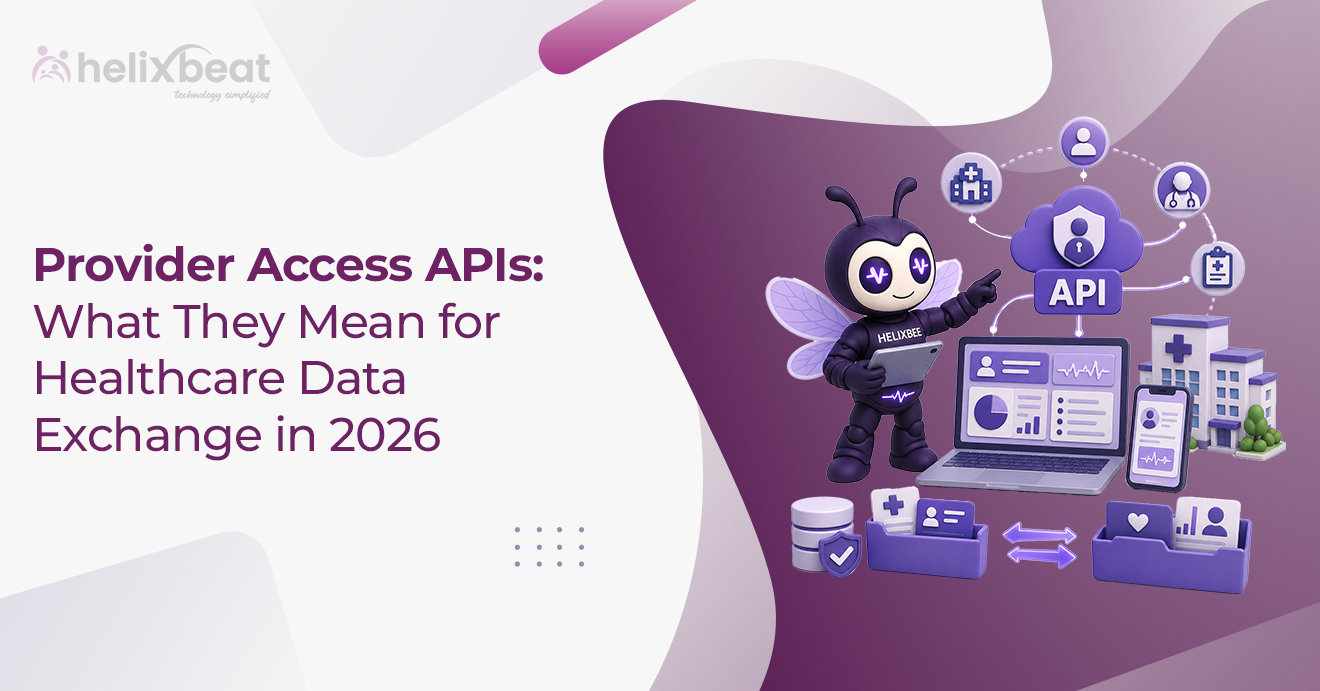
A provider access API is a standardized channel that lets in-network providers pull a patient’s health data straight from a payer’s system. Instead of faxing records, a clinician’s EHR can request the same information directly. No hold music, no separate portal login. Just an automated request for claims, clinical, and prior authorization data.
It comes from CMS-0057-F, the Interoperability and Prior Authorization Final Rule, finalized in January 2024. The rule covers Medicare Advantage organizations, Medicaid and CHIP managed care plans, and state Medicaid and CHIP fee-for-service programs. It also covers Qualified Health Plan issuers on the federal exchanges. All of them must build this API by January 1, 2027.
Why This Matters Beyond Compliance?
It’s easy to treat this as another item on a compliance checklist. That undersells it. If done well, this new access channel changes how clinical data exchange actually happens between practices and payers, day to day.
Right now, a lot of that exchange still runs on phone calls and PDFs. A provider needs to check a patient’s claims history or confirm whether a plan already has recent lab results. That usually means a portal login, a fax request, or a hold queue.
A working provider access API turns that into a query a system runs in seconds, not a task a staff member handles.
This is where real-time healthcare data exchange starts being an actual workflow. A provider’s EHR can pull claims history, encounter data, and prior authorization status straight from a payer. As a result, care teams spend less time chasing paperwork and spend more time with the patient.
The FHIR Backbone
Every provider access API under CMS-0057-F runs on FHIR, the HL7 standard that has become the default for modern healthcare data exchange APIs. FHIR resources like Patient, Claim, Encounter, and Coverage give both sides a shared structure. Therefore, a payer’s system and a provider’s EHR don’t need a custom translation layer just to talk to each other.
However, a FHIR provider access API needs built-in attribution logic. That is, payers can only share a member’s data with providers who have a treatment relationship with that patient. That attribution rule, combined with a patient’s right to opt out, is what separates this from a plain open data feed. Members can decline to have their data shared with a provider through this channel, and payers have to honor that choice.
What Payers Actually Need to Build?
Hitting the January 2027 deadline takes more than exposing an endpoint. Payers need:
- A FHIR-compliant server or data exchange platform that can host and version Patient, Coverage, Claim, and Encounter resources
- OAuth 2.0 and SMART on FHIR authentication, so provider systems connect securely.
- Attribution logic tied to actual claims or care management data, not guesswork
- Audit logging, since CMS expects payers to show who accessed what, and when.
- A clean way to handle member opt-outs without breaking the rest of the pipeline.
Where Providers Fit Into This?
Providers don’t carry the compliance burden here. Payers do. But providers stand to gain the most once these APIs are live. An EHR or practice management system connected to a payer’s provider access API can pull claims and clinical history ahead of a visit.
That has real downstream effects. Fewer duplicate labs get ordered. Fewer medication interactions slip through. Prior authorization decisions also move faster, since the same API carries prior auth status. IT teams supporting practices should start testing payer sandbox environments as they open through 2026. A real-time data exchange platform like AERIS can shorten that integration runway by a wide margin.
How AERIS Enhances Healthcare Data Interoperability with FHIR APIs?
Achieving true healthcare data interoperability demands real-time, standardized, and secure access to patient information. This is where AERIS by Helixbeat comes in, offering a powerful platform that combines event streaming with FHIR APIs.
AERIS enables healthcare providers, clinics, hospitals, pharmacies, and insurers to move beyond fragmented systems and adopt a connected, API-driven approach. Through FHIR APIs, the system supports real-time data exchange and provides instant access to critical patient information at the point of care.
As a result, AERIS creates a consistent, reliable data layer that simplifies integration, accelerates digital transformation, and drives meaningful improvements in healthcare data interoperability.
The Bigger Interoperability Picture
The provider access API is one of four APIs under CMS-0057-F, alongside the Patient Access API, the Payer-to-Payer API, and the Prior Authorization API.
Together, these four APIs push healthcare toward the kind of data sharing other industries figured out years ago. 2026 is the build year. 2027 is when it has to work in production, with real patients and real claims moving through it.
Need a reliable interoperability partner? Get in touch with us!
FAQs
- What is a provideraccessAPI in simple terms?
It’s a FHIR-based connection that lets an in-network provider’s system request a patient’s claims, clinical, and prior authorization data directly from a health plan, instead of relying on faxes, portals, or phone calls.
- Is the provideraccessAPI the same as the Patient Access API?
No. The Patient Access API lets members pull their own data into a third-party app of their choice. The provider access API lets attributed, in-network providers pull that same kind of data for treatment and care coordination.
- When do payers have to have a provideraccessAPI live?
CMS-0057-F sets a compliance deadline of January 1, 2027, for most impacted plan types, including Medicare Advantage, Medicaid, CHIP, and QHP issuers on the federal exchanges.
- Which payersare required tobuild a provider access API?
Medicare Advantage organizations, Medicaid and CHIP managed care plans, state Medicaid and CHIP fee-for-service programs, and Qualified Health Plan issuers on the federally facilitated exchanges.
- What data can providers get through a provideraccessAPI?
Claims and encounter data, clinical data formatted to USCDI, and prior authorization status and decisions, limited to patients the provider is attributed to.