

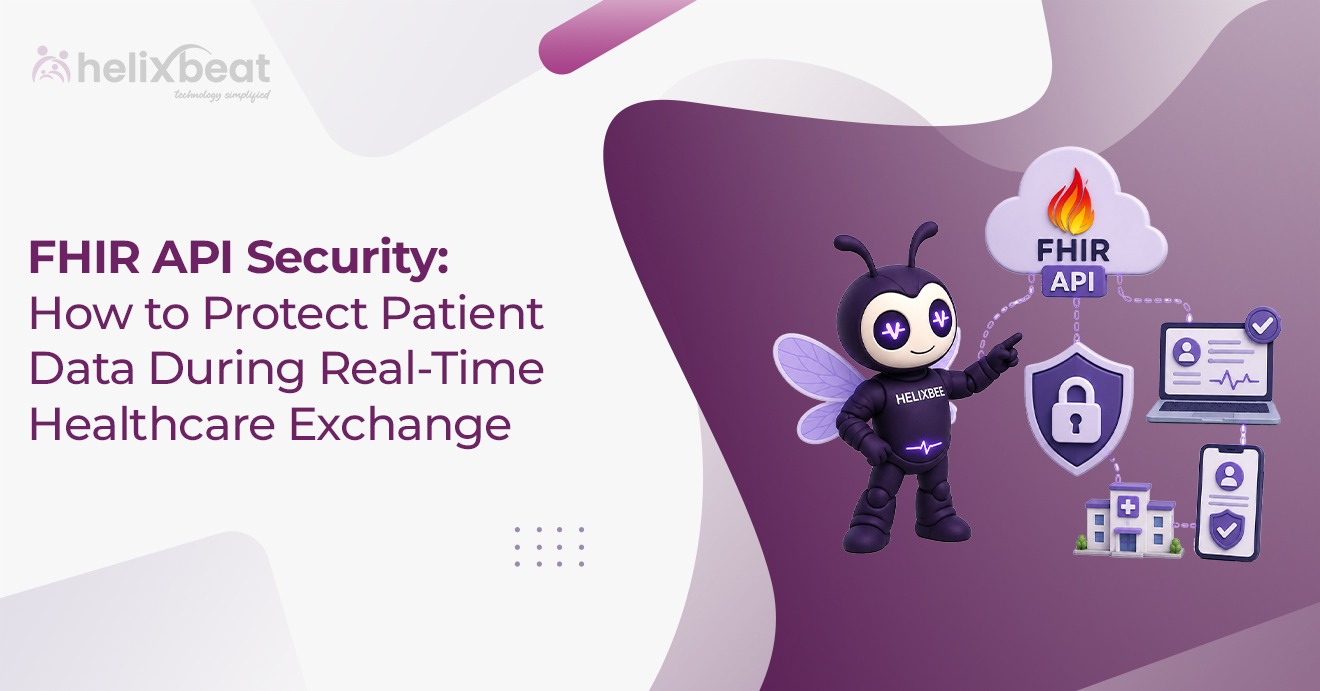
Every time a doctor pulls up your lab results on a tablet, or a pharmacy app checks your allergy list before filling a prescription, a FHIR API is quietly doing the work. Fast Healthcare Interoperability Resources, or FHIR, has become the backbone of real-time healthcare data exchange. It lets hospitals, payers, labs, and patient-facing apps talk to each other in a shared language.
But that same openness also makes FHIR API security a genuine business risk. One misconfigured endpoint can expose thousands of patient records immediately. Therefore, strong healthcare API security has to be part of the architecture from day one.
Table of Contents
Why FHIR Changes the Security Conversation?
Older interoperability standards, like HL7 v2 messaging, moved data through point-to-point interfaces. FHIR flips that model, running on standard REST APIs, JSON, and HTTP. It’s the same stack behind most consumer apps. That’s exactly why adoption took off, and why FHIR security has to borrow from general web API practices while layering on healthcare-specific rules around consent and identity.
A FHIR server exposes resources like Patient, Observation, MedicationRequest, and Condition, each reachable through predictable URLs. If access controls on those endpoints are loose, an attacker doesn’t need to breach a database. They just need to guess or alter a resource ID in the request. This exact weakness, Broken Object Level Authorization, has topped the OWASP API Security Top 10 since 2019 and kept its position in the 2023 update. It shows up wherever developers assume login alone is enough. This exact gap is what disciplined FHIR API security practices exist to close.
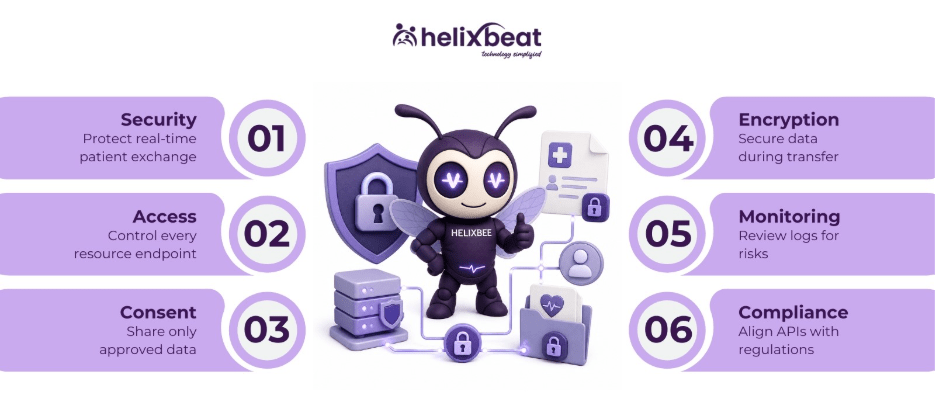
The Core Pillars of FHIR API Security
- Authentication and Authorization, Done Properly
Authentication confirms who is calling the API. Authorization decides what they’re permitted to see. FHIR APIs typically rely on SMART on FHIR, a framework pairing OAuth 2.0 with OpenID Connect for identity. Scopes such as patient/Observation.read or user/*.write limit exactly which resources a client can touch, instead of granting blanket access to an entire chart.
For system-to-system exchange, where no one sits at a login screen, SMART Backend Services uses signed JWT assertions. If your team is deciding how to structure this layer, our guide on users, clients, and permission strategies for FHIR walks through the practical setup.
- Encrypted Transport, Every Time
Patient data should never travel unencrypted. TLS 1.2 is the accepted floor for any FHIR API security program, and TLS 1.3 is preferable wherever infrastructure allows it. For backend integrations between trusted systems, mutual TLS adds a second layer by requiring both sides to prove their identities with certificates.
- Consent and Field-Level Access Control
Patient data security isn’t only about keeping outsiders away. It’s about respecting what a patient actually agreed to share. FHIR includes a Consent resource for this purpose, and mature implementations tie authorization scopes to consent records, so an app can’t pull sensitive notes. Likewise, granular, resource-level permissions are what separate a truly secure healthcare data exchange from one that technically functions but overshares by default.
- Audit Logging That Actually Gets Reviewed
The AuditEvent resource in FHIR can record who accessed what, when, and from where. Logging alone doesn’t help if nobody reviews it. Therefore, pair audit trails with automated alerts for unusual patterns. A single client pulling thousands of records in minutes usually signals a misconfigured integration, not normal clinical use. This habit of watching logs is what separates real FHIR API security from a policy document.
- Rate Limiting and Resource Protection
Unrestricted Resource Consumption ranks fourth on the current OWASP API list, and FHIR servers aren’t exempt. Without throttling, a single client can send enough concurrent requests to slow the system for everyone. Therefore, rate limits, pagination caps, and query-complexity limits keep real-time exchange fast without leaving the door open to abuse.
- An API Gateway as a Single Control Point
Routing FHIR traffic through a dedicated gateway centralizes authentication checks, throttling, and logging, instead of scattering that logic across every microservice. Platforms built for cross-organization sharing, like AERIS, lean on the same principle to keep security consistent as more partners connect.
Where Compliance and Security Overlap?
The HIPAA Security Rule requires technical safeguards — access control, audit controls, integrity checks, and transmission security. The ONC Cures Act Final Rule and the CMS Interoperability and Patient Access Rule both push payers and providers toward FHIR-based APIs as the standard way to share data. Likewise, TEFCA sets common rules for exchange between larger networks of participants.
None of these regulations spell out how to configure OAuth scopes or rotate certificates. They set the bar. The engineering work of clearing it consistently, across every partner and endpoint, is where real FHIR API security lives day to day.
A Practical FHIR API Security Checklist
- Confirm every endpoint enforces authorization at the resource level, not just at login
- Use SMART on FHIR scopes instead of all-or-nothing access tokens
- Require TLS 1.2 or higher, with mutual TLS for backend integrations
- Tie consent records to the actual API scopes granted
- Turn on AuditEvent logging and connect it to real alerting, not just storage
- Apply rate limits and pagination on every public-facing resource endpoint
- Run penetration tests against OWASP API Top 10 categories specifically
How AERIS Enhances Healthcare Data Interoperability with FHIR APIs?
Achieving true healthcare data interoperability demands real-time, standardized, and secure access to patient information. This is where AERIS by Helixbeat comes in, offering a powerful platform that combines event streaming with FHIR APIs.
AERIS enables healthcare providers, clinics, hospitals, pharmacies, and insurers to move beyond fragmented systems and adopt a connected, API-driven approach. Through FHIR APIs, the system supports real-time data exchange and provides instant access to critical patient information at the point of care.
As a result, AERIS creates a consistent, reliable data layer that simplifies integration, accelerates digital transformation, and drives meaningful improvements in healthcare data interoperability.
The Bottom Line
Real-time healthcare data exchange isn’t slowing down, and FHIR isn’t going anywhere either. That’s good news for patient care, but convenience and safety have to move together. Getting FHIR API security right means treating authentication, consent, encryption, and monitoring as one connected system.
Ready to strengthen your FHIR API security strategy? Get in touch with us!
FAQs
- What is FHIR API security, and why does it matter for real-time exchange?
FHIR API security is the set of controls that protect patient data as it moves through FHIR-based systems. It matters more in real-time exchange because data is exposed the moment it’s requested, so there’s no overnight batch window to catch a mistake before damage spreads.
- How does SMART on FHIR improve FHIR API security?
SMART on FHIR pairs OAuth 2.0 with OpenID Connect, enabling apps to request narrow, specific scopes rather than full access to a patient’s record. This limits what any single compromised app or credential can actually reach.
- What’s the difference between authentication and authorization in a FHIR context?
Authentication confirms who is making the request. Authorization determines what that identity is allowed to read, write, or update once verified. Both are required; one without the other leaves a gap.
- What is Broken Object Level Authorization, and why does it matterforFHIR?
It’s a flaw where an API checks that a user is logged in but not whether they’re allowed to access the specific record requested. Because FHIR resources use predictable, guessable IDs, this has remained the top-ranked risk on the OWASP API Security Top 10 since 2019.
- Does FHIR require encryption in transit?
The FHIR specification itself doesn’t mandate a specific cipher suite, but any production deployment handling patient data should require TLS 1.2 at minimum, with TLS 1.3 preferred, to meet HIPAA’s transmission security expectations.