

Table of Contents
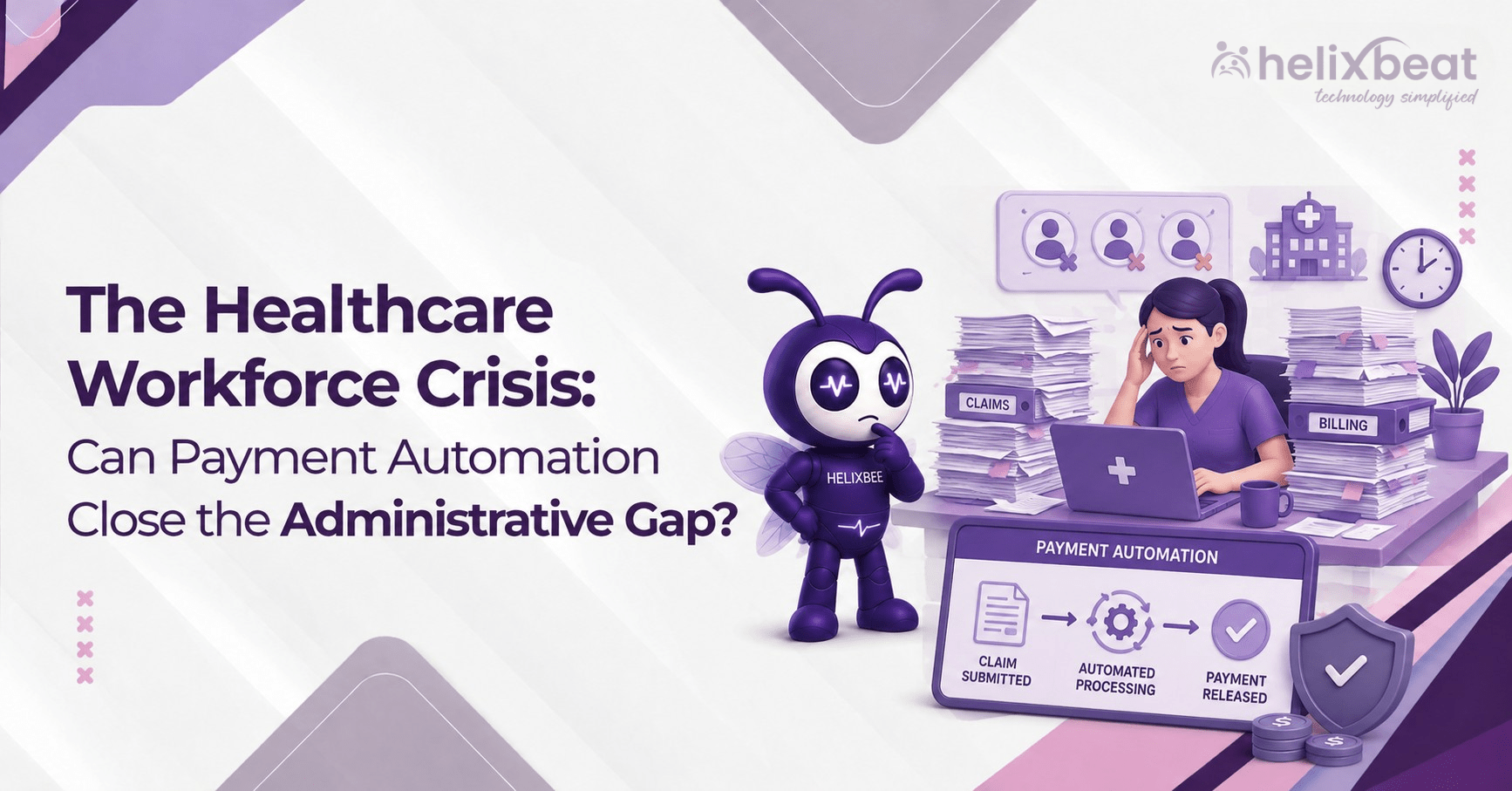
The Healthcare Workforce Crisis: Can Payment Automation Close the Administrative Gap?
The U.S. healthcare workforce crisis is usually discussed in terms of nurses, physicians, and direct care professionals. Yet it also affects the people who keep organizations financially operational: front-desk teams, patient account representatives, billing specialists, and revenue cycle leaders.
A widely cited projection estimated that the United States could face a shortage of roughly 3.2 million direct care professionals by 2026. Earlier Bureau of Labor Statistics projections also estimated about 203,200 registered nurse openings per year from 2021 to 2031—not 203,000 jobs vacant at one time. The current BLS outlook projects about 189,100 RN openings annually from 2024 to 2034.
Hiring remains essential, but healthcare organizations cannot recruit their way out of every bottleneck. They must also reduce unnecessary work. Healthcare payment automation can close part of the administrative gap by removing repetitive tasks, improving billing consistency, and preserving time for patients and complex financial issues.
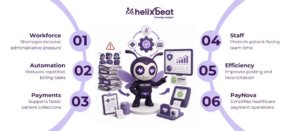
The Workforce Crisis Extends Beyond Clinical Care
When a hospital or clinic is short-staffed, the pressure spreads across the organization. Clinical teams may be asked to handle more patients, while administrative teams manage higher call volumes, billing questions, payment plans, delayed balances, refunds, and reconciliation work.
Medical practices also face rising labor and operating costs. MGMA reported that wages, benefits, staffing shortages, and related labor expenses remained major reasons practices saw higher costs in 2026.
The problem is not only too few employees. Valuable workers are occupied by tasks software can complete consistently, including sending routine billing messages, entering payment data, processing installments, matching transactions, and preparing reports.
This is where healthcare payment automation becomes a workforce strategy, not just a finance technology project.
Why Manual Payment Workflows Widen the Gap
Many healthcare organizations still use a mix of paper statements, spreadsheets, stand-alone payment terminals, phone-based collections, EHR screens, billing platforms, and bank reports. Each tool may work independently, but staff must connect the information manually.
Consider a common workflow. A patient receives care, gets a statement after insurance processing, calls the billing office, requests a payment plan, and later asks for a receipt. Staff may update several systems. One missed update can produce an incorrect reminder or outdated balance.
Small manual steps can become hundreds of staff hours across thousands of accounts while increasing duplicate entries, delayed posting, inconsistent communication, and preventable calls.
The 2024 CAQH Index identified an estimated $20 billion in potential annual savings from greater automation of administrative transactions across healthcare. Healthcare payment automation helps address this opportunity by connecting repeatable actions to defined digital workflows.
What Payment Automation Can Take Off Staff Plates
Payment technology should not replace employee judgment or empathy. It should handle predictable work so people can focus on exceptions and patient needs.
- Automated Billing Notifications
Organizations can schedule secure text or email notifications based on balance age, payment status, or an agreed payment schedule. Patients receive timely communication, while employees avoid repetitive outreach.
Automation can also prevent employees from manually reviewing every account to determine which patients need reminders. Instead, staff can concentrate on accounts that require a personalized conversation.
- Self-Service Digital Payments
A secure portal allows patients to view balances, select an available payment method, download receipts, and complete transactions without calling the billing office. This reduces phone traffic and makes payment available outside business hours.
Self-service does not mean leaving patients without assistance. It gives patients who are comfortable managing their bills digitally a convenient option while preserving staff capacity for patients who need additional guidance.
- Recurring Payments and Payment Plans
With healthcare payment automation, approved installments can run according to schedule, with receipts and status updates generated automatically. Employees can concentrate on failed payments, hardship cases, and questions that require personal support.
This is particularly valuable when organizations manage hundreds or thousands of active payment plans. Without automation, employees may spend significant time initiating payments, confirming transactions, producing receipts, and updating account records.
- Payment Posting and Reconciliation Support
Where payment tools integrate with EHR, practice management, or billing systems, transaction data can move into the appropriate financial workflow with less manual entry.
Automated matching and reporting help teams identify exceptions rather than checking every transaction individually. Staff can focus on unmatched payments, unusual adjustments, refunds, and other cases that genuinely require investigation.
- Real-Time Reporting
Dashboards can show collections, overdue balances, payment-plan performance, refunds, and payment-channel activity. This reduces spreadsheet work and helps leaders identify problems earlier.
Instead of waiting for a monthly report, managers can see where balances are accumulating, which payment options patients prefer, and which locations or departments may need operational support.
The American Hospital Association has encouraged automating low-value work, including revenue cycle activities, and highlighted technology as a response to staffing shortages.
How Healthcare Payment Automation Protects Patient-Facing Time
Administrative overload eventually affects the patient experience. When employees constantly switch between payment portals, spreadsheets, bank files, and calls, patients may wait longer for answers. They may receive late statements, unclear instructions, or reminders that do not reflect recent activity.
Healthcare payment automation makes routine communication more consistent. Patients can receive digital statements, secure links, confirmations, and reminders at the appropriate stage of the billing journey. They can use self-service options when their needs are straightforward.
This does not eliminate human support. It makes support more available. Staff can spend less time processing routine payments and more time explaining balances, resolving errors, or arranging manageable plans.
PayNova’s guide to healthcare payment processing for patient billing explains how digital billing, payment choice, and connected reporting can reduce confusion for patients and staff.
Can Payment Automation Solve the Workforce Shortage?
No single platform can solve a shortage of nurses, caregivers, physicians, or other essential professionals. Healthcare payment automation cannot add clinical capacity, improve staffing ratios by itself, or replace recruitment, training, retention, and workforce investment.
What it can do is reduce the administrative pressure surrounding care delivery.
When organizations automate reminders, self-service transactions, recurring plans, receipts, and routine reporting, fewer low-complexity tasks compete for employee attention. The result can be a smaller backlog, faster response times, fewer avoidable errors, and more resilient financial operations.
Automation can also support growth without increasing administrative headcount at the same rate. Clinics can standardize workflows as they add providers, locations, telehealth services, or payment channels.
In this sense, healthcare payment automation does not solve the workforce crisis. It helps prevent scarce workforce capacity from being consumed by work that does not require a person.
Where PayNova Fits
PayNova supports the financial side of healthcare operations by simplifying how organizations collect, manage, and understand patient payments. Rather than treating payment acceptance as an isolated transaction, it helps create a more connected billing experience.
Depending on implementation, PayNova can support:
- Digital and mobile-friendly patient payments
- Multiple payment methods
- Automated reminders and digital receipts
- Recurring payments
- Flexible payment plans
- Telehealth and remote payments
- Financial dashboards and collection visibility
- Secure payment handling
- Integration with existing healthcare workflows
These capabilities are designed to reduce repetitive financial work while giving patients clearer and more convenient ways to manage their balances.
With healthcare payment automation, these capabilities can reduce repetitive work across front-desk, billing, and finance teams. PayNova’s role is not to replace an entire revenue cycle department. It is to give that department better tools for routine payment operations.
PayNova’s article on reducing administrative burden with automated payment solutions offers additional guidance on simplifying billing and collection work while maintaining a patient-friendly process.
A Practical Implementation Approach
Automation works best when organizations begin with a clearly defined operational problem. Buying technology without redesigning the workflow can simply move inefficiency from one screen to another.
Identify Repetitive Payment Tasks
Measure how much staff time is spent sending reminders, taking payments by phone, posting transactions, managing plans, producing receipts, and preparing reports.
Organizations should initially focus on high-volume tasks governed by predictable rules. These workflows generally provide clearer automation opportunities than complex accounts requiring individual judgment.
Map the Patient Payment Journey
Review what happens before, during, and after care. Identify where patients become confused, employees re-enter information, communication breaks down, and payment delays occur.
Mapping the full journey prevents organizations from automating one isolated step while leaving the surrounding workflow disconnected.
Establish Measurable Goals
A healthcare payment automation initiative should be tied to clear outcomes, such as:
- Fewer billing-related phone calls
- Faster payment posting
- Reduced manual follow-up
- Higher digital payment adoption
- Shorter patient payment cycles
- Lower reconciliation time
- Fewer preventable posting errors
Clear goals help leaders determine whether the technology is reducing work or merely changing how that work is performed.
Protect Exceptions
Organizations must protect exceptions. Financial hardship, disputes, complex coverage issues, and sensitive circumstances require human review. Automation should route these cases to trained employees.
The purpose is not to remove people from the payment experience. It is to reserve their attention for situations where empathy, negotiation, investigation, or judgment adds value.
Train Employees
Staff need to understand what the system handles, what remains their responsibility, how to interpret dashboards, and when to intervene.
Employees should also understand how automation benefits their daily work. Adoption is more successful when workers see the technology as a tool that removes repetitive tasks rather than a threat to their roles.
What Healthcare Leaders Should Measure
To determine whether healthcare payment automation is closing the administrative gap, organizations should track workforce and financial indicators together.
Useful measures include manual-posting hours, billing-call volume, response time, digital-payment adoption, automatic transaction matching, failed plan transactions, collection time, errors, and employee satisfaction.
Leaders should also evaluate whether staff are spending more time on activities that require human expertise. These may include financial counseling, dispute resolution, complex account review, patient education, and workflow improvement.
Financial improvement matters, but workforce impact should also be visible. A system that collects faster while creating more exceptions has not solved the underlying problem. The goal is a process that is easier for patients, employees, and leaders.
The Administrative Gap Is a Strategic Risk
Workforce shortages and financial pressure reinforce each other. Inefficient payment operations can slow cash flow and increase administrative costs, making it harder to invest in recruitment, employee development, technology, and patient services.
Better payment operations can improve visibility and reduce routine workload. Healthcare payment automation gives organizations a practical way to strengthen this part of the system without expecting already-stretched employees to work faster indefinitely.
The workforce crisis requires broad action across education, recruitment, retention, compensation, care models, and public policy. Payment technology addresses only one piece of the challenge—but it is a piece providers can act on now.
Conclusion
The United States needs more healthcare professionals, but it must also use the time of its existing workforce more wisely. Manual billing, repetitive reminders, payment-plan administration, reconciliation, and reporting consume capacity that could support patients and higher-value financial work.
Healthcare payment automation can close part of the administrative gap by standardizing routine tasks, reducing rework, expanding self-service, and improving financial visibility. It will not replace the people healthcare needs. Used responsibly, it can help those people spend less time managing payment friction and more time supporting care.
Frequently Asked Questions
- What is healthcare payment automation?
Healthcare payment automation uses digital tools to manage routine tasks such as billing reminders, online payments, recurring payments, receipts, and transaction reporting.
- Can payment automation solve the healthcare workforce shortage?
It cannot replace nurses or other healthcare professionals, but it can reduce repetitive administrative work and help existing staff use their time more effectively.
- How does payment automation reduce administrative workload?
It automates payment reminders, self-service transactions, payment plans, reconciliation, and reporting, reducing manual data entry and follow-up work.
- How can PayNova support short-staffed healthcare teams?
PayNova can simplify patient payments, automate recurring billing tasks, improve financial visibility, and allow staff to focus on complex accounts and patient support