

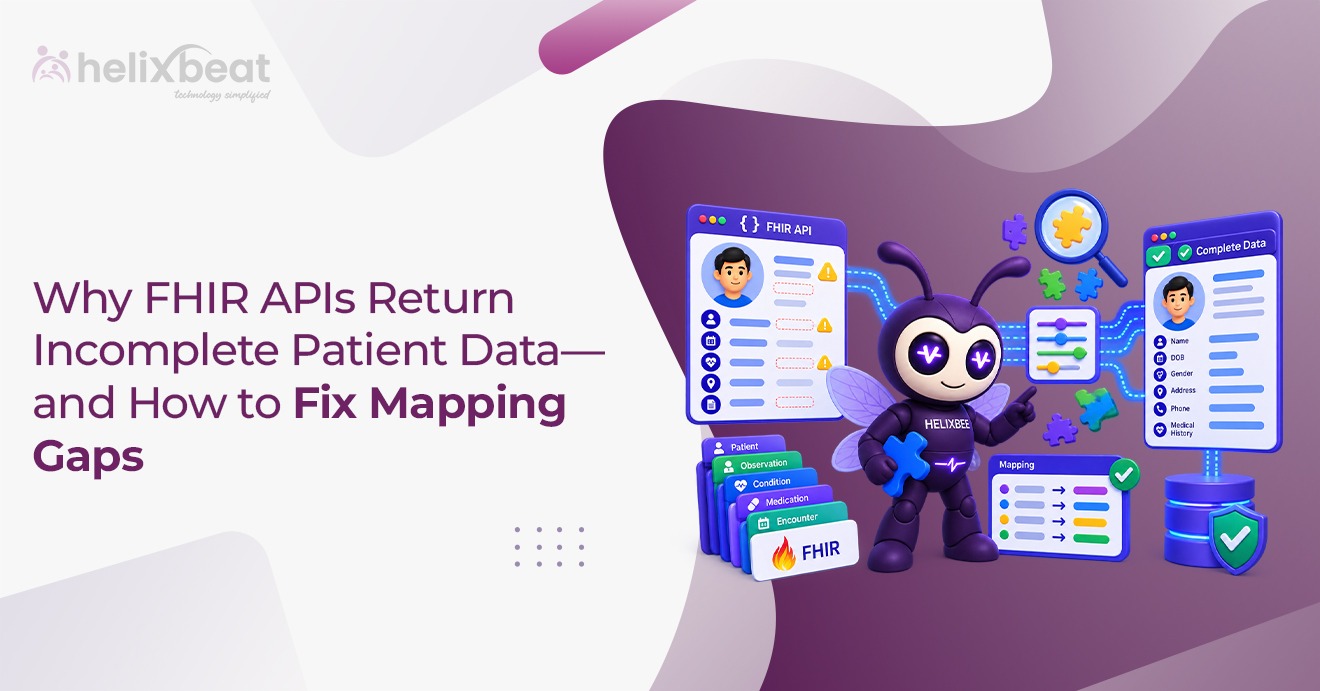
A provider pulls up a patient record through a FHIR API. The allergies are there. The medications look current. But the last three lab results are missing, and nobody notices until a clinician makes a decision without them.
The real issue is in the FHIR data mapping. It decides which source fields make it into the resource and which ones get silently dropped.
Table of Contents
The API Isn’t the Problem. The Mapping Layer Is.
FHIR defines a structure. It does not specify how your EHRs align with that structure. That translation work is FHIR data mapping — matching a legacy field to the right FHIR resource, element, and terminology code. It’s where most FHIR mapping errors start.
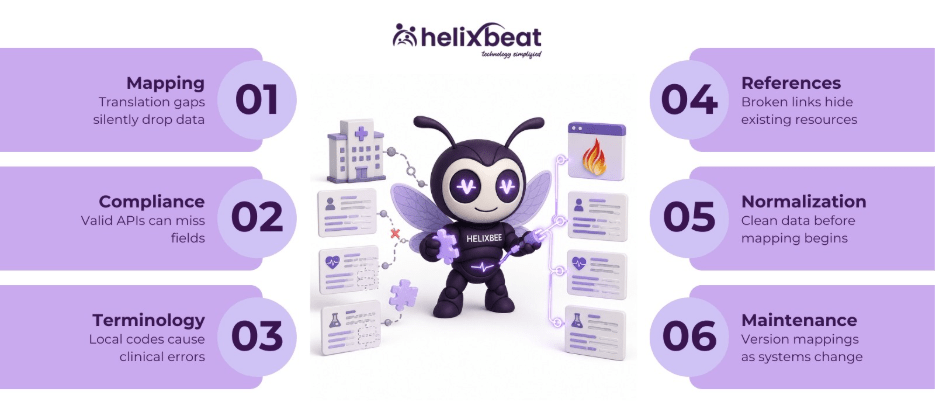
A FHIR API can be technically compliant and still return an incomplete picture. That’s because compliance only checks whether the response follows the FHIR schema. However, it does not check if every clinically relevant field from the source system was mapped. For example, a field can be left out of the mapping specification, and the API will never know it’s missing.
Where Missing Clinical Data Actually Comes From
A few patterns show up frequently in mapping reviews.
Unmapped custom fields. Most EHRs carry locally built fields that have no obvious home in a standard FHIR resource. As a result, teams under deadline pressure often skip these rather than model them properly. That’s how missing clinical data ends up inside a “compliant” API response.
Terminology mismatches. FHIR resources expect LOINC for labs, SNOMED CT for conditions, and RxNorm for medications. However, if a source system stores a local code instead of a standard one, and no crosswalk exists, the value either gets dropped or mapped to the wrong concept entirely. This is a leading cause of FHIR mapping errors that pass basic validation but fail clinical review.
Broken or missing references. FHIR resources link to each other. An Observation should reference the correct Patient and Encounter. If that reference logic wasn’t built correctly, the resource exists in the system but never surfaces in the query meant to retrieve it. Structurally, nothing looks wrong. Functionally, the data is invisible.
Cardinality assumptions. Source systems sometimes store one value where FHIR expects an array, or the reverse. A mapping built for the common case silently drops the second or third instance when a patient has more than one.
Getting FHIR Resource Mapping Right, Not Just Fast
Solid FHIR resource mapping starts before a single line of transformation logic gets written. It starts with a field-by-field inventory: every source field carrying clinical meaning, matched to a target FHIR element, with an explicit note on where terminology translation is needed.
Skipping that inventory is how organizations end up building against implementation guides.
Healthcare Data Normalization Comes Before Mapping, Not After
A mapping specification can only be as clean as the data feeding it. Therefore, healthcare data normalization — resolving unit mismatches, standardizing date formats, deduplicating patient identifiers — needs to happen before the mapping layer. Building normalization rules into the pipeline itself, rather than the API layer, tends to catch far more of these issues before they reach a clinician’s screen. AERIS handles this normalization step in real time, so the FHIR layer receives clean, consistent input rather than raw legacy data with its inconsistencies intact.
A Practical Checklist Before You Trust the Output
Before treating a FHIR API as production-ready, run these checks against your FHIR data mapping:
- Compare every US Core-required element against your actual mapping spec, not just the resources you chose to build first.
- Test with real patient records that carry multiple diagnoses, multiple medications, and repeat lab orders.
- Validate terminology bindings against the code systems your implementation guide actually requires.
- Confirm every Observation, Condition, and MedicationRequest carries a working reference back to the correct Patient and Encounter.
- Run the output through a FHIR validator, then have a clinical informaticist review a sample manually. Validators catch structural errors. They don’t catch a field that was simply never mapped.
This kind of review matters more now that CMS-driven interoperability rules are pushing more payers and providers toward FHIR-based exchange on a fixed timeline. Our breakdown of the FHIR API requirements taking effect in 2027 covers what that build-out actually demands, and mapping accuracy sits at the center of it.
Get the Mapping Right Once
FHIR data mapping isn’t a one-time task. Source systems change, new fields get added, and terminology sets get updated. That’s how a mapping specification that isn’t revisited will drift out of sync with the systems it was built against.
The organizations that avoid repeat incidents treat mapping as a maintained asset: documented, versioned, and reviewed whenever a source system changes. That habit is what keeps a FHIR API returning a complete patient record instead of a technically correct but clinically thin one.
Ready to treat your FHIR mappings as a living asset? Get in touch with us!
FAQs
- What is FHIR data mapping?
It’s the process of matching fields from a source system, like an EHR or claims database, to the correct FHIR resources, elements, and terminology codes. It happens before data ever reaches the FHIR API layer.
- Why does a FHIR-compliant API still return incomplete data?
Compliance testing checks structure, not completeness. A field can be missing from the mapping specification entirely, and the resulting FHIR resource will still pass validation because there’s nothing malformed for the validator to flag.
- What causes most FHIR mapping errors?
Unmapped custom fields, terminology mismatches between local codes and standards like LOINC or SNOMED CT, broken resource references, and incorrect assumptions about cardinality are the most common causes.
- How do terminology mismatches cause missing clinical data?
When a source system stores a local or proprietary code with no crosswalk to a standard code system, the mapping logic often drops the value or maps it to the wrong clinical concept.
- What’s the difference between FHIR validation and mapping accuracy?
Validation confirms a resource follows the FHIR schema correctly. Mapping accuracy confirms that all the clinically relevant source data was actually included in that resource in the first place. A resource can pass one and fail the other.