

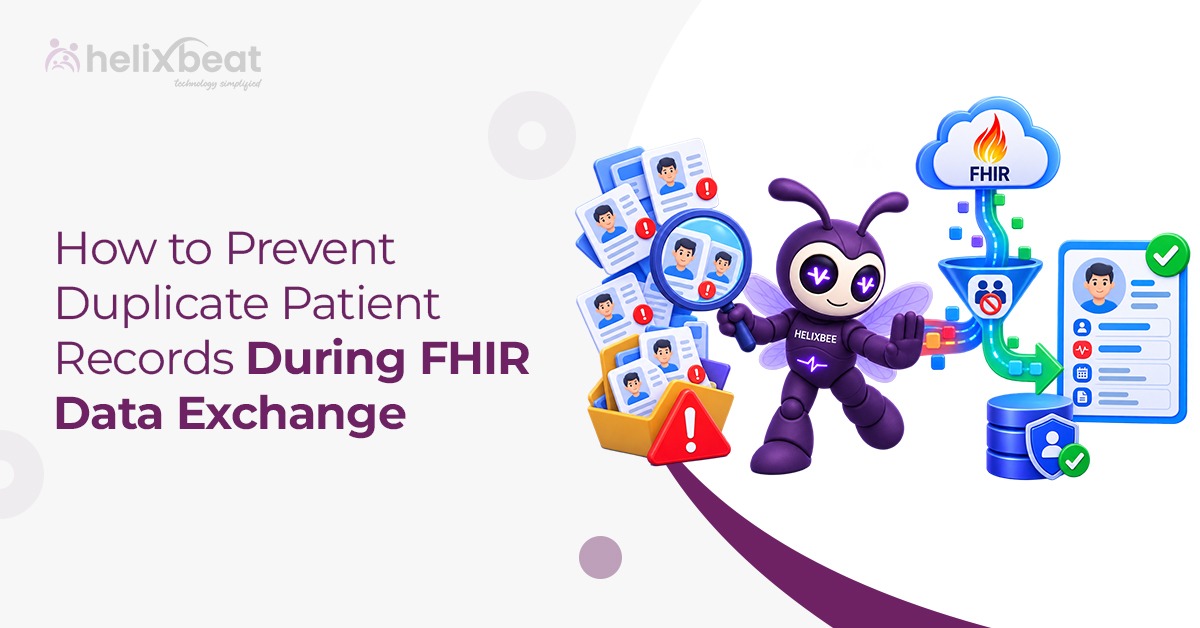
Imagine a hospital queries the regional exchange, gets back a rich FHIR bundle, and tries to link it to an existing profile. But without an absolute match in its database, the system takes the cautious route and simply generates a new chart from scratch.
That is how most duplicates sneak in these days. They do not start at the front desk anymore; they happen right in the middle of a live FHIR data exchange. That is where FHIR patient matching comes in. It is the gatekeeper deciding whether you get a single, clear patient story, or just another broken fragment floating around the network.
Table of Contents
Why FHIR data exchange multiplies duplicate risk?
FHIR patient matching does its work between two independent systems.
Every platform plugged into a FHIR network operates in its own little world. Every platform plugged into a FHIR network operates in its own little world. One hospital tracks patients with an MRN tied to their specific system URI, while an outpatient clinic down the street uses a completely different identifier and namespace. In isolation, both are totally valid.
The mess starts when the receiving system realizes there’s no universal ID to anchor the incoming record. Suddenly, it has to rely on demographic guesswork. If there’s a typo, an outdated street name, or a missing middle initial, the system gets nervous, plays it safe, and spins up a brand-new duplicate chart.
Bulk FHIR data exchange makes this worse, not better. A single $export job can pull thousands of Patient resources from a partner system in one pass. If FHIR patient matching behind that pipeline isn’t tuned carefully, it can seed hundreds of them into a production database overnight, long before anyone reviews a single record by hand.
What FHIR Patient Matching Actually Involves?
FHIR manages patient identity through two distinct fields, and mixing them up trips people up all the time. First, you have the resource’s id. This is just an internal key generated by the server hosting the record, and it means nothing once you step outside that specific environment. Then there is the identifier. This is the business ID, like a Medical Record Number (MRN) or a national health identifier, specifically built to carry meaning across different platforms.
Patient data matching compares these real-world identifiers alongside demographic details to determine whether two records belong to the same human being.
To tackle this, the standard gives us the $match operation. You hand the server a partial Patient resource with whatever details you have, and it hands back a bundle of potential candidates. Each result gets tagged with a match grade like certain, probable, or possible, while clear mismatches receive a certainly-not tag and fall off the list. The standard stops short of setting rigid mathematical scoring rules, leaving the exact confidence thresholds up to your own system to define.
How FHIR duplicate patient records actually form?
Take a close look at high duplicate rates, and you’ll notice familiar patterns every single time. They’re symptoms of underlying gaps in FHIR patient matching.
Zero shared identifiers. When two systems don’t agree on a common namespace from day one, you’re forced to rely entirely on demographic matching. You’d be surprised how often people share the exact same name and birthday. When that happens, the system misses the connection, generating false negatives and fragmenting records that should have stayed whole.
Overly strict match thresholds. Teams often set their matching engines to play it super safe. The problem? Every “probable” or “possible” hit gets spun off into a brand-new chart instead of landing in a review queue. Before long, duplicate records are piling up completely unnoticed.
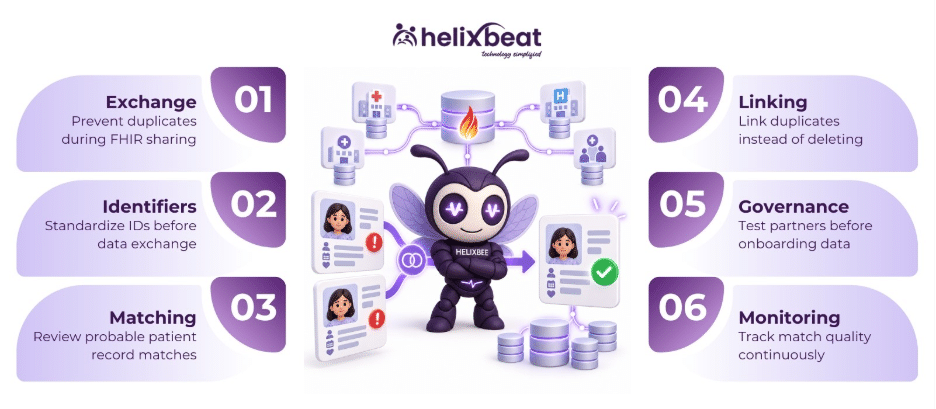
Hit “delete” instead of linking. When a duplicate finally gets caught, the knee-jerk reaction is often to just wipe one of the records out. But FHIR solves this with the Patient.link element (using types like replaces, replaced-by, and seealso). Linking keeps your audit trail intact and lets downstream tools trace the full clinical history straight to the active record.
Skipping onboarding governance. A new trading partner plugs into your FHIR endpoint, and data starts moving immediately. The catch? Nobody paused to test the matching rules against how that partner actually formats identifiers or handles messy demographic quirks.
Where a healthcare master patient index fits in?
FHIR patient matching rarely lives entirely inside the FHIR server itself. A healthcare master patient index (MPI) usually sits behind the FHIR interface as the actual decision engine. The FHIR endpoint accepts and exposes resources. The MPI compares incoming demographics and identifiers against everything already on file. It then decides whether a resource represents an existing patient, a probable match needing review, or a genuinely new one.
This isn’t a new idea invented for FHIR. IHE’s Patient Identifier Cross-Referencing (PIX) and Patient Demographics Query (PDQ) profiles have handled this role in HL7 v2 environments for years. Their FHIR-based successors, PIXm and PDQm, bring that same cross-referencing logic into FHIR patient matching. Both use the $match operation.
Fixing patient identity matching: what actually works
Strong FHIR patient matching starts before go-live. Therefore, standardize identifiers before exchange goes live. Every trading partner’s identifier system should be registered and documented, ideally as a formal NamingSystem, so receiving systems know exactly which namespace a given MRN belongs to. FHIR patient matching applies this same discipline to unify and govern identifiers before they cause downstream conflicts.
Route “possible” and “probable” matches to a human, not to auto-create. This single change closes more patient identity matching gaps than most algorithm upgrades ever do. A short review queue for ambiguous matches costs far less than duplicated records.
Use Patient.link for every merge. Never silently delete a record that might still be referenced elsewhere in the system. A FHIR server built around identity resolution can enforce this kind of linking automatically.
Test matching rules against real demographic edge cases before onboarding a new partner. Twins with identical demographics, patients who share a household, and recently married patients who use two names all expose weak matching logic fast.
Monitor match rates continuously, the same way an interoperability platform tracks data quality across every connected source. Treat FHIR patient matching as something to watch over time, not something to configure once and forget.
The real takeaway
FHIR patient matching rarely fails because the underlying standard is incomplete. It fails when organizations treat the $match operation, identifier governance, and MPI logic as separate afterthoughts. At the end of the day, success isn’t about hunting down a smarter algorithm. It really comes down to bridging the gap between what FHIR can do on paper and what your team actually sets up. Every time you bring on a new trading partner, you get a choice: you either dial in your pipeline, or you quietly let the cracks get wider.
FAQs
- What is FHIR patient matching?
It’s the process FHIR-connected systems use to decide whether a Patient resource received from one system represents the same person as a record already on file elsewhere. It relies on comparing identifiers and demographic fields, often through the FHIR $match operation.
- What’s the difference between a FHIR resource id and a patient identifier?
The id is assigned by whichever server stores the resource and only has meaning on that server. The identifier is a business identifier, like a Medical Record Number, made up of a system and a value. It’s designed to carry meaning across systems, which makes it central to patient data matching.
- Why do FHIR duplicate patient records happen even with good data exchange standards in place?
FHIR standardizes the format of the data, not the matching decision itself. Two connected systems can exchange perfectly valid FHIR resources and still create duplicates. This happens when they lack a shared identifier, or when their matching thresholds default to “create new” too easily.
- What does the FHIR $match operation actually return?
It returns a bundle of candidate Patient resources, ranked from most to least likely to match, each carrying a match-grade extension such as certain, probable, possible, or certainly-not. The exact scoring logic behind those grades depends on the implementing system.
- What should happen before onboarding a new FHIR trading partner?
Their identifier systems should be documented and registered, and their typical demographic data should be tested against the existing matching logic. Skipping this step is one of the most common reasons new duplicate records appear right after a new connection goes live.